
Basement Finish – Philadelphia, PA
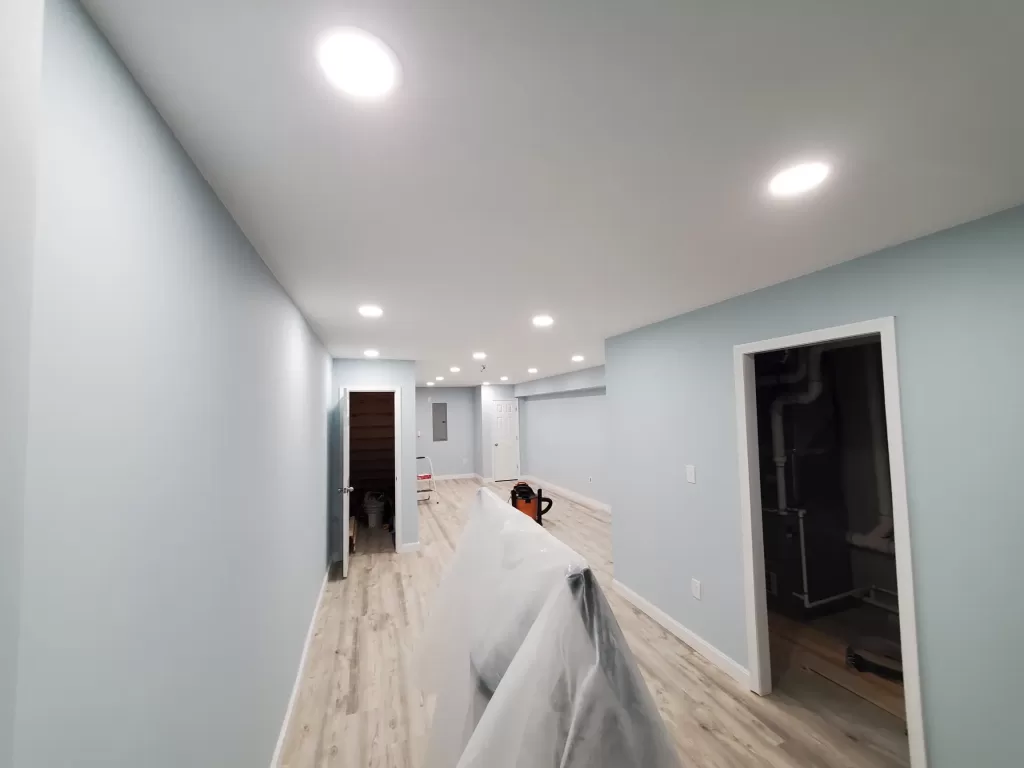
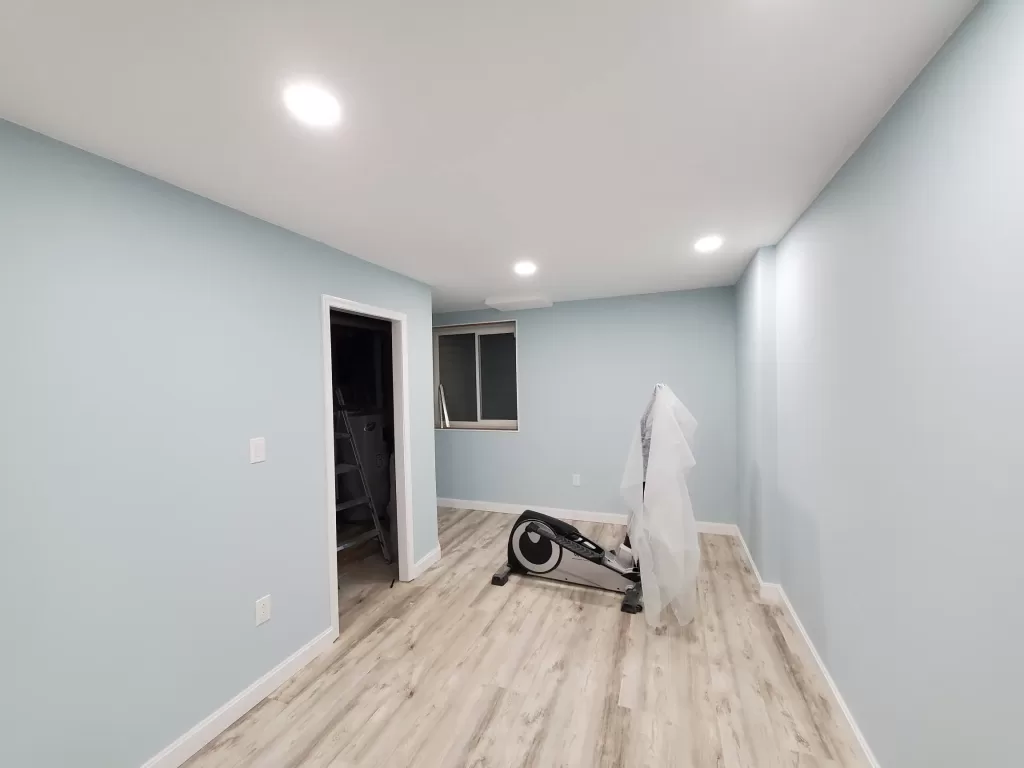
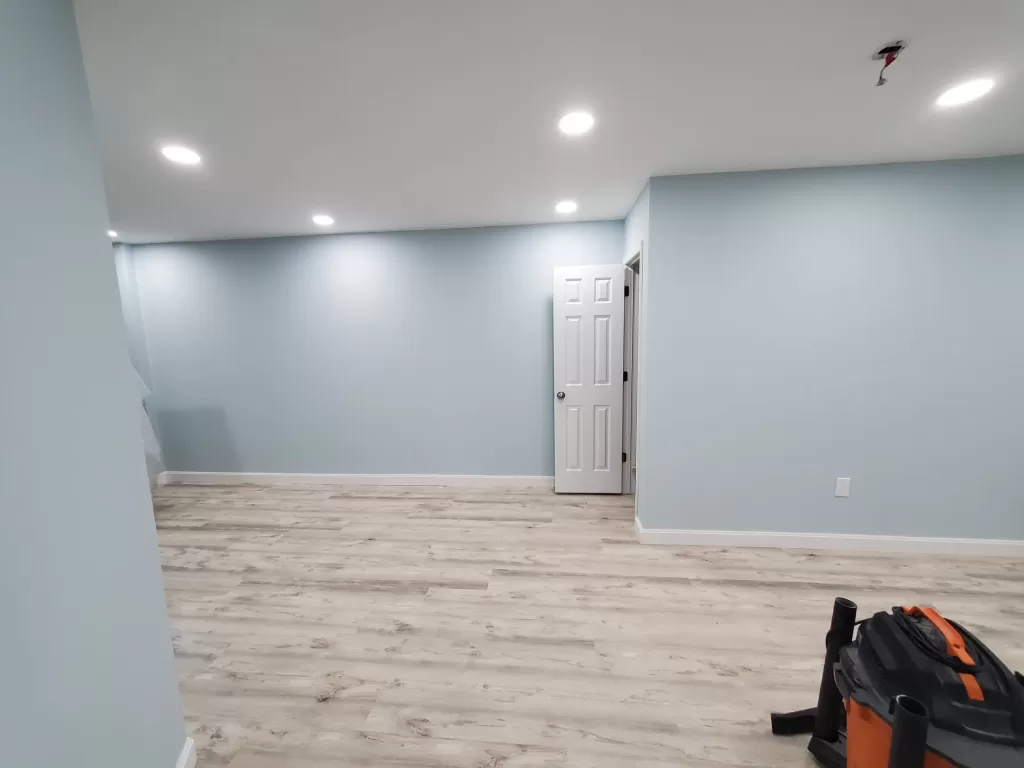
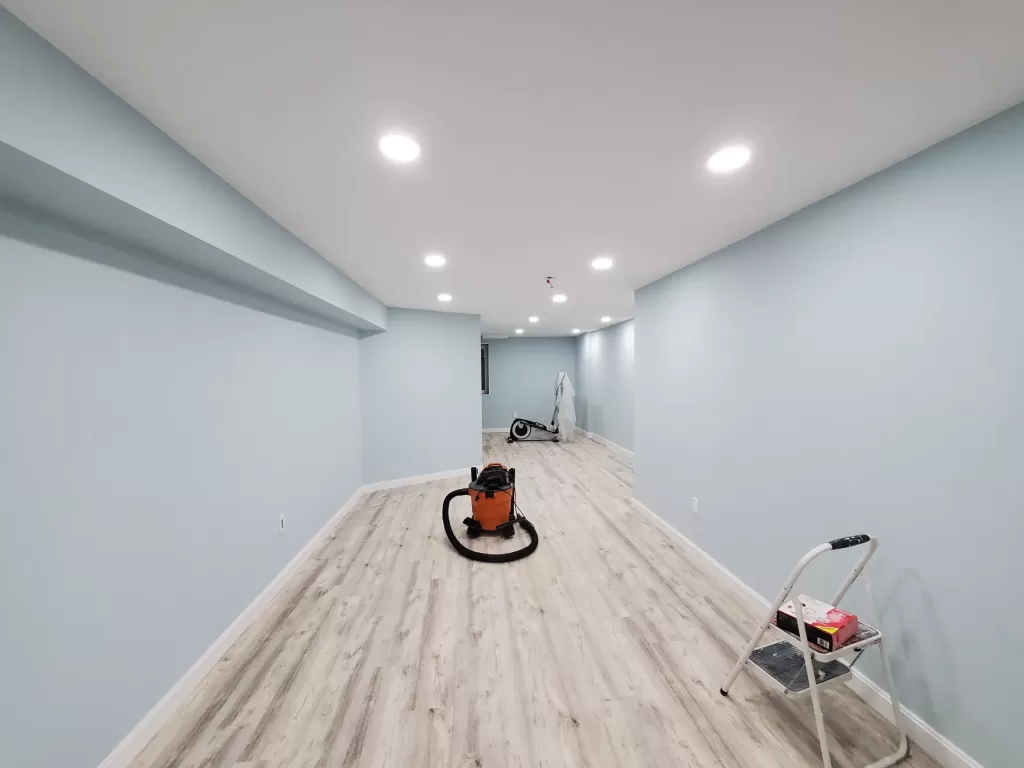
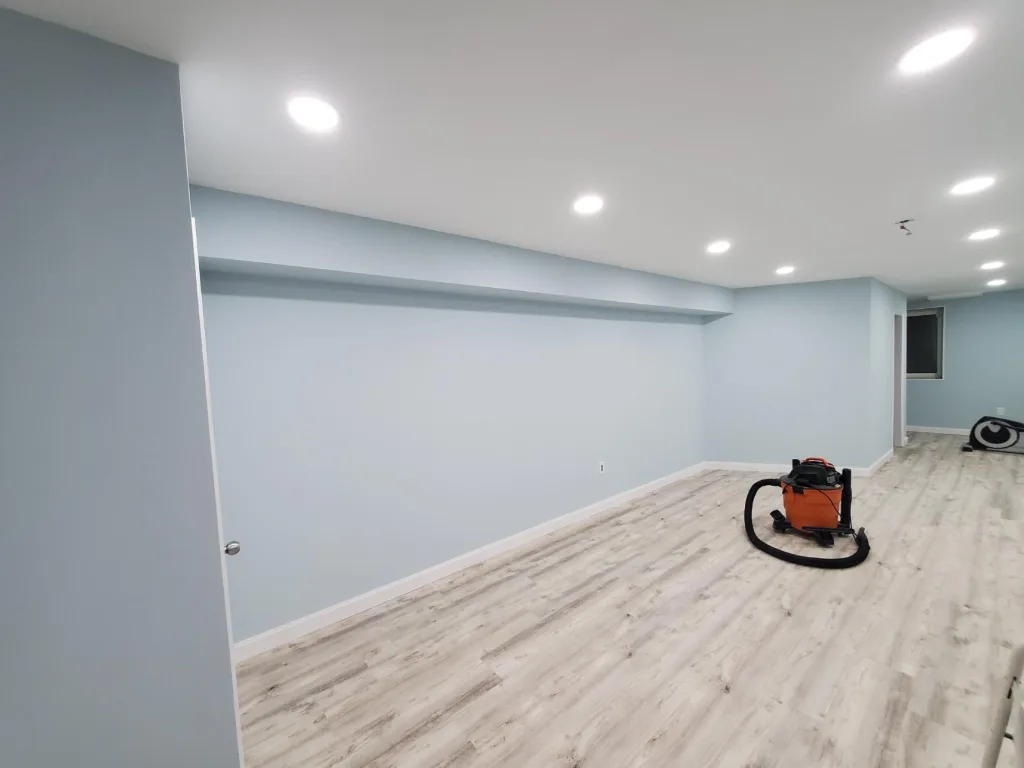
This 600-square-foot basement finish in Philadelphia converted an unfinished basement into a defined, livable lower level. The scope covered the elements that turn raw basement space into a room: new partition walls to divide the footprint into distinct areas, new doors, recessed lighting throughout the ceiling, LVP flooring across the full 600 square feet, and paint. At $11,600 for 600 square feet, this project reflects what a focused basement finish costs when the work is executed correctly without structural changes or plumbing additions.
Scope of Work
- New partition walls framed and drywalled to divide basement into rooms
- New doors installed at room openings
- Recessed lighting installed throughout ceiling
- LVP flooring installed across full 600 sq ft
- Paint throughout
What a Basement Finish Actually Involves
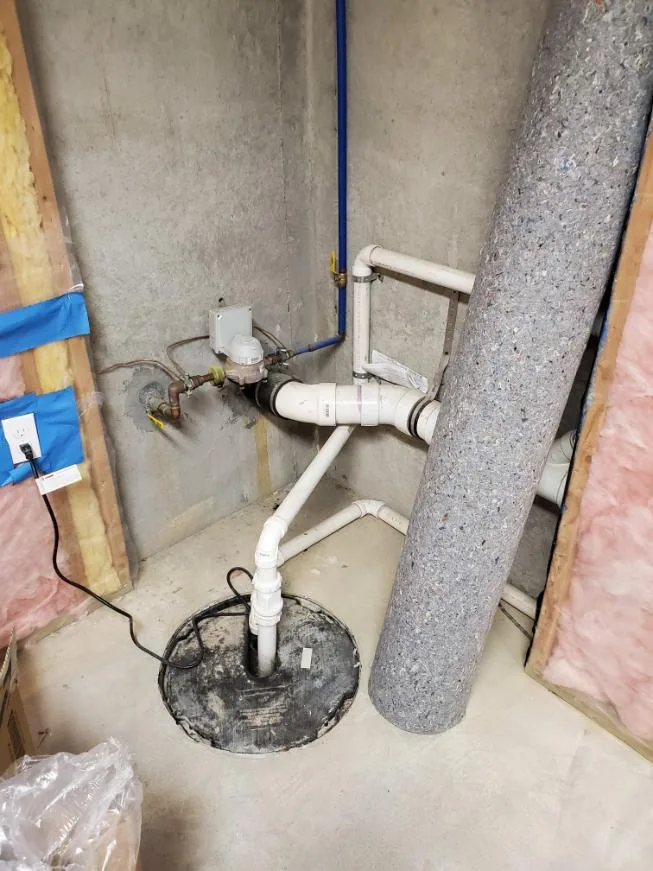
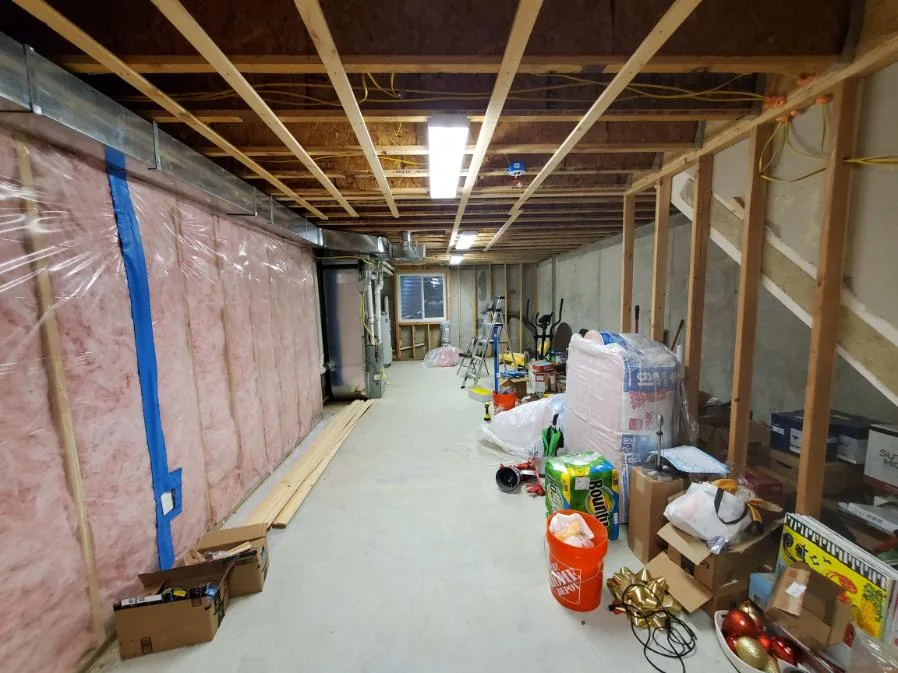
A basement finish — converting an unfinished basement into usable living space — starts with a space that has a concrete floor, exposed or drywalled foundation walls, and typically some mechanical equipment (water heater, HVAC, electrical panel) that has to remain accessible. The finish scope converts that raw condition into rooms that look and function like the rest of the house.
The work follows a fixed sequence. Framing comes first: partition walls are built to define the layout and create distinct rooms. Rough electrical is next: circuits are run for the new lighting and outlets, and the panel is updated if new circuits require it. Mechanical rough-in follows if the project includes HVAC extension or plumbing. Then insulation, drywall, flooring, doors, and paint. Each phase has to close before the next opens — you cannot set flooring before drywall, and you cannot paint before flooring is protected or complete. In this Philadelphia project, the scope covered framing, electrical (recessed lighting), doors, LVP, and paint.
Partition Walls: Defining the Layout
New partition walls were framed and drywalled to divide the 600-square-foot basement into distinct areas. Partition walls in a basement finish are typically non-load-bearing — they define rooms without carrying structural load from the floor above, which is supported by the foundation walls and any existing columns or beams. The wall layout determines how the basement functions: whether it is one open space or a series of defined rooms, where the doors land, and how light and air move through the level.
In a basement, partition walls also have to account for the mechanical equipment that occupies part of the space. The water heater, HVAC unit, and electrical panel need to remain accessible — typically in a utility room that is framed off from the finished areas. The wall layout has to incorporate that utility zone without making the accessible areas feel residual or awkwardly shaped.
Recessed Lighting
Recessed lights were installed throughout the basement ceiling. Basement ceilings in Philadelphia rowhouses and single-family homes typically run 7 to 8 feet — lower than above-grade rooms. At that height, surface-mounted fixtures hang close enough to feel imposing and can create headroom concerns in rooms with lower clearance points. Recessed cans sit flush with the ceiling plane, direct light downward without occupying vertical space, and give the basement a finished ceiling appearance consistent with the rest of the house.
The electrical rough-in for recessed lighting is done before drywall is installed on the ceiling — the wiring runs between the joists and the fixture housings are set in the framing bays before the ceiling closes. In a basement finish where the ceiling joists are typically exposed or covered by the existing floor structure above, this rough-in phase is straightforward: the electrician has full access to the ceiling framing before any finish materials go up.
LVP Flooring Over a Concrete Slab
Luxury Vinyl Plank flooring was installed across the full 600-square-foot basement floor. Concrete slabs in below-grade basements present a specific challenge for flooring: the slab can be cold, slightly uneven, and subject to moisture migration from the ground below. LVP is one of the most appropriate finish flooring choices for a basement slab for several reasons.
First, LVP is water-resistant — it will not swell, buckle, or delaminate from minor moisture exposure the way hardwood or laminate would. Second, it installs as a floating floor over the slab rather than requiring adhesive or fasteners into the concrete, which simplifies installation and allows the floor to expand and contract with temperature changes without cracking. Third, it is available in formats that closely replicate the appearance of hardwood, so the finished floor reads as a proper room floor rather than a basement floor.
Before LVP is installed, the slab has to be checked for levelness — significant humps or depressions have to be addressed with self-leveling compound or grinding before the flooring goes down. LVP has some tolerance for minor variation, but at 600 square feet, any visible dip or ridge across the floor reads immediately.
Doors
New doors were installed at the room openings created by the partition walls. In a basement finish, door selection and installation at partition wall openings is one of the finishing details that determines whether the space reads as a properly finished room or as a basement with walls. A door that fits correctly in its frame, swings and latches cleanly, and is trimmed with consistent casing on both sides is the detail that completes each room opening and makes the space feel finished rather than constructed.
Paint
The basement was painted throughout after the drywall, flooring, and doors were in place. Paint in a basement finish has a specific consideration that above-grade rooms do not: moisture. If the foundation walls have any history of seepage or condensation, the paint selection and application sequence matters. Moisture-resistant primer on the foundation walls before finish paint prevents the moisture from lifting the paint film over time. In a space where the slab and walls are at or below grade, this is a practical application decision rather than a preference.
Paint color selection in a basement also affects how the space reads in the absence of natural light. Lighter tones reflect the recessed lighting back into the room and make the space feel more open; darker tones absorb light and can make a basement feel smaller than its 600-square-foot footprint. The goal in this Philadelphia project was a fresh, current color that worked with the recessed lighting and LVP flooring.
What $11,600 Buys in a 600-Square-Foot Basement Finish
At $11,600 for 600 square feet, this project reflects a focused scope: walls, electrical, doors, flooring, and paint — the core elements of a basement finish without plumbing additions, bathroom rough-in, egress window work, or specialty finishes. The cost-per-square-foot is in the lower range for a finished basement because the scope was disciplined and the project did not include the higher-cost items that expand a basement finish budget significantly.
For comparison: adding a bathroom to a basement finish adds $12,000–$22,000 to the scope depending on whether gravity drainage works or an ejector pump is required. Adding a wet bar adds plumbing rough-in. Egress window installation for a bedroom adds excavation and window well work. This Philadelphia project stayed within the finish scope and came in at a price point that reflects that focus.
Basement Finishing in Philadelphia
Philadelphia’s rowhouses, twins, and detached single-family homes contain basements of varying size and condition — some fully unfinished, some partially finished, many somewhere in between. A focused basement finish that adds livable square footage to the lower level is one of the most efficient ways to expand usable space in a Philadelphia home without altering the exterior footprint. Belmax Remodeling works throughout Philadelphia on basement finishing and remodeling projects at varying scopes. For more on our basement work, see our basement remodeling service page. Homeowners in Philadelphia can also visit our Philadelphia service area page for more on what we do in the area.
Considering a Similar Project?
Basement finishes in the 600-square-foot range with partition walls, recessed lighting, LVP flooring, doors, and paint — without plumbing or bathroom additions — typically fall in the $10,000–$15,000 range in Philadelphia. This project came in at $11,600, completed July 2019. To discuss what your basement would involve, request a free estimate.