


Three-Level Deck Renovation – Princeton, NJ
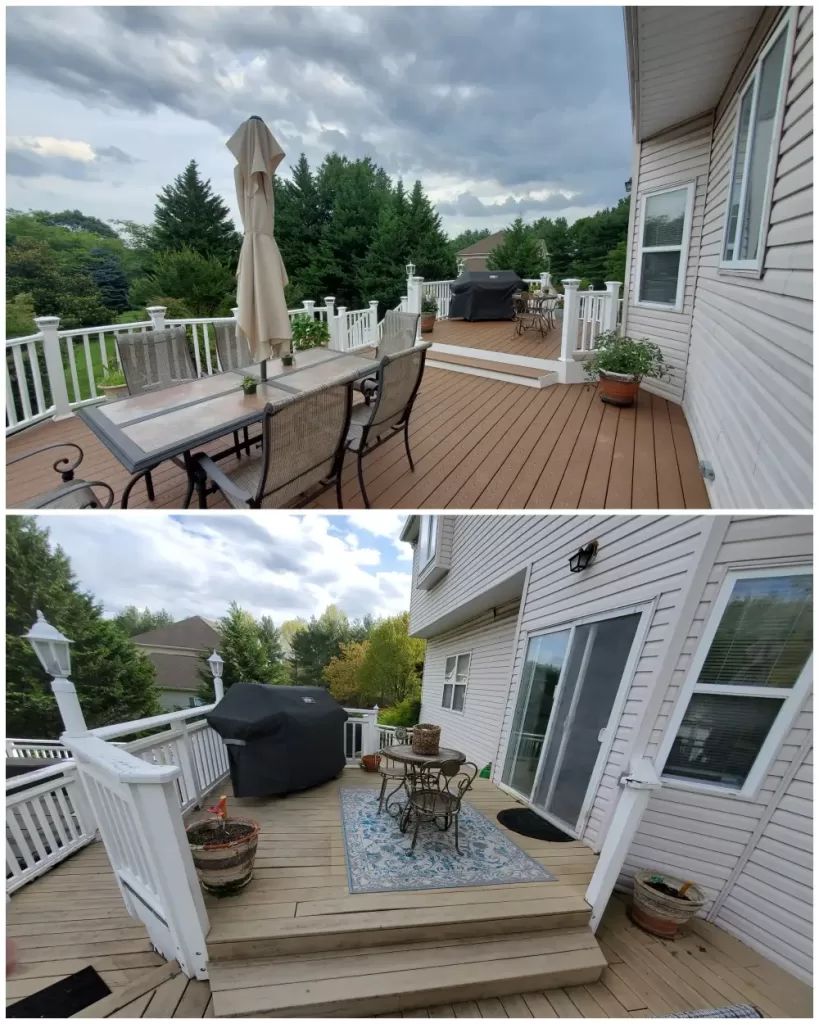
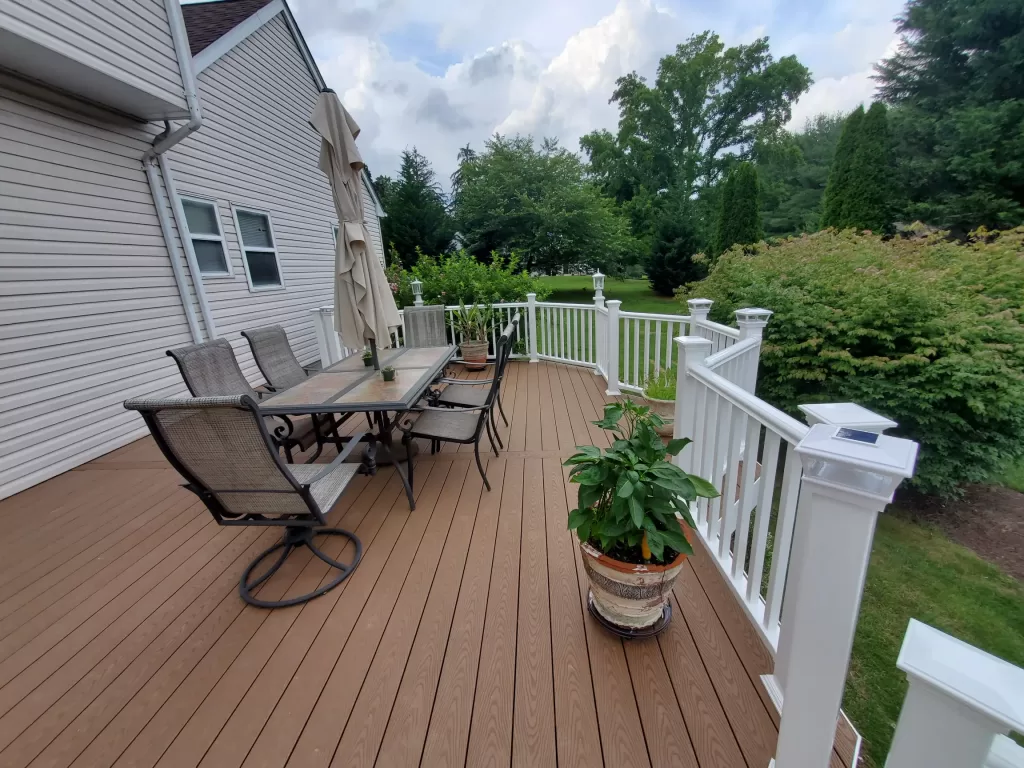
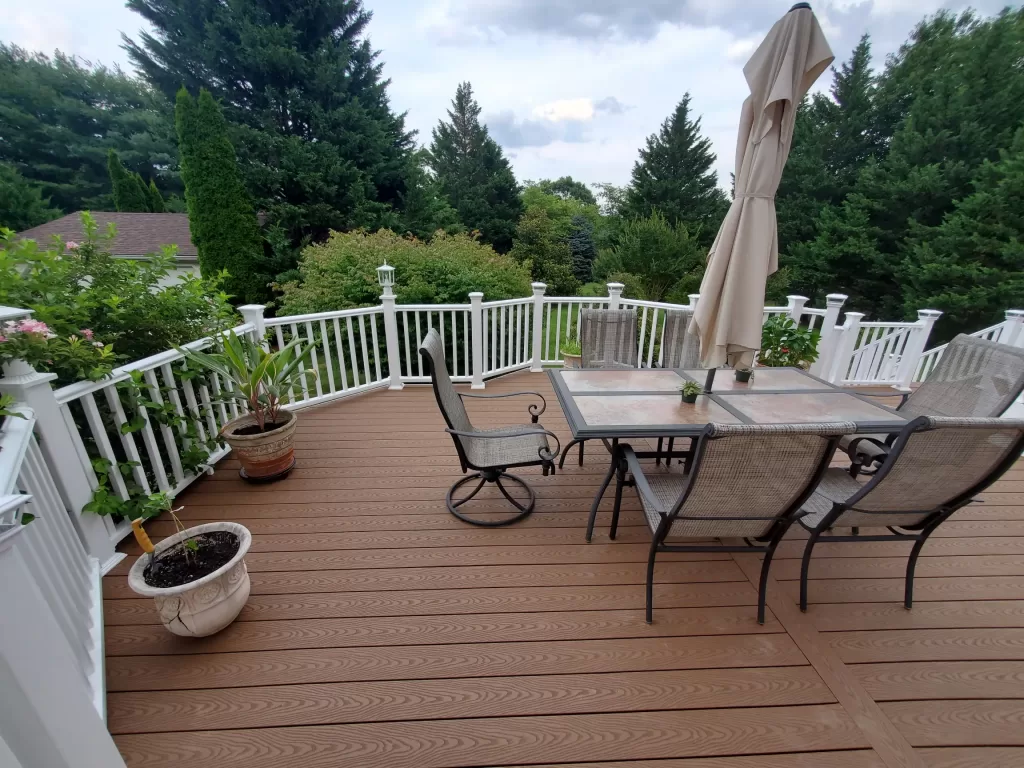
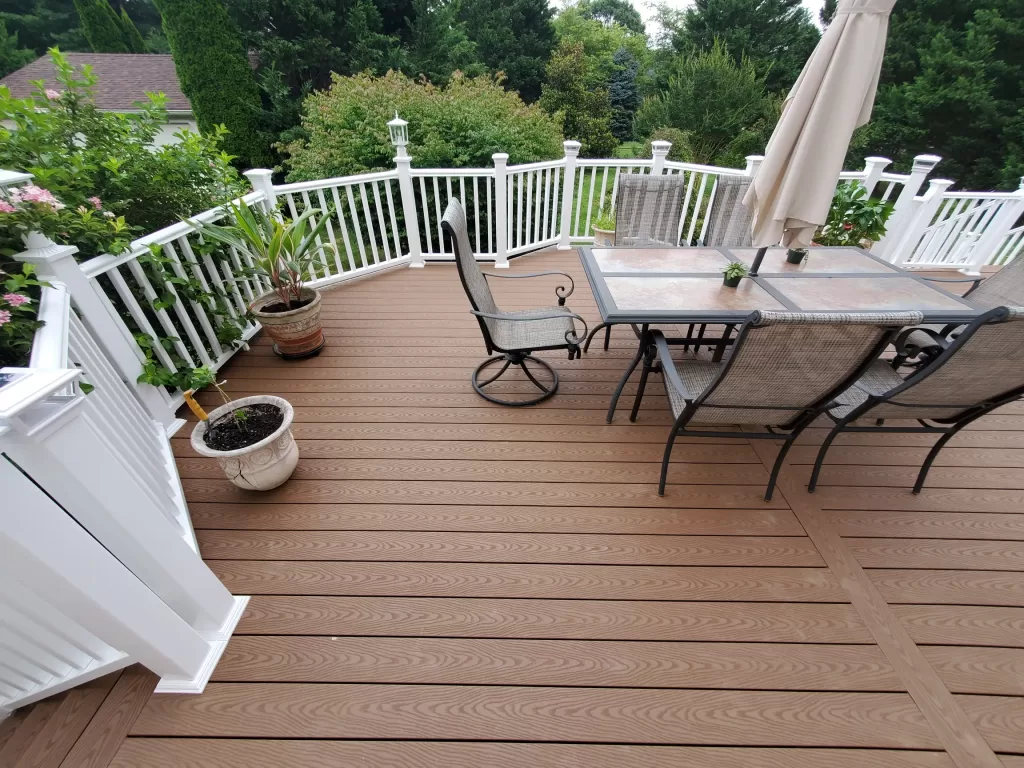
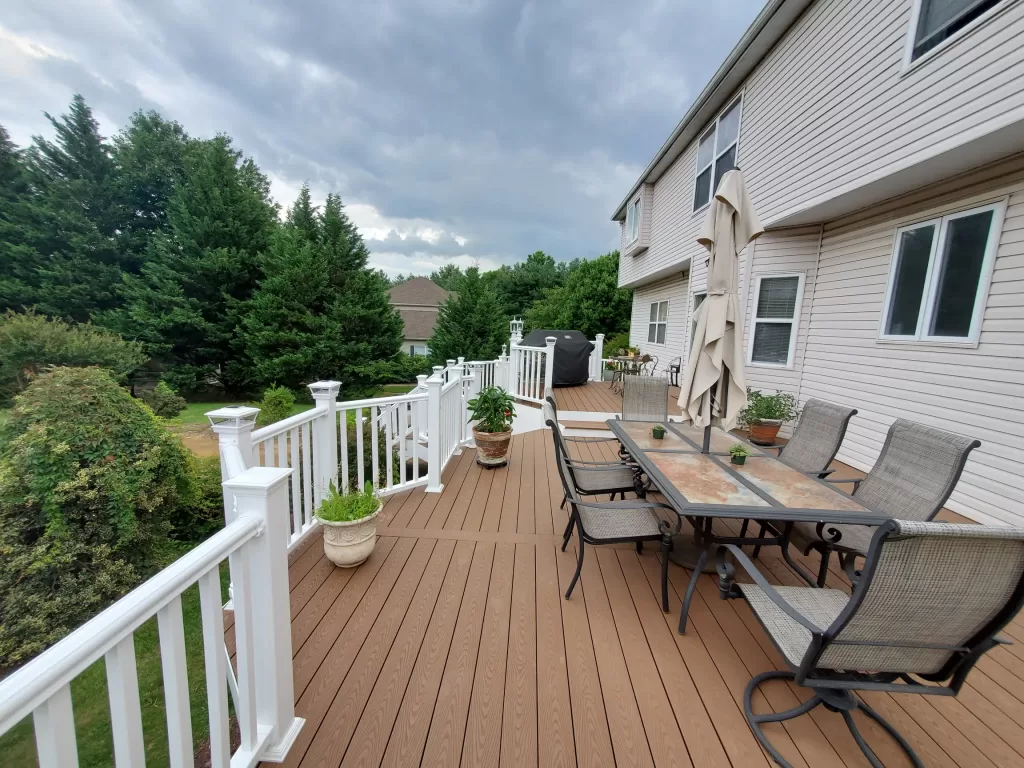
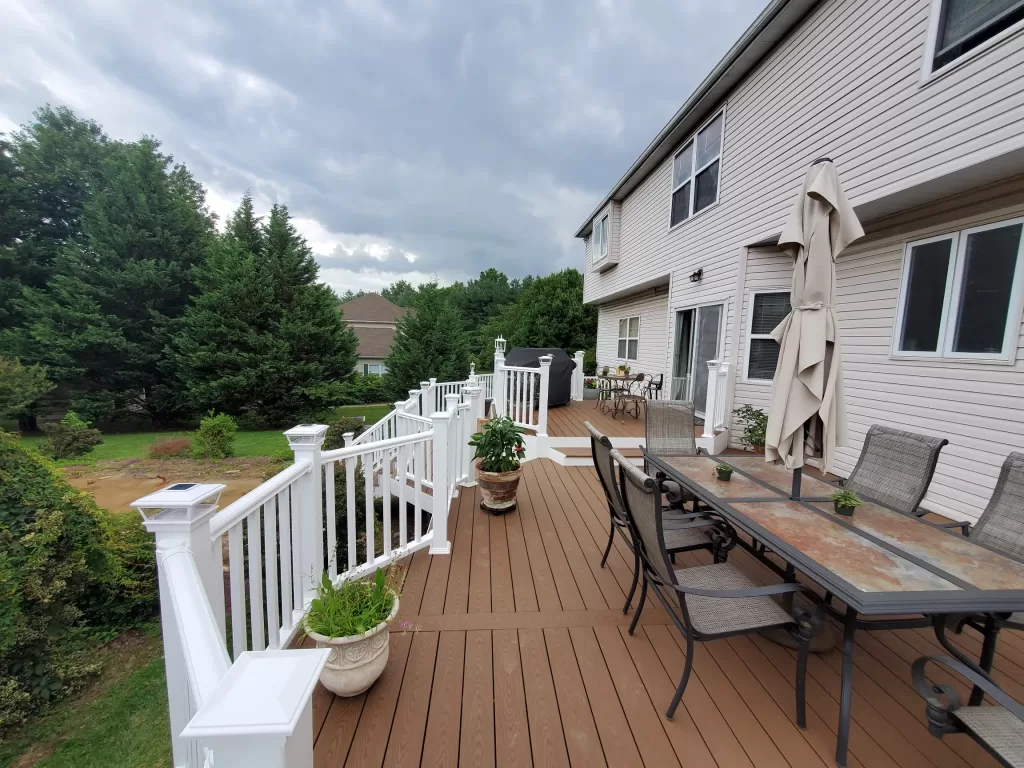
This Princeton deck renovation addressed a three-level structure that had deteriorated to the point where the decking boards had to come off and structural elements had to be replaced. New joists were installed throughout, composite decking boards went down across all three levels, a new central staircase was built connecting the levels, white composite railings were installed, and the project added wiring for exterior lighting.
Scope of Work
- Deteriorated decking boards removed from all three levels
- Structural elements assessed; damaged members replaced
- New joists installed throughout
- Composite decking boards installed on all three levels
- New central staircase built connecting the three levels
- White composite railings installed throughout
- New electrical wiring run for exterior lighting
Three Levels: What That Means for Structural Assessment
A three-level deck is structurally more complex than a single-platform deck of equivalent total square footage. Each level has its own framing system — its own posts, beams, and joists — and the levels are connected to each other and to the house through a series of ledger board connections, post-to-beam connections, and stair framing attachments. When a deck of this type deteriorates, the deterioration is rarely uniform: wood rot and moisture damage tend to concentrate at connections — where the ledger meets the house, where posts sit near grade, where water pools on horizontal surfaces rather than draining.
Before any new material went down, the decking boards were removed from all three levels to expose the framing underneath. Removing the decking is the only way to properly assess what is below it — a deck surface that looks worn from above may be concealing joists that are partially rotted through at their ends, or ledger connections that have lost their fasteners to corrosion. The structural assessment after the decking was removed identified which elements had to be replaced. New joists were installed throughout, providing a solid, correctly sized base for the new composite surface across all three levels.
Composite Decking on a Multi-Level Structure
Composite decking boards were installed across the full three-level structure. Composite decking at this scope has specific installation considerations that differ from a single-level deck. On a multi-level structure, the decking on each level runs in a direction and pattern that has to be planned relative to the level’s framing — composite boards are typically installed perpendicular to the joists, and the joist direction on each level may differ based on how the levels step down from the house.
Composite decking also has specific fastener and spacing requirements that vary by product. Proper end-to-end spacing between board ends — typically 1/8 to 1/4 inch — allows for the thermal expansion that composite boards undergo between cold winters and hot summers. Boards installed without adequate end spacing will buckle in summer heat. At 400 square feet across three levels, the number of board-end-to-frame connections and the consistency of that spacing throughout the installation reflects the care of the work.
New Central Staircase Connecting the Three Levels
A new central staircase was built to connect all three levels. On a multi-level deck, the stair is both a functional access element and a structural one: the stair stringers transfer the load of people on the stairs into the deck frames at the top and bottom of each stair run, and the stair position affects how each level is used and how traffic moves across the structure.
A central staircase — positioned in the middle of the deck rather than at the perimeter — allows access to each level from a single route rather than requiring the user to navigate to a corner or edge to move between levels. The stair stringers were attached to the framing of the upper level at the top of each run and to a landing pad or the lower level frame at the bottom. Each run was built to code requirements for riser height and tread depth, with a graspable handrail for the full run.
White Composite Railings
White composite railings were installed around the perimeter of the three-level structure and along the stair runs. On a multi-level deck, the railing system is more extensive than on a single-platform deck — it covers the perimeter of each level and both sides of each stair run, with posts anchored to the framing at regular intervals and transition hardware where the railing changes height or direction at the level transitions.
Composite railings in white do not require painting or staining. The white finish does not yellow or chalk the way painted wood does under UV exposure over multiple seasons. On a three-level deck with significant railing linear footage, the maintenance difference between composite and painted wood accumulates substantially over a five- to ten-year period.
Exterior Lighting Wiring
New electrical wiring was run to support exterior lighting on the deck. Adding lighting to a deck renovation requires running a circuit from the home’s electrical panel to the deck structure, protecting the outdoor wiring with appropriate conduit or outdoor-rated cable, and positioning the fixtures and switches relative to the deck’s entry points and primary use zones. Wiring for lighting is best handled during the renovation — before the decking is down and the wiring can be routed through the framing bays — rather than as a retrofit after the surface is complete, which requires drilling through finished decking and concealing surface-mounted conduit.
Deck Renovation in Princeton and Mercer County
Princeton is a Mercer County community with established residential neighborhoods and properties where older deck structures are common. A three-level deck that has reached the point of structural deterioration requires more than a surface refinish — the framing has to be opened up, assessed, and rebuilt where it has failed, before a new composite surface can be installed that will perform correctly over time. Belmax Remodeling works throughout Princeton and Mercer County. For more on our deck work, see our deck installation service page. Homeowners in the Princeton area can also visit our Mercer County service area page for more on what we do in the region.
Considering a Similar Project?
Multi-level deck renovations that include structural repair, new joists, composite decking, new staircase, composite railings, and electrical wiring typically fall in the $20,000–$28,000 range in Mercer County for 400 square feet. This Princeton project came in at $22,800, completed August 2019. To discuss what your deck project would involve, request a free estimate.