
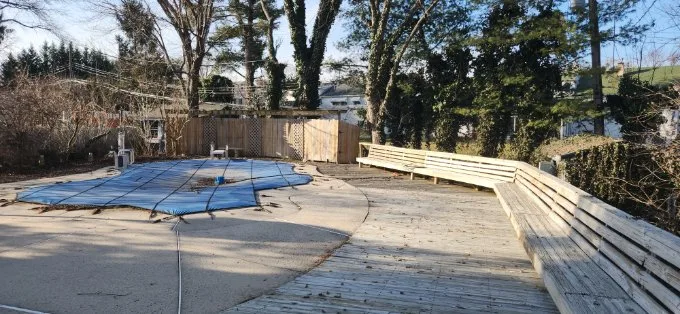
Deck Renovation – King of Prussia, PA
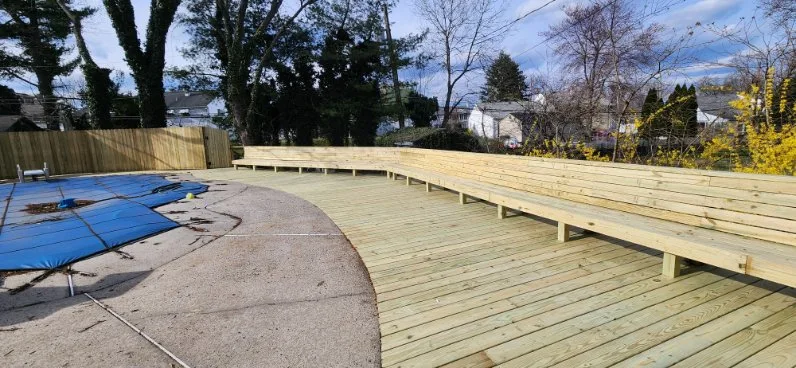
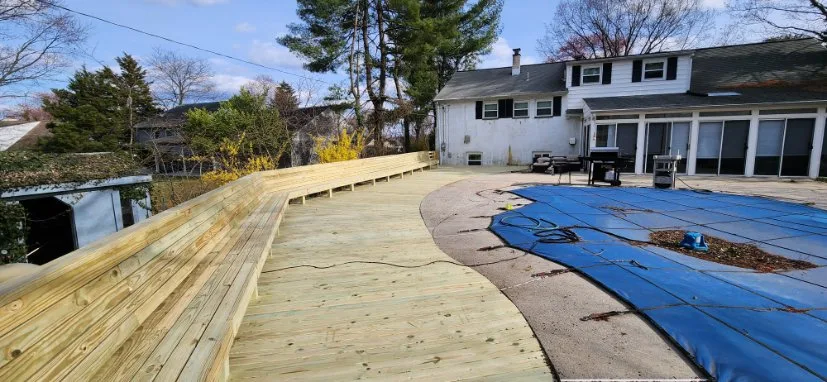
This King of Prussia deck had a specific problem at its core: it had been built with 2×4 dimensional lumber laid flat as decking boards instead of actual decking material. That is not a surface issue — it is a structural and safety problem that no amount of refinishing can fix. The project addressed it properly: full demolition, new joists, correct decking boards, and a complete build-out that added custom benches, a privacy fence, two sets of stairs, and two gates.
Scope of Work
- Full demolition of the existing deck
- Removal of improper 2×4 decking material
- New joist installation throughout
- New correct decking boards installed
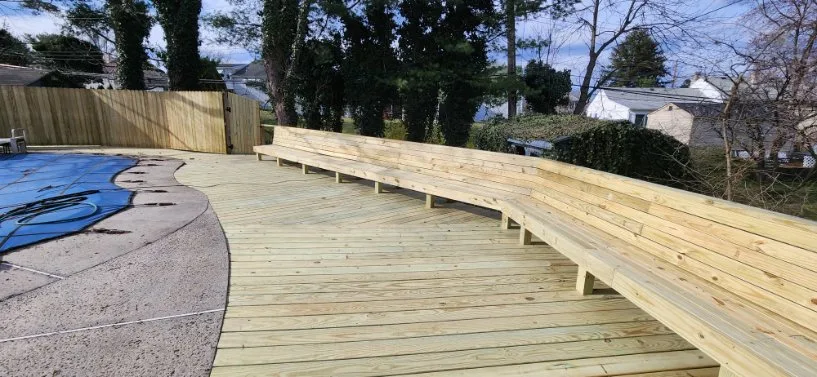
- Custom built-in benches
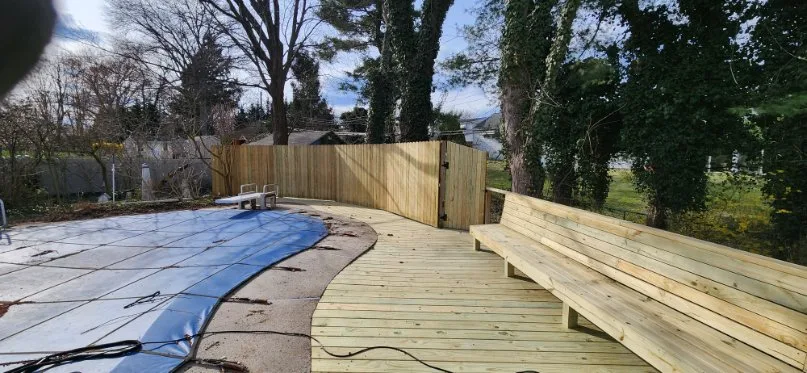
- Privacy fence installed
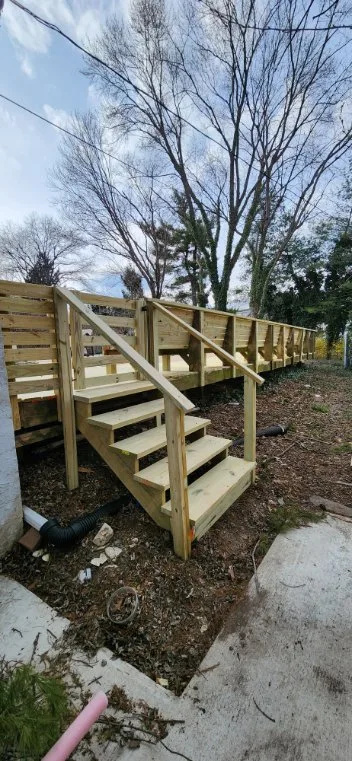
- Two new sets of stairs
- Two new gates
The 2×4 Problem: Why Demolition Was the Only Option
The original deck had been built using 2×4 dimensional lumber as its surface material — boards oriented flat, edge-up, spanning between the joists. Standard decking boards are a different product: wider, specifically milled for outdoor use, and designed to handle foot traffic, water exposure, and the expansion and contraction that comes with seasonal temperature change. A 2×4 laid flat as decking is narrower than it needs to be, oriented in a way that traps debris and holds moisture, and is not rated for deck surface loads over time.
This is not the kind of problem that gets fixed with sanding, sealing, or board replacement. The entire surface was the wrong material in the wrong orientation. Once the old decking came off and the joists below were inspected, new joists were installed to establish a clean, properly engineered base before any new surface material went down.
New Joists: Getting the Base Right
New joists were installed as part of the rebuild. Joists are the horizontal framing members that run between the beams and carry the load of the decking surface above them. On a 1,100-square-foot deck, the joist spacing, sizing, and connection hardware determine how rigid and stable the finished deck surface feels underfoot. Installing new joists during a full demo — rather than trying to reuse the original framing — ensures the structural base is correct before any finish material is applied and eliminates any concern about the condition of the original framing hidden beneath the old surface.
Correct Decking Boards
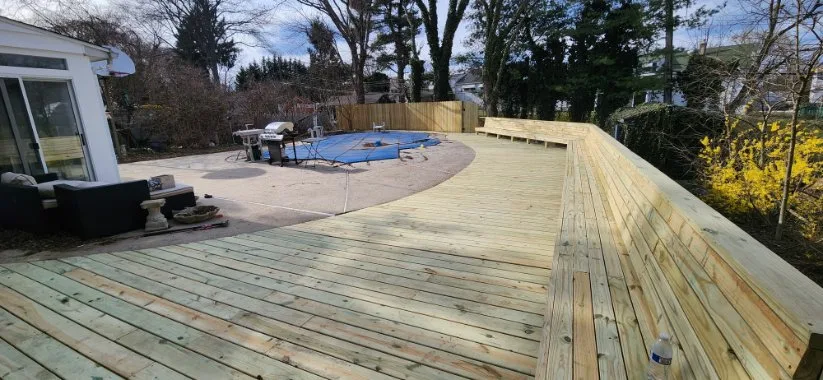
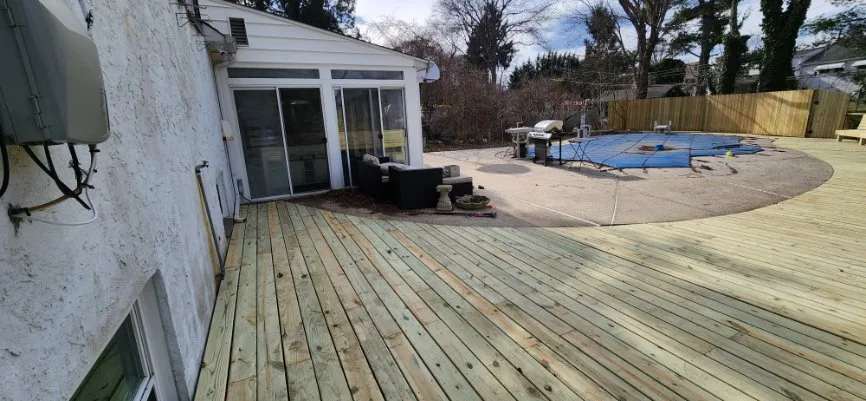
Once the new joists were in place, proper decking boards were installed across the full 1,100-square-foot surface. Decking boards chosen for this project were selected for durability and compatibility with the home’s exterior. At 1,100 square feet, the visual impact of the decking surface is significant — it is the largest single element of the outdoor space and the one that sets the character of everything built on top of it. The boards were fastened according to manufacturer specifications for spacing and fastener placement, which affects both drainage and the board’s ability to expand and contract without cupping or warping.
Custom Built-In Benches
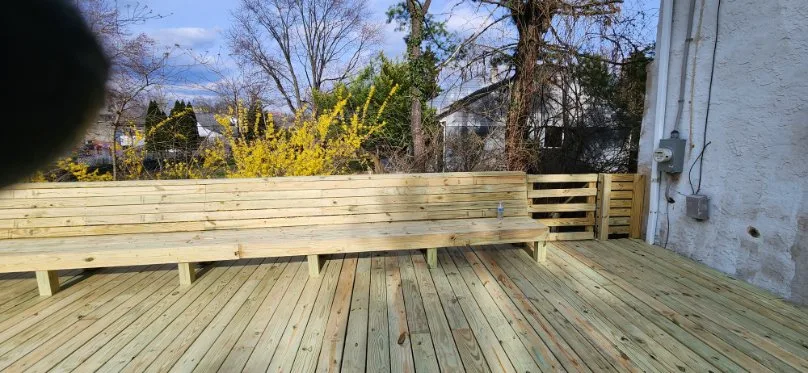
Custom benches were built as permanent features of the deck rather than as freestanding furniture. Built-in benches are attached to the deck framing, which means they stay in position, do not need to be stored or moved seasonally, and read as part of the deck’s design rather than objects placed on it. On a 1,100-square-foot deck, permanent seating along the perimeter or at defined zones helps organize how the space gets used — it creates a social area without requiring the homeowner to furnish the deck separately.
Privacy Fence
A privacy fence was installed around the deck. On a large deck in an area with neighboring properties, a privacy fence changes how the outdoor space is experienced — it reduces visibility from adjacent yards and the street, which affects how comfortable the space feels for daily use and for entertaining. A properly built privacy fence attached to the deck framing is also more structurally stable than a freestanding fence panel, because it ties into the deck structure rather than relying solely on posts set in the ground.
Two Sets of Stairs and Two Gates
Two sets of stairs were built connecting the deck to the yard at different access points. On a deck of this size, having more than one stair location means the deck connects to the yard at multiple points, which improves traffic flow and makes it easier to move between the deck and the garden or other outdoor areas without everyone routing through the same corner. Each stair set was built to code requirements for residential deck stairs — consistent tread depth, riser height, and proper attachment to the deck frame.
Two gates were installed to match the privacy fence and provide controlled access points at the stair locations. Gates that are properly hung and latched give the deck perimeter a finished, intentional boundary rather than an open gap where the fence meets the stairs.
Deck Installation in King of Prussia
King of Prussia is a Montgomery County community with significant residential development and a range of property types where deck conditions vary widely — from newer builds to original structures that have not been properly maintained or were not built correctly from the start. A deck built with the wrong materials is a liability that accumulates over time; addressing it with a proper full rebuild is the correct approach. Belmax Remodeling works throughout King of Prussia and the surrounding Montgomery County area. For more on our deck work, see our deck installation service page. Homeowners in King of Prussia can also visit our King of Prussia deck builder page for more completed local projects.
Considering a Similar Project?
Deck rebuilds at this scale — 1,100 square feet, full demo, new joists, new decking, built-in benches, privacy fence, two stair sets, and two gates — typically fall in the $13,000–$18,000 range in Montgomery County, depending on material selection. This King of Prussia project came in at $14,800, completed in February 2024. To discuss what your deck project would involve, request a free estimate.