
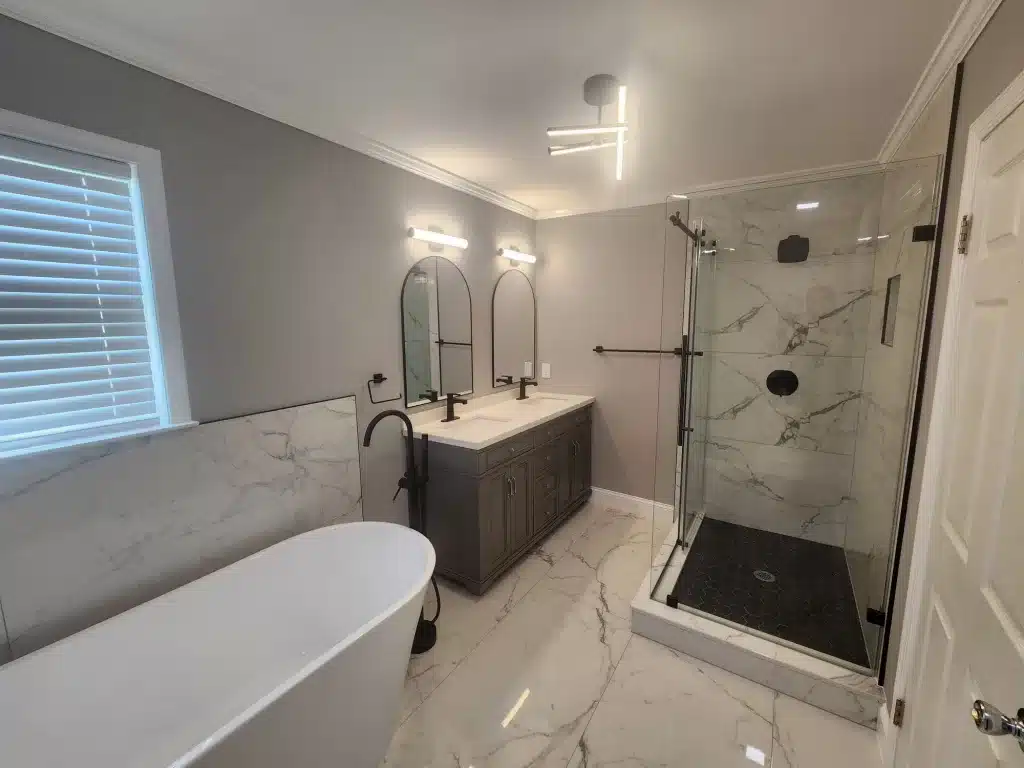
- By admin
- In Kitchen and bath, Painting, Plumbing, Renovation, Tiling
Master Bathroom Remodeling Ideas
Master Bathroom Remodel Ideas — What Actually Works
A master bathroom remodel is a different kind of project than a hall bath or guest bath renovation. The space is larger, the scope is more complex, the material quantities are bigger, and the decisions you make — about the shower, the vanity configuration, the tile, whether to include a tub — have a larger effect on both daily usability and project cost.
This article covers what actually improves a master bathroom: the layout decisions that change how the space functions, the upgrade choices that add real value versus ones that add cost without proportional benefit, and the common planning mistakes that make master bathroom renovations harder and more expensive than they need to be.
For cost ranges and project examples, the bathroom renovation cost page covers master bathroom pricing in detail. This article is about making the right decisions before you get to the numbers.
Layout ideas that actually improve the space
Most master bathrooms in homes built before 2000 in Bucks County and Montgomery County follow a similar formula — a vanity on one wall, a combined tub and shower on another, a toilet tucked in a corner. The layout works but rarely uses the available square footage well. A renovation is the opportunity to reconsider how the space is organized.
Larger shower in place of a tub-shower combo
The most common master bathroom layout change we execute is converting a tub-shower combo to a dedicated walk-in shower. Most master bathrooms have a tub that rarely gets used — the shower is the daily fixture, and the tub occupies significant floor space that could give the shower real usable size.
A 36×36 shower stall feels cramped. A 42×60 or 48×72 walk-in shower — which becomes possible when the tub footprint is reclaimed — feels entirely different. The change also allows a bench, a larger niche configuration, and a wider glass opening. This single layout decision has more effect on how the master bathroom functions daily than almost any finish choice.
Double vanity done right
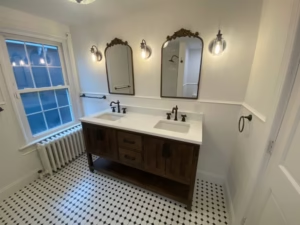
A double vanity in a shared master bathroom is genuinely useful — two people can use the bathroom at the same time without getting in each other’s way. But the execution matters.
The most common double vanity mistake is fitting the largest possible vanity into the available wall space without leaving adequate clearance. A double vanity that makes the walking path too narrow or that bumps against the door swing causes daily frustration. The rule of thumb is at least 36 inches of clearance in front of the vanity and at least 15 inches from the center of each sink to the nearest wall or obstruction.
A double vanity with two separate mirrors or a wide framed mirror, adequate drawer storage under each sink, and proper vanity lighting on both sides works well. A double vanity with a single small mirror centered above both sinks and no storage creates the opposite experience.
Separate toilet enclosure
Enclosing the toilet in a separate water closet — a small partitioned space with a door or pocket door — is one of the most functional layout changes possible in a master bathroom with enough square footage to accommodate it. It allows one person to use the toilet while another is at the vanity or in the shower, which matters practically in a shared space.
A toilet enclosure doesn’t require a large footprint. A 36×66 inch space with a pocket door is adequate. It does require moving walls, which adds to the project scope and cost — but in a master bathroom where privacy matters, it’s consistently one of the changes homeowners are most glad they made.
Better circulation and clear zones
Master bathrooms that feel cramped despite having adequate square footage are usually organized so that fixtures compete for the same circulation space. The toilet is directly across from the vanity, leaving only 24 inches of walking path. The shower door swings into the main traffic area. The linen storage is in the least accessible corner.
Part of what a renovation accomplishes is redistributing space so each zone has clear room to function. This isn’t just about aesthetics — it’s about whether the room actually works for two people in the morning routine.
Shower ideas that add value and what they actually cost
The shower is the most complex element of a master bathroom renovation and the one where decisions have the most effect on both project cost and daily experience. Here’s how the major shower decisions break down.
Walk-in shower size
The minimum for a comfortable walk-in shower is 36×36 inches — and most people who install a 36×36 wish it were larger. A 42×48 or 42×60 shower has noticeably more usable space. If the layout allows for 48 inches in either dimension, the shower starts to feel genuinely generous.
Larger showers cost more in tile, waterproofing, and labor, but the cost increase is proportional — and the functional improvement is significant. If you’re investing in a master bathroom renovation, sizing the shower appropriately for the available space is one of the highest-value decisions you can make.
Built-in bench
A built-in bench in a walk-in shower is a practical addition, not just a design choice. It provides a place to sit while shaving legs, a surface for soap and shampoo when the shower is in use, and a resting point that improves accessibility as homeowners age. It’s built during the tile work phase — the framing is done before waterproofing and tile, so it’s integral to the shower rather than added on. Cost is modest relative to the total shower scope: typically $400 to $800 added to the shower build.
Niches
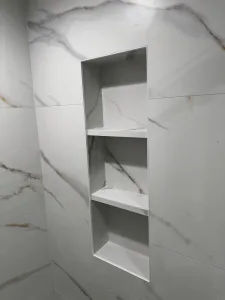
A built-in niche in the shower wall eliminates surface-mounted caddies and provides a clean, permanent place for shower products. The niche is framed and waterproofed before tile goes in. One niche between studs is straightforward. A niche wider than the stud bay or a niche positioned in an exterior wall requires structural consideration.
A single niche on the non-shower-head wall at shoulder height is the most useful configuration for most showers. Two niches at different heights give more flexibility for product storage.
Frameless glass enclosure
A frameless glass shower enclosure — whether a fixed panel with a pivot door, a sliding door, or a hinged panel — opens the visual field of the bathroom significantly compared to a framed enclosure or a curtain. In a master bathroom, this matters because the shower is typically visible from the main area of the room and a frameless enclosure makes the whole space read as larger and more finished.
Frameless glass runs $1,500 to $3,500 depending on the size of the opening and the hardware. Semi-frameless is a middle option at lower cost. For a master bathroom renovation at any reasonable budget level, frameless or semi-frameless glass is worth prioritizing over other upgrade choices.
Multi-head shower systems
A rain head, a handheld, and a standard showerhead on the same shower valve is achievable and adds real function. Body jets and separate thermostatic valve systems are significantly more expensive — both in fixture cost and in the plumbing work required to supply them with adequate pressure and volume.
For most master bathrooms, a quality fixed rain head combined with a handheld on a slide bar provides the most function for the cost. Body jets require volume that most standard residential water supplies can’t sustain effectively. The fixture cost is also $2,000 to $5,000 or more for a full thermostatic multi-body system, before installation.
Tile choices and their labor implications
Tile selection in a master bathroom shower affects both material cost and labor cost. Large-format tile — 12×24 or larger — requires more precise substrate preparation but installs faster per square foot than small mosaic. Complex patterns (herringbone, chevron, inlay borders) add significant labor time regardless of material cost.
Floor-to-ceiling tile on all shower walls produces a clean, finished result and is proportionally more expensive than tile to a standard height. A practical approach for budget management is to tile to the ceiling on the shower walls and use a simpler finish (paint or lighter tile) on the non-wet walls of the bathroom.
Vanity, storage, and mirror planning
Vanity depth and drawer configuration
Standard vanity depth is 21 inches. In a master bathroom with adequate floor space, a 24-inch deep vanity provides more counter space and typically more storage depth in the drawers. The tradeoff is the additional 3 inches into the floor plan — which matters in tighter bathrooms and doesn’t in larger ones.
Drawer storage is more useful than door-and-shelf storage under the sink. Deep drawers on both sides of the under-sink area accommodate hair dryers, styling tools, and full-size product bottles that don’t fit in standard under-sink cabinet openings. Specifying drawer banks on the outside of each sink and plumbing access in the center is more functional than the default two-door cabinet configuration.
Mirror and lighting placement
Vanity lighting that comes from the side — sconces at face height on either side of the mirror, or a lit mirror with side lighting built in — provides far better illumination for daily grooming than a bar light mounted above the mirror. Overhead-only lighting creates shadows across the face that make the mirror less useful.
For a double vanity, two separate mirrors with sconces between them or flanking each mirror looks more finished than a single wide mirror spanning the full vanity width. Each person gets their own well-lit mirror zone, and the space between the mirrors accommodates an outlet without interrupting the design.
Recessed medicine cabinet vs mirror
A recessed medicine cabinet provides storage that a flat mirror doesn’t. In a master bathroom with a double vanity, one recessed medicine cabinet on each sink side provides storage for frequently used items without requiring drawer space. The tradeoff is installation complexity — recessed cabinets require opening the wall and framing the recess, which has to happen before drywall and tile.
If medicine cabinets are being considered, they need to be specified before framing is closed. This is one of the decisions that has to be made early in the planning process rather than selected during finish work.
Freestanding tub — when it makes sense and when it doesn’t
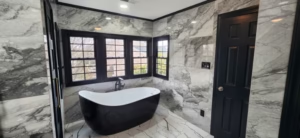
A freestanding tub is one of the most requested design elements in master bathroom renovations and one of the most frequently installed in spaces where it doesn’t work well. Here’s an honest assessment.
When a freestanding tub works
A freestanding tub works in a master bathroom that has enough space to give it a proper position — not jammed against a wall, not blocking a circulation path, not competing with the shower for visual dominance. Specifically: a tub needs at least 12 to 18 inches of clearance on the sides and end for cleaning and visual breathing room, and it needs a filler faucet that’s positioned correctly for the tub model.
A freestanding tub also needs to be connected to plumbing — supply lines and a drain. Floor-mount faucets require supply lines run through the floor, which adds plumbing work beyond a standard wall-mount installation. This is worth planning for during the rough-in phase rather than retrofitting.
In a master bathroom where there’s genuine square footage to give a tub its own zone — under a window, in a dedicated alcove, or in a separate area from the shower — a freestanding tub can be both functional and visually effective.
When a freestanding tub is the wrong choice
A freestanding tub placed against the wall in a bathroom where it only fits by eliminating walking space, or installed in a master bathroom where the homeowners genuinely won’t use it, is an expensive design decision that reduces the bathroom’s usability rather than improving it.
Tub cost ranges from $600 for a basic acrylic freestanding model to $3,000+ for a cast iron or stone resin option. Installation adds $500 to $1,500 for plumbing depending on the faucet configuration. That’s $1,500 to $5,000 or more for a fixture that takes up significant floor space and that, in a majority of households, gets used less than once a week after the first few months.
The honest question to ask before committing to a freestanding tub: do you currently use the tub in your bathroom? If the answer is rarely or never, reclaiming that square footage for a larger shower is almost always the better functional choice.
Where master bathroom renovation costs increase
Master bathroom renovations are expensive relative to other bathroom projects primarily because of scale — more tile, more glass, more plumbing fixtures, larger vanities. But the decisions that push cost highest are predictable.
Custom tile work and labor
Tile is the largest variable in a master bathroom renovation budget. A master bathroom with floor-to-ceiling tile throughout, a complex pattern, large-format natural stone, and decorative accent inlays can spend $8,000 to $15,000 on tile alone. The same master bathroom with standard porcelain tile in a clean stacked layout lands at $3,000 to $6,000. The functional result is similar. The budget difference is significant.
Plumbing moves
Moving any plumbing fixture — relocating the toilet to create a water closet, moving the shower drain to accommodate a larger footprint, adding a second sink where only one existed — requires opening the floor, rerouting supply and drain lines, and patching back. Each fixture moved adds $1,500 to $3,000 to the plumbing scope.
Frameless glass size
Frameless glass is priced by the size of the opening and the weight of the glass panels. A large shower opening — 72 inches wide or more — requires heavier glass and more complex hardware, which pushes cost above a standard single-door frameless enclosure.
Hidden conditions
Master bathrooms in older homes in Bucks County and Montgomery County frequently have water damage behind the existing shower surround, soft subfloor at the tub perimeter, and galvanized supply lines. These conditions add cost when they’re found during demo. Budgeting a 10 to 15 percent contingency on master bathroom renovations in homes built before 1985 is a practical approach. For more on what typically drives change orders in bathroom projects, see our article on how bathroom remodel budgets are built.
Common planning mistakes in master bathroom renovationsOvercrowding the layout
Trying to include every possible feature — a large shower, a freestanding tub, a double vanity, a toilet enclosure, and a linen closet — in a bathroom that doesn’t have adequate square footage for all of them produces a cramped result where nothing works well. Prioritizing two or three significant improvements and executing them properly is better than including everything at the cost of usable space.
Forcing a tub where it doesn’t fit
A freestanding tub positioned too close to walls, blocking a circulation path, or visually competing with the shower in a small room doesn’t enhance the bathroom — it makes it harder to use. If the bathroom doesn’t have genuine space for a freestanding tub with proper clearance, a built-in soaking tub or no tub is the better decision.
Underplanning lighting
Master bathrooms that skip vanity-level lighting in favor of overhead recessed fixtures alone produce a room that’s adequately lit but not well lit for daily use at the mirror. Vanity lighting, shower lighting, and general illumination are three separate needs. Recessed lighting in the shower ceiling (wet-rated fixtures), sconces at the vanity, and overhead fixtures for general illumination is the complete approach.
Too many tile materials in one space
A master bathroom with different tile on the floor, different tile on the shower walls, different tile on the accent wall, and a decorative border at the vanity backsplash is visually busy rather than visually rich. One or two tile types used consistently throughout the wet area and floor, with a single accent application, produces a cleaner result and costs less in labor.
Insufficient storage planning
A master bathroom renovation that doesn’t address storage leaves homeowners with a better-looking bathroom that functions the same as before. Linen storage, medicine cabinet space, and vanity drawer configuration all need to be part of the design conversation before construction begins — not addressed with furniture or baskets after the fact.
Planning a master bathroom renovation?
If you’re planning a master bathroom renovation in Bucks County, Montgomery County, or surrounding areas of Pennsylvania and want an honest conversation about what your specific project would involve and what it would cost, our bathroom remodeling team is glad to help.
Call us at 609-712-2750 or request a free estimate online. We’ll come to your home, look at the existing bathroom, and give you a detailed written quote based on what the project actually involves. You can also browse our completed bathroom projects to see examples of master bathroom renovations across different scopes and budgets.


