
- By admin
- In Uncategorized
How to Choose the Right Bathroom Mirror for Your Vanity and Layout
How to Choose a Bathroom Mirror — Size, Proportion, Lighting, and When a Medicine Cabinet Makes More Sense
Bathroom mirror selection gets less attention than tile and vanity choices during a renovation, but it affects the finished bathroom more than most homeowners expect. A mirror that’s the wrong width for the vanity makes the vanity wall look unbalanced. A mirror mounted too high or too low changes the daily usability of the space. A standard flat mirror on a bathroom that needs storage is a missed opportunity. And the relationship between the mirror and the lighting — whether sconces are flanking the mirror at face height or a bar light is mounted above — determines how well the vanity area actually works for daily grooming.
This article covers the practical decisions involved in choosing a bathroom mirror: how to size it correctly, when a medicine cabinet is the better choice, how to think about lighting in the same conversation as the mirror, and the mistakes that are most worth avoiding.
For general bathroom renovation planning, our bathroom remodeling page covers the full scope of what a bathroom renovation involves.
Mirror size and proportion — getting the width right
The most important mirror dimension is width, and it should be determined in relation to the vanity below it, not the wall around it. A mirror that’s significantly narrower than the vanity looks undersized and makes the wall feel visually heavy on the sides. A mirror that’s wider than the vanity competes with the vanity’s boundaries and can read as mismatched.
Single vanity proportion
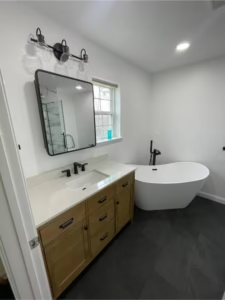
For a single vanity, the mirror width should be close to the vanity width — either matching it or running 2 to 4 inches narrower on each side. A 36-inch vanity works well with a 28 to 36-inch mirror. A 48-inch vanity works well with a 40 to 48-inch mirror. Staying within a few inches of the vanity width on each side keeps the relationship between mirror and vanity visually coherent.
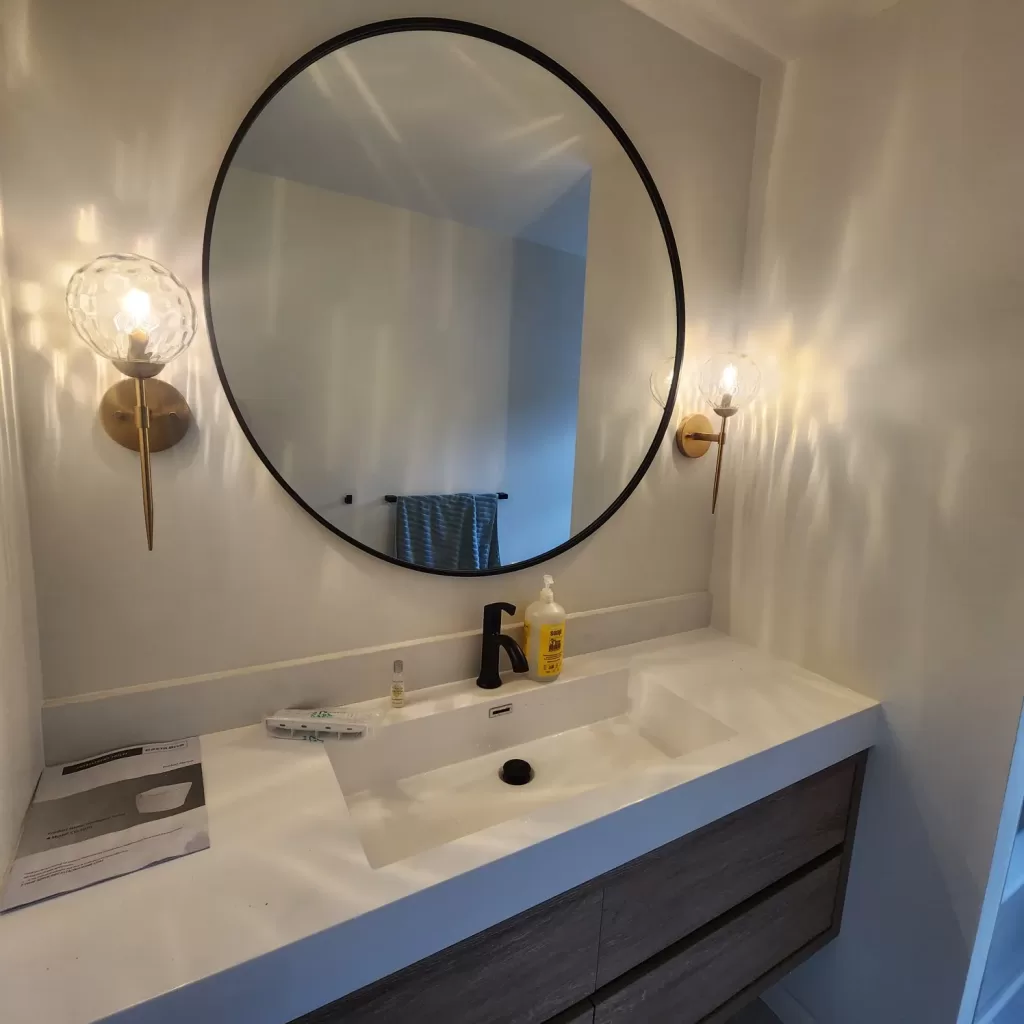
The exception is when sconces are flanking the mirror rather than a bar light above it. In that case, the mirror needs to be narrow enough to leave adequate wall space on each side for the sconces — typically 6 to 10 inches of clear wall space per side. This affects mirror width significantly and needs to be figured out before the mirror is ordered.
Double vanity — one wide mirror or two separate mirrors
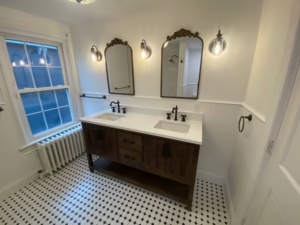
A double vanity can use either a single wide mirror spanning the full vanity width or two separate mirrors — one centered over each sink. Both approaches are common and both work. The choice is partly aesthetic and partly functional.
A single wide mirror gives the vanity wall a unified, expansive feel and reflects more light. It works well with a bar light or LED strip above the full width, and in bathrooms where the goal is to maximize the sense of space.
Two separate mirrors give each person their own distinct mirror zone and light source, which functions better for simultaneous daily use. Each mirror is centered over its own sink, each has its own sconce or light fixture, and there’s typically a gap between the two mirrors where an outlet or small accessory shelf can be positioned. This is the approach used in most well-planned master bathrooms.
For more on how vanity and mirror decisions work in a primary bathroom renovation, see our article on master bathroom remodel ideas.
Mirror height
Standard mirror height ranges from 28 to 36 inches for a typical bathroom. The key dimension is where the mirror is mounted vertically. The bottom of the mirror should sit 5 to 10 inches above the faucet to avoid visual conflict with the faucet handles and to keep the mirror clear of splash. The top of the mirror should be at a height that works for the tallest person using the bathroom without requiring them to tilt their head.
In bathrooms with tile on the wall behind the vanity, the mirror should be sized and positioned so it doesn’t split a tile course awkwardly at the top or bottom edge. Tile layout and mirror height need to be coordinated if both are being specified in the same renovation.
Mirror vs medicine cabinet — when each makes sense
A recessed medicine cabinet provides storage that a flat mirror doesn’t. In a bathroom without adequate storage elsewhere — no linen closet, a vanity with limited cabinet depth, no under-sink drawer space — a medicine cabinet can store everything that would otherwise sit on the countertop or in a separate organizer.
When a medicine cabinet makes more sense
A medicine cabinet makes the most sense when: the bathroom needs surface storage for daily-use items and the vanity doesn’t have adequate drawer or cabinet space; when the bathroom is small enough that countertop space is limited; or when the renovation budget calls for practical decisions that improve daily function over decorative ones.
In small bathrooms in particular, a recessed medicine cabinet is one of the most consistently worthwhile additions — it provides storage without protruding into the room, it adds a mirror, and it keeps the wall surface clean. Our article on small bathroom remodeling covers this in more detail.
One important note: a recessed medicine cabinet requires framing during rough-in. The cabinet housing needs to fit between studs, which are typically 16 inches on center. A standard recessed medicine cabinet is sized for a single stud bay — typically 14 to 16 inches wide. A wider recessed cabinet may require a header and modified framing. This decision needs to be made before walls close, not after.
When a standard flat mirror makes more sense
A flat mirror makes more sense when: the vanity has adequate drawer and cabinet storage and the medicine cabinet would be redundant; when the bathroom has a wide vanity where a recessed cabinet’s width would look too narrow relative to the vanity; when sconces flanking the mirror are preferred over lighting mounted above or integrated into the cabinet; or when a specific decorative mirror has been selected and is part of the design direction.
In a master bathroom with a well-configured double vanity and good drawer storage, a flat mirror on each side — with sconces between or flanking — typically produces a better-looking and better-functioning result than two medicine cabinets.
Mirror shape and style — what actually matters functionally
Shape affects both the visual character of the mirror and its practical proportions. Rectangle mirrors are the most versatile and proportional across the widest range of vanity configurations. Round and oval mirrors are popular and work well over a single vanity — they’re less practical over a double vanity where the rectangular proportions of the vanity below read better with a rectangular mirror above.
Frameless vs framed
Frameless mirrors are the cleaner, more visually neutral choice. They don’t add visual weight to the wall and they’re easier to keep clean at the edges. They work with almost any vanity style and don’t require coordinating a frame material with other finishes in the bathroom.
Framed mirrors can be a considered design choice when the frame finish coordinates with the hardware, faucet, and fixture finishes in the bathroom. A mirror with a brushed gold frame in a bathroom with brushed gold hardware throughout creates a consistent finish thread that reads as intentional. The same mirror in a bathroom with mixed finishes can feel disconnected.
The practical rule: if the finish can be matched consistently throughout the bathroom, a framed mirror is a legitimate design choice. If the finish coordination is uncertain, frameless is the more reliable option.
LED and backlit mirrors
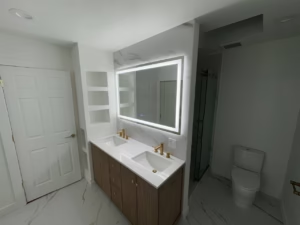
LED mirrors — mirrors with integrated LED lighting along the edges or behind a translucent frame — have become common in bathroom renovations and provide a practical combination of mirror and task lighting in a single fixture. They work particularly well in bathrooms where wall space for separate sconces is limited, or where a modern aesthetic is the goal.
The trade-off: LED mirrors are more expensive to replace than a standard mirror, and the LED element has a finite life. In most residential applications this is not a significant concern, but it’s worth knowing. The electrical connection for an LED mirror is also more involved than hanging a standard mirror — a junction box behind the mirror location needs to be roughed in at the right height during the renovation.
Lighting and mirror planning — they need to be decided together
The most common bathroom lighting mistake is specifying the mirror first and then treating lighting as a separate decision. Mirror width, mirror position, and lighting type all interact directly, and getting one wrong can make the others awkward.
Sconces flanking the mirror
Sconces mounted on the wall on either side of the mirror provide the best functional lighting for daily grooming — light comes from the sides at face height, illuminating evenly without overhead shadows. This approach requires the mirror to be narrow enough to leave adequate wall space for the sconces on each side.
The typical sconce positioning is centered at roughly 60 to 65 inches above the floor, which places the light source at face height for most adults. The sconces should be mounted symmetrically — equal distance from the mirror edge on each side. If the bathroom tile extends behind the vanity area, the electrical rough-in for the sconces needs to be positioned before tile goes on the wall.
Bar light or LED strip above the mirror
A bar light mounted above the mirror is the most common lighting configuration and the simplest to install — one electrical box behind the center of the mirror, one fixture. The functional limitation is that overhead light creates downward shadows across the face, which is less useful for grooming than side lighting.
A wide LED strip light mounted above a wide mirror distributes the light more evenly than a single narrow fixture and reduces the shadow problem somewhat. This is a reasonable approach for bathrooms where the wall width doesn’t support flanking sconces and a single fixture would be too narrow for the mirror width.
Integrated mirror lighting
An LED mirror with integrated edge or backlit lighting provides illumination without requiring separate sconce rough-in. The light is softer and more diffused than a bar light. It works well when the electrical rough-in for the mirror position is already planned as part of the renovation — it just needs a single junction box, same as a standard fixture.
Common mistakes homeowners make
Mirror too small for the vanity
The most common mirror mistake is choosing a mirror that’s significantly narrower than the vanity below it. This makes the vanity wall look unbalanced — the vanity is visually heavy and the mirror is floating above it without filling the width. The general rule is that the mirror should come within a few inches of the vanity width on each side. If sconces are being used, the mirror needs to be sized to accommodate the sconce positions — but this is a constraint to design around, not a reason to hang a small mirror over a wide vanity.
Ignoring storage needs and choosing a flat mirror by default
A flat mirror is the default choice for most homeowners who haven’t thought through storage needs. In bathrooms where the vanity doesn’t have adequate storage for daily-use items, a flat mirror leaves that problem unsolved. The question to ask before choosing between a flat mirror and a medicine cabinet is: where will all the things that need to be accessible from the vanity actually go? If there’s no good answer, a medicine cabinet is the practical choice regardless of aesthetic preference.
Mounting the mirror too high
A mirror mounted too high forces shorter household members to tilt their head or strain to see their full face. The center of the mirror should be at or slightly below eye level for the average adult height in the household, not at the center of the wall space above the vanity. In bathrooms with high ceilings and tall tile, the instinct to center the mirror vertically in the tile field produces a mirror that’s positioned for a much taller person than is actually using it.
Deciding on lighting after the mirror is already ordered
Lighting and mirror selection need to happen in the same conversation. The mirror width affects how much space is available for sconces. The lighting type affects what electrical rough-in is needed and where. The mirror mounting height affects where sconces should be positioned. Ordering a 48-inch mirror for a 48-inch vanity and then discovering there’s no wall space for flanking sconces is a preventable problem that requires compromising on one or both elements.
Buying the mirror before confirming faucet clearance
In bathrooms with a tall or deck-mount faucet, the bottom of the mirror needs to clear the faucet handles with adequate space — typically at least 5 inches. Ordering a mirror and then discovering it hangs directly over the faucet handles, making them difficult to reach or visually cluttered, is avoidable by confirming faucet height before mirror selection is finalized.
Practical steps before finalizing the mirror choice
- Measure the vanity width — the mirror width should be within a few inches of vanity width on each side, adjusted for sconce positions if flanking sconces are planned.
- Decide on lighting type first — sconces flanking vs bar light above vs LED mirror determines available mirror width and electrical rough-in requirements.
- Assess storage needs honestly — if storage is needed at the vanity and isn’t provided by the vanity itself, a medicine cabinet may serve better than a flat mirror regardless of aesthetic preference.
- Confirm faucet height — the bottom of the mirror should clear the faucet by at least 5 inches to avoid visual clutter and clearance issues.
- For recessed medicine cabinets, specify before rough-in closes — the framing for a recessed cabinet has to be done before drywall, not after.
- Coordinate with tile layout — if the wall behind the vanity is being tiled, mirror dimensions and mounting height should be coordinated with the tile layout so edges land cleanly.
For more on how bathroom design decisions work together in a renovation context, our bathroom design page covers the planning process in more detail.
Planning a bathroom renovation?
If you’re planning a bathroom renovation in Bucks County, Montgomery County, or surrounding areas of Pennsylvania and want to work through selections — mirror, lighting, vanity, tile — with a contractor who understands how those decisions interact with installation — call us at 609-712-2750 or request a free estimate online.
We’ll come to the space, look at what’s there, and have an honest conversation about what the project involves and what it will cost.


