
- By admin
- In Kitchen and bath
Smart & Stylish: Top Small Bathroom Remodeling Ideas on a Budget
Small Bathroom Remodeling — What Actually Works and What Wastes Money
Small bathrooms have a specific set of problems that larger bathrooms don’t. The space is tight, so every fixture decision affects clearance. Storage is limited, so every inch of wall and floor has to earn its place. The budget is often the same as a larger bathroom because the labor and material costs don’t scale down proportionally with square footage.
This article is a practical guide to remodeling a small bathroom well. Not a list of ideas that might work in someone else’s bathroom, but an honest look at where to spend, where to save, what actually makes a small bathroom function better, and what commonly overpromises and underdelivers.
If you want full cost ranges for small bathroom renovations, the bathroom renovation cost page covers that in detail. This article is about the decisions that determine whether your specific project is money well spent.
Design moves that actually make a small bathroom feel larger
Making a small bathroom feel bigger is partly about design choices and partly about what you don’t put in it. The instinct to fill every surface creates visual clutter that makes tight spaces feel tighter. Restraint is usually the right direction.
Mirror size and placement
The single highest-impact, lowest-cost change in most small bathrooms is a larger mirror. A mirror that runs the full width of the vanity — or close to it — visually doubles the wall it’s on and reflects light back into the space. Most small bathrooms have a mirror that’s too small for the vanity, which makes the wall feel heavy and the room feel closed in.
Lighting
Poorly lit small bathrooms feel smaller. Two changes make a significant difference: adding vanity-level lighting on either side of or above the mirror, and improving the overhead fixture if it’s inadequate.
Recessed lighting is cleaner than surface-mounted fixtures in tight spaces because it doesn’t visually lower the ceiling. The goal is even illumination across the whole room — not one bright spot over the vanity and dim corners everywhere else.
Glass instead of opaque barriers
A shower curtain and rod is one of the most visually heavy elements in a small bathroom. It cuts the room in half visually and makes both halves feel smaller. A clear glass shower panel or enclosure opens the sightline through the shower area and makes the bathroom read as a single continuous space.
Frameless glass is more expensive than a framed enclosure. A semi-frameless option provides most of the visual benefit at lower cost.
Tile scale and color in small bathrooms
Large-format tile — 12×24 or larger — in a small bathroom creates fewer grout lines per square foot, which reads as cleaner and more expansive than smaller tile with dense grout patterns. Light tile colors are the consistent choice for small bathrooms where the goal is to maximize perceived size.
Keeping the visual field clear
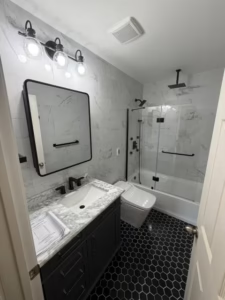
Built-in storage — recessed medicine cabinet, recessed shelving in the shower — keeps the wall surfaces clean. A vanity with drawers rather than open shelving under it keeps the floor area visually clear. These choices don’t require more square footage — they require more intentional planning.
Budget-smart upgrades that actually change how the bathroom works
The vanity is the most important fixture decision
The vanity affects storage, counter space, clearance, and the visual weight of the room. The two most common vanity mistakes in small bathrooms are choosing one that’s too wide — creating clearance problems with the door or toilet — and choosing one with a pedestal or legs that looks clean but provides no storage.
Measure the door swing, the toilet clearance, and the walking path before selecting any vanity. In a small bathroom, the standard clearances are not automatic — they require checking.
Keeping plumbing in place
Moving the toilet, sink, or shower drain in a small bathroom renovation adds $1,500 to $3,000 or more to the project cost and adds complexity without improving function in most cases. Unless the current layout has a genuine functional problem, keeping plumbing where it is is almost always the right budget decision.
The tub-to-shower conversion
If the small bathroom has a tub that’s rarely used, converting it to a walk-in shower is often the most functional improvement possible in the space. A prefab base with a tile surround is the budget-conscious approach that still produces a good result.
Recessed storage in the shower
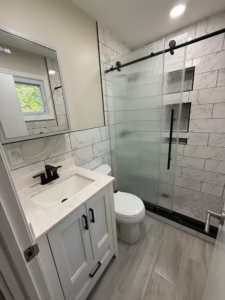
A built-in niche in the shower wall provides shampoo and soap storage without a surface-mounted caddy. It’s installed during the tile work phase and adds modest cost — typically $200 to $400 — for a result that works better and looks cleaner than any surface alternative.
Layout decisions that save money without compromising function
Simpler shower setup
A standard shower configuration — one valve, one showerhead, one drain — is significantly less expensive than a multi-function shower system. In a small bathroom where the shower footprint is limited, a complex shower system doesn’t provide proportionally more function. The cost difference can be $1,000 to $3,000 depending on the system.
Standard fixture sizes
Standard-sized toilets, sinks, and vanities are less expensive and easier to source than compact specialty sizes. Specialty fixtures marketed specifically for small bathrooms are often priced at a premium for the marketing rather than proportionally more value.
Simpler tile layout
A clean stacked or offset tile layout costs significantly less in labor than a diagonal, herringbone, or pattern-within-pattern layout. The material cost is the same. In a small bathroom where the tile coverage area is limited, a simpler layout executed well looks better than a complex layout executed quickly.
Where small bathrooms still get expensive
Custom tile shower with frameless glass. A custom tile shower with floor-to-ceiling tile, a curbless design, a built-in bench, and a frameless glass enclosure can run $6,000 to $10,000 for the shower alone. The glass enclosure typically represents $1,500 to $3,000 of that total.
Waterproofing. Proper waterproofing is not optional and is not cheap. It’s the phase of construction that determines whether the renovation lasts 5 years or 20 years.
Hidden conditions. Small bathrooms in older homes frequently have water damage behind the shower surround, soft subfloor at the tub perimeter, and galvanized plumbing. Budgeting a 10 to 15 percent contingency is practical. For more on what causes change orders, see how bathroom remodel budgets are built.
High-end fixtures in a small space. In a small bathroom, premium fixtures’ visual contribution is more limited than in larger bathrooms where they have more space to be appreciated.
Mistakes homeowners commonly make in small bathroom renovations
Choosing the vanity before checking clearances. A vanity that’s 2 inches too wide creates a clearance problem that affects every use of the bathroom for years. Measure first, shop second.
Too many materials competing for attention. Choose one element to be the design feature and keep everything else simple.
Open shelving in a small bathroom. Open shelves collect moisture, dust, and clutter quickly in a high-humidity environment. A medicine cabinet or vanity with drawers provides the same storage with less visual and maintenance burden.
Buying fixtures before confirming rough-in dimensions. Fixtures ordered without confirming rough-in dimensions sometimes don’t fit without plumbing modification.
Chasing ideas that look good in photos of larger bathrooms. Features like freestanding tubs and double vanities often dominate a small room rather than complementing it.
Practical small bathroom ideas worth doing
Replace a curtain with glass. Even a simple panel or a pivot door visually opens the shower area and makes the room feel significantly larger.
Add a recessed medicine cabinet. Provides storage without protruding into the room. Adds a mirror. Keeps the wall surface clean.
Install a niche in the shower wall. Eliminates surface-mounted caddies. Built during tile work at modest additional cost.
Choose a wall-mounted or floating vanity. Clears the floor space visually and in small bathrooms creates a noticeably more open feel.
Upgrade the lighting properly. Vanity-level lighting plus adequate ceiling illumination. Not expensive, but requires planning during the rough-in phase.
Use large-format tile in a simple layout. 12×24 porcelain in a stacked or offset layout looks clean, wears well, and reads as more expensive than it actually is.
Ready to talk about your small bathroom?
If you’re planning a small bathroom renovation in Bucks County, Montgomery County, or surrounding areas of Pennsylvania and want an honest assessment of what your specific project would involve — call us at 609-712-2750 or request a free estimate online.
Our bathroom remodeling page has more on what a full bathroom renovation involves, and the bathroom renovation cost page has detailed ranges for projects of different scopes. You can also browse our bathroom design page for inspiration before your consultation.


