
- By Saveli
- In Kitchen and bath
Home Additions in Pennsylvania — A Planning Guide for Homeowners
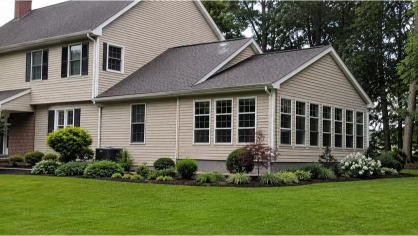
A home addition is a structural expansion of an existing house — new square footage built onto or above the current footprint. Homeowners pursue additions when they’ve outgrown the existing space, when internal reconfiguration can’t solve the problem, or when they want a specific room type that the house simply doesn’t have.
Additions are significant projects. They involve foundation work, structural framing, roof construction, utility extensions, permits, and inspections. They take months rather than weeks. And they cost considerably more than interior renovations of similar square footage because they require building new structure from the ground up.
They’re also among the highest-return home improvement investments when the scope matches the house and the neighborhood. A well-executed addition adds permanent usable space, resolves a genuine functional problem, and increases resale value in ways that furniture and cosmetic improvements can’t.
This guide covers the main types of home additions, when each makes sense, what drives complexity and cost, and how to start planning. For information about working with us on your specific project, visit our home addition services page.
Main types of home additions
Not all additions are the same project. The type of addition you’re considering determines the structural approach, the permit requirements, the timeline, and a significant portion of the cost. Here’s how the main types differ.
First-floor room additions
A ground-floor addition extends the house horizontally — out the rear, side, or sometimes front. It requires a new foundation along the addition perimeter, new exterior walls, and a roof that ties into the existing structure. First-floor additions are the most common type and cover a wide range of room types: a family room, a bedroom, an expanded kitchen, or a combination of rooms.
The main constraint is the lot. Township zoning setback requirements determine how close to the property lines the addition can extend — typically 25 to 30 feet from the rear line and 10 to 15 feet from the side line in most Bucks County and Montgomery County municipalities. The buildable area between the house and those setback lines determines how much square footage is possible.
Second-floor additions
A second-floor addition builds living space above an existing single-story portion of the house, or adds a full second story above the entire first floor. It avoids expanding the ground-level footprint, which matters on smaller lots, but requires more structural work — assessing whether the existing first-floor walls can carry the additional load, removing and replacing the roof over the area being built above, and routing utilities through the floor structure.
Second-floor additions are well suited for ranch homes and single-story houses where the lot doesn’t support a first-floor expansion. For a detailed look at what this project type involves, see our article on adding a second floor.
Master suite additions
A master suite addition is a specific type of addition built to create a private primary bedroom, ensuite bathroom, and walk-in closet. It’s one of the most commonly requested addition types because it solves several problems at once: undersized bedroom, shared bathroom, and inadequate closet space.
The bathroom component makes master suite additions more construction-intensive than a simple room addition of similar square footage. Plumbing supply and drain lines, waterproofing, tile work, and ventilation all add scope that a bedroom-only addition doesn’t require.
For full planning detail on this addition type, see our master suite addition guide.
Kitchen bump-outs and expansions
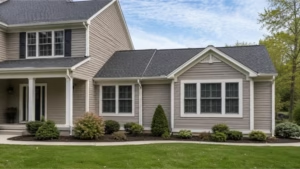
A kitchen bump-out is a smaller addition — typically 50 to 150 square feet — that extends an existing kitchen a few feet outward to create more floor space, counter space, or room for a larger island. It’s less expensive than a full room addition because the new foundation and roof area is smaller, but it still requires the same structural steps: footings, framing, roof tie-in, and finishing.
Larger kitchen additions — expanding into an adjacent room or extending the kitchen to include a dedicated dining space — involve more foundation and framing scope. They often also require reconfiguring the kitchen layout to take advantage of the new square footage, which means the addition and the kitchen renovation happen together.
Bathroom additions
Adding a bathroom where one doesn’t exist — a half bath on the main floor, a full bathroom in a basement, a bathroom adjacent to a guest bedroom — is sometimes done as a standalone project and sometimes as part of a larger addition. The plumbing scope is the primary cost driver: drain lines, supply lines, and ventilation all have to reach the new bathroom from the existing house systems.
Where the new bathroom is located in the house determines how complex the plumbing routing is. A bathroom directly above or adjacent to existing wet walls is far easier and less expensive to plumb than one that requires running drain lines across the house or through a slab.
Garage conversions and garage additions
A garage conversion repurposes existing garage space as habitable living area without adding new square footage. It typically involves insulation, subfloor work, HVAC, electrical, and closing or replacing the garage door wall. A garage addition builds new living space above an existing garage or constructs a new garage with living space above.
Garage conversions are often considered as a lower-cost alternative to a full addition. The cost gap is real but smaller than most homeowners expect, and the tradeoffs are real: losing garage parking affects daily use and can affect resale. Our article on garage conversion covers the honest assessment of when this makes sense.
When a home addition makes sense
An addition is the right answer to a specific set of problems — not to every space problem. Understanding when an addition is genuinely the best solution helps avoid committing to a major project when a less expensive alternative would work.
The house is at room capacity
When a household needs more bedrooms or specific room types — a home office, a dedicated playroom, a guest suite — and the house is already using every room for a necessary function, there’s no internal reconfiguration that creates new rooms. Adding square footage is the only path.
The existing layout has a structural problem
Some homes have layouts that simply don’t work for how the household lives — a kitchen that’s genuinely too small to function well for the people using it, a primary bedroom with no private bathroom, or a single-story house that can’t accommodate a growing family without taking over every room. Interior renovation can sometimes address these, but sometimes the only real solution is more space.
The alternative is moving
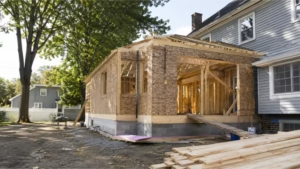
For households that are otherwise well situated — good neighborhood, good school district, established roots — the cost of an addition can compare favorably to the transaction costs of selling and buying, plus the premium for a larger house in the same area. This calculation is worth doing concretely before assuming moving is cheaper.
The lot and zoning support it
An addition is only feasible if the lot has room for it within zoning setback requirements and the existing structure can connect to new construction in a way that makes structural and aesthetic sense. This feasibility check happens early in the planning process and determines whether an addition is possible before design begins.
What affects complexity and cost
Addition cost in Bucks County and Montgomery County typically ranges from $150 to $350 per square foot of finished space depending on scope and finish level. Several factors move that number significantly.
Foundation type and site conditions
Every ground-floor addition requires a new foundation. Pennsylvania’s frost line — typically 36 to 42 inches depending on the township — determines how deep the footings must go. Soil conditions, site access, and whether the addition is over a crawl space, slab, or partial basement all affect foundation cost.
Structural connection to the existing house
The addition has to connect structurally to the existing house through foundation, floor, wall, and roof systems. If the connection requires cutting through a load-bearing wall, engineering review and beam installation are required. If the connection is straightforward — a new door opening in a non-bearing wall — the structural scope is simpler.
Roof tie-in
Every addition needs its roof integrated with the existing roof. A simple shed or gable addition ties in cleanly. More complex roof integrations — matching unusual pitches, working around dormers, creating valleys in difficult locations — add scope and require careful flashing detail. The roof tie-in is where long-term moisture management is either secured or compromised.
Utility extension
New square footage needs heat, cooling, ventilation, and electrical circuits. HVAC is either extended from the existing system or supplemented with a new unit. Electrical circuits run from the existing panel. Bathrooms or kitchens in the addition require plumbing supply and drain lines. Each of these needs to be assessed for feasibility and cost during the planning phase.
Permit scope
All additions in Pennsylvania require building permits. The permit process involves plan review, multiple inspections (foundation, framing, rough mechanical, insulation, final), and sometimes zoning board review for variances. Permit timelines vary by township — some municipalities in this area process applications within two weeks, others take considerably longer. We manage permit coordination as part of every project we handle as general contractor.
Finish level
Foundation, framing, and mechanical work are relatively fixed in cost for a given scope. Finish level — flooring, trim, tile, fixtures, cabinetry — is where homeowner choices move the final number. The same structural shell can be finished simply for one budget or elaborately for another.
Addition vs reconfiguring existing space
Before committing to an addition, it’s worth honestly evaluating whether internal reconfiguration addresses the real problem. Sometimes it does — at significantly lower cost and shorter timeline.
Reconfiguration is worth considering when the household has underused rooms that could be repurposed, when the existing space is large enough but poorly organized, or when the need is primarily a different room configuration rather than more total square footage.
An addition is the clearer choice when the house is genuinely at room capacity, when the specific space type needed (a larger kitchen, a master suite, a home office that doesn’t displace a bedroom) doesn’t exist and can’t be created by repurposing what’s there, or when the household needs to stay in the house while solving a space problem that would otherwise require moving.
The honest assessment of which path is right depends on the specific house and the specific need. We discuss this during estimate conversations so homeowners can make the decision with accurate information rather than assumptions.
What to decide before requesting estimates
Getting useful, comparable estimates for an addition project requires clarity on a few key questions before anyone comes to the site. Without these decisions made, different contractors will base their estimates on different assumptions and the quotes won’t be comparable.
- Purpose of the addition — what specific problem is the addition solving? More bedroom space, a private primary suite, a larger kitchen, a dedicated workspace? The purpose drives the room type and the functional requirements.
- Location on the house — rear extension, side extension, second floor, or above garage? Even a rough preference helps because structural and utility implications differ significantly by location.
- Approximate size — not exact square footage, but a general sense of scale: a targeted bump-out (100–200 sq ft), a standard room addition (200–400 sq ft), or a larger multi-room addition.
- Bathroom or kitchen component — does the addition include a new bathroom or kitchen? These are the most construction-intensive elements and have the largest effect on cost.
- First floor or second floor — each has different structural and utility implications. A first-floor addition on a constrained lot may not be feasible; a second-floor addition requires different structural assessment.
- Budget range — a rough sense of the budget helps the contractor assess whether the desired scope is realistic and where tradeoffs may be needed.
Arriving at an estimate conversation with these questions answered — even roughly — produces a more accurate and useful quote. It also allows for honest early discussion of what’s feasible given the lot, the existing structure, and the budget.
Addition types in depth — where to go next
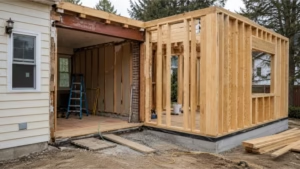
Each addition type has its own planning considerations, cost drivers, and construction complexity. If you’re already thinking about a specific type of addition, the following articles go deeper on each one:
- Master suite addition — what’s included, where it can be built, what makes it complex, and how to plan before getting estimates.
- Adding a second floor — full second-story additions and above-existing-footprint second-floor additions: structural considerations, cost, and timeline.
- Garage conversion — when converting a garage to living space makes sense, what construction it actually involves, and how it compares to building new.
If you’re not sure which addition type fits your situation, that’s a conversation we have regularly with homeowners in the early planning phase. We can help assess what’s feasible for your specific property before any design commitment.
Ready to talk about an addition?
We serve homeowners throughout Bucks County, Montgomery County, Philadelphia, and Mercer County NJ. We have an in-house architect, structural engineer, and designer — which means for addition projects that require design and engineering, we manage the full process from planning through permitted construction without the homeowner having to coordinate those professionals separately.
Call us at 609-712-2750 or request a free estimate online. We’ll come to your property, look at what’s feasible for your lot and existing structure, and give you an honest assessment of what the project involves and what it will realistically cost.


