
- By Saveli
- In Kitchen and bath
How to Choose a Countertop for White Kitchen Cabinets — The Selection Process That Actually Works
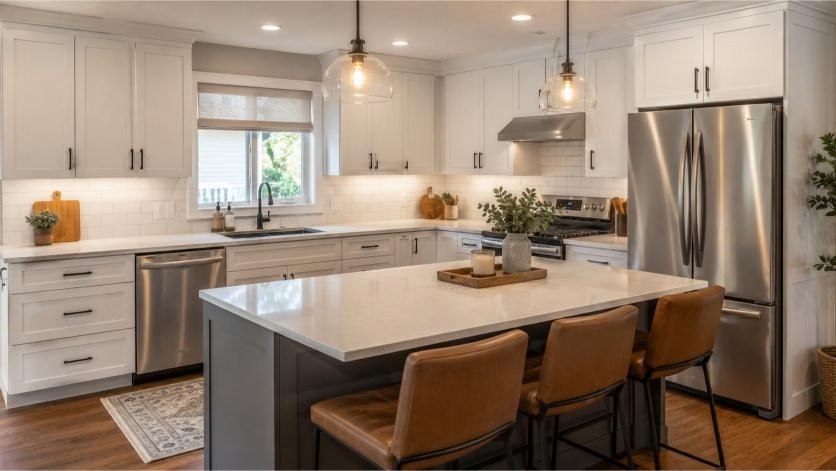
Most homeowners choosing a countertop for white kitchen cabinets approach the decision the same way: they look at photos online, find a countertop they like, order a sample or two, and hold them up in the kitchen. The sample that looks closest to what they saw in the photo usually wins.
This process produces a surprising number of kitchens where the countertop and cabinets don’t look right together — not obviously wrong, but slightly off in a way that’s hard to name. The countertop looks warmer than expected, or cooler, or the two surfaces seem to fight each other in a way that wasn’t apparent from the sample.
The problem isn’t the countertop selection. It’s the selection process. Choosing a countertop for white cabinets requires understanding what type of white the cabinets actually are before evaluating any countertop. It requires testing samples in the actual kitchen under actual light rather than against a white sheet of paper in a store. And it requires seeing how the countertop reads in combination with all the other finishes in the kitchen — the floor, the backsplash, the hardware — not in isolation.
This article is about that process. For an overview of which countertop color directions tend to work well with white cabinets, see our guide to countertop colors for white cabinets. This article focuses specifically on how to evaluate and compare options before committing — the steps that determine whether the countertop you chose looks the way you expected it to.
Start by identifying your cabinet’s undertone — this changes everything
White cabinets are not a single color. They span a wide spectrum from warm, cream-toned whites to cool, blue-toned whites, with dozens of variations in between. The undertone of your specific cabinet finish — warm or cool — is the most important factor in determining which countertop will look right with it.
Cool white cabinets
Cool white cabinets have blue, gray, or green undertones. They read as crisp and clean in warm light, and can read slightly cold in cooler light. Examples in the paint world: Benjamin Moore Chantilly Lace, Sherwin-Williams Extra White, and similar true whites with no yellow content.
Cool white cabinets generally work better with countertops that have cool or neutral undertones — gray-veined quartz, cool white marble looks, medium to dark charcoal surfaces. They can work with warm countertops but the contrast has to be intentional and executed with enough other warm elements in the space (hardware, flooring, backsplash) to create coherence rather than conflict.
Warm white cabinets
Warm white cabinets have yellow, cream, or beige undertones. They read as softer and more inviting than true white, and they’re particularly common in older colonial-style homes in Bucks County and Montgomery County where antique white or off-white finishes have been standard for decades.
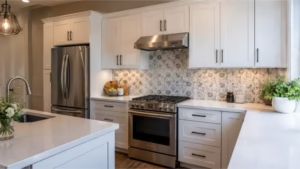
Warm white cabinets generally work better with countertops that have warm undertones — cream, beige, warm gray, or warm white surfaces. Pairing a warm white cabinet with a countertop that has cool gray-blue veining creates an undertone clash that’s difficult to resolve with other elements in the space.
How to identify your cabinet’s undertone
Hold a pure white piece of paper against your cabinet door. If the cabinet looks slightly yellow, cream, or beige next to the paper — it’s warm. If the cabinet looks similarly white or slightly cool — it’s on the cooler end. You can also hold a gray piece of paper against the cabinet: if the gray reads as slightly warm or green next to the cabinet, the cabinet is cooler. If the cabinet looks warm by comparison, it’s on the warmer end.
This exercise is worth doing before you look at a single countertop sample. Knowing the undertone direction of your cabinets gives you a filter for every countertop you evaluate afterward.
How to compare countertop samples correctly
The difference between a successful countertop selection and one that produces regret is almost always in how samples were tested. The following process consistently produces better results than evaluating samples on their own.
Step 1 — Get a cabinet door sample first
If your cabinets are being selected as part of a kitchen renovation, get a physical door sample from the cabinet manufacturer before you evaluate any countertops. If your cabinets already exist and you’re replacing only the countertop, photograph the cabinet under your kitchen’s natural light and bring that photo when evaluating countertop samples — but better still, bring a small section of the cabinet door or door trim if you can.
The countertop sample has to be evaluated against the actual cabinet, not against your memory of it or a photo from a website. Undertone relationships that aren’t visible in either sample independently become visible when they’re placed next to each other.
Step 2 — Bring samples home before deciding
Every countertop sample that’s in serious consideration should be brought home and placed in the kitchen. Not evaluated in the showroom, not chosen from a 4×4 inch chip against a white background. In the kitchen, where it will actually live, under the kitchen’s actual light, next to the cabinet door sample.
Most showrooms will lend or sell samples for this purpose. Some stone yards will let you take a small remnant piece home. The time this takes is minimal compared to the cost of discovering the countertop doesn’t look right after it’s been fabricated and installed.
Step 3 — Evaluate at different times of day
Morning light, afternoon light, and evening light with your kitchen fixtures on can all make the same countertop sample look meaningfully different. A sample that looks like a clean warm white at noon in south-facing light can look slightly yellow in morning shadow. A gray-veined quartz that looks sophisticated under warm evening light can look cooler and flatter in the afternoon glare from a west-facing window.
This isn’t a reason to choose a different countertop — it’s information about what you’re actually committing to. Knowing how the surface reads across different light conditions helps you make the decision with full information rather than based on one favorable moment in the showroom.
Step 4 — Place the countertop sample adjacent to the floor and backsplash
The countertop is visually adjacent to three surfaces simultaneously: the cabinet above it, the backsplash behind it, and the floor below it. A countertop that reads well against the cabinet alone may conflict with the floor or fight with the backsplash direction.
If the floor is already in place, put the countertop sample on the floor in the kitchen. If backsplash tile is being selected at the same time, put all three samples together: cabinet door, countertop sample, backsplash tile sample. The combination tells you far more than any single sample tells you in isolation.
Step 5 — Evaluate the veining at the right scale
A 4-inch countertop sample shows a small fraction of the slab’s veining pattern. Veining that appears once in a 4-inch sample may repeat every few inches across your full countertop — or the sample may have caught the most dramatic portion of the slab and the rest is much calmer. For any stone with significant movement, viewing the actual full slab before committing is worth the trip to the stone yard.
This is particularly important for Calacatta-style quartz and natural marble. The difference between a slab with dramatic veining throughout and one with a single bold vein against a mostly plain background is significant at countertop scale and nearly invisible in a 4-inch sample.
How lighting changes what your countertop looks like
Lighting is the most underestimated factor in countertop selection. The same slab looks different in every lighting environment, and most homeowners evaluate samples in showroom lighting that has little relationship to their actual kitchen’s lighting conditions.
Warm vs cool artificial light
Kitchen lighting with warm LED or incandescent bulbs (2700K to 3000K color temperature) adds yellow-orange warmth to every surface. Warm whites look warmer, beige countertops look richer, and cool gray surfaces can look more neutral than they truly are under cool light. If your kitchen uses warm lighting and you evaluate a countertop sample under cool daylight or cool-white LED showroom lighting, you’re seeing a version of the countertop that doesn’t exist in your kitchen.
If your kitchen renovation is replacing light fixtures, determine the color temperature of the new fixtures before finalizing countertop selection. A countertop chosen to work with warm lighting can look different under cool-white under-cabinet LEDs installed as an afterthought.
Natural light direction
Kitchens with south or west-facing windows receive warm, directional light for most of the day. This light makes warm surfaces richer and can make cool surfaces look more neutral. Kitchens with north or east-facing windows receive cooler, more diffused light that emphasizes cool tones and can make warm surfaces look slightly muddy or dull if they’re not warm enough to read well in cool light.
The direction your kitchen faces affects which countertop tones will look their best in your specific space. A countertop that photographs beautifully in a south-facing kitchen may not produce the same result in a north-facing one. This is part of why evaluating samples in your actual kitchen matters more than evaluating them in any other environment.
Shadows and under-cabinet lighting
The underside of upper cabinets creates a shadow zone directly above the countertop surface. Without under-cabinet lighting, the countertop in this zone reads darker and cooler than it does in the center of the room. Under-cabinet lighting — warm or cool LED strips — illuminates the countertop surface near the wall and affects how the surface reads in that zone.
If your renovation is adding under-cabinet lighting, the sample evaluation should include a moment of holding the sample near the wall in your kitchen to simulate the under-cabinet zone — and considering how the under-cabinet light temperature will interact with the countertop color.
Countertop directions that tend to hold up across different white cabinet tones
Some countertop directions are forgiving enough to work across a range of white cabinet tones without requiring perfect undertone alignment. These are useful starting points for homeowners who are uncertain about their cabinet’s specific undertone.
Soft white with subtle movement
A white or very light quartz with fine veining or subtle variation in tone tends to be forgiving. It reads as part of the cabinet family rather than contrasting against it, and the subtle movement prevents the kitchen from feeling flat. This approach works with both warm and cool white cabinets because the countertop itself is neutral enough that undertone conflicts are less visible.
Medium gray with soft veining
Medium gray quartz is one of the most versatile countertop choices for white cabinets. It provides clear separation between countertop and cabinet without dramatic contrast, and gray is neutral enough in temperature to work with both warm and cool white cabinet finishes. It reads as neither particularly warm nor particularly cool, which reduces the risk of undertone conflict.
Warm beige or greige
Beige and greige (gray-beige blend) countertops work particularly well with warm white cabinets. They add warmth to the lower half of the kitchen without the dramatic contrast of a dark surface. The risk is undertone mismatch — a beige countertop with pink undertones against a cool white cabinet creates visible tension. Testing beige options against the specific cabinet door is especially important.
Darker contrast surfaces
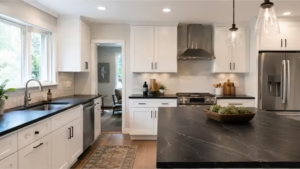
Black, charcoal, or deep-toned countertops against white cabinets create strong visual contrast that’s effective in the right context. The risk is maintenance — dark polished surfaces show water spots, fingerprints, and crumbs more than lighter or matte surfaces. A dark countertop with some movement or texture shows less than a uniform flat-dark surface. This direction is bold rather than safe, and the maintenance reality should be part of the decision.
The most common mistakes in the selection process
Choosing the countertop before seeing the cabinet in person
Online photos of cabinet finishes don’t accurately represent the undertone of the actual product. A cabinet that looks like a clean neutral white on screen often has a distinct warm or cool undertone in person that changes which countertop works with it. The cabinet selection needs to happen first, or at minimum simultaneously, with a physical sample in hand.
Evaluating samples on a white background
A countertop sample placed on a white sheet of paper tells you what the countertop looks like next to white. It doesn’t tell you what it looks like next to your specific cabinet finish, your floor, or your backsplash. Every sample evaluation that matters should happen against the adjacent finishes, not against a neutral white background.
Choosing too much contrast
A very dark countertop against a bright white cabinet creates a striking result that photographs well. It also requires precise design execution everywhere else in the kitchen to prevent it from feeling visually heavy. High contrast combinations work best when the backsplash provides a visual bridge, hardware is chosen deliberately to mediate between the two extremes, and there’s enough natural light to prevent the dark surface from dominating. Going into a high-contrast selection without understanding those conditions tends to produce kitchens that feel heavier in person than they looked in inspiration photos.
Assuming the showroom sample matches what will be fabricated
Quartz samples are consistent because quartz is manufactured. Natural stone samples are not consistent — the sample represents one portion of one slab, and the slabs in the fabricator’s yard on the day you order may look different. For any natural stone countertop, seeing and selecting the actual slabs that will be used in your kitchen is the only way to know exactly what you’re getting.
How the countertop connects to the rest of the kitchen design
The countertop doesn’t exist independently. It’s visually adjacent to the backsplash, visually separated from the floor by the cabinet base, and viewed alongside hardware finishes throughout the day. Getting the countertop right in relation to the cabinet is the first step — getting it right in relation to everything else is the full process.
If the backsplash is also being selected, countertop and backsplash should be chosen as a pair, not sequentially. A heavily veined countertop limits the backsplash to something simple — subway tile, a solid color, a minimal pattern. A simple countertop gives the backsplash more design freedom. Making one decision without the other results in combinations that each seemed right and fight each other in the finished kitchen.
Hardware finish is another element that interacts with the countertop. Warm brushed gold hardware reads differently against a cool gray countertop than against a warm beige one. Matte black hardware against a white countertop with black veining creates a different effect than matte black against a plain white surface. These relationships are part of the kitchen design conversation, not accessories to figure out after construction.
For more on how kitchen design decisions work together before a renovation begins, visit our kitchen design page. For information on our kitchen renovation scope and what a kitchen remodeling project involves, visit those pages for full detail. And for how countertop choices affect overall project cost, see our kitchen renovation cost guide.
Planning a kitchen renovation?
If you’re planning a kitchen renovation in Bucks County, Montgomery County, or surrounding areas of Pennsylvania and want to work through countertop selection alongside cabinet direction, backsplash, and overall kitchen design with someone who understands how the decisions connect to what’s actually being built — call us at 609-712-2750 or request a free estimate online.
Our kitchen showroom in Horsham at 390 Easton Rd has installed cabinet displays and countertop samples you can evaluate in combination before finalizing any selection.


