
- By Saveli
- In Uncategorized
Kitchen Addition vs Kitchen Bump-Out — Which One Do You Actually Need?
A kitchen that doesn’t have enough space is one of the most common reasons homeowners start thinking about a renovation. The existing kitchen feels cramped, there’s no room for a proper island, the dining area is squeezed into a corner, or the layout makes cooking and cleanup genuinely difficult.
Not every kitchen space problem requires a full addition. Sometimes a targeted bump-out — pushing one wall of the kitchen out a few feet — resolves the core issue without the scope and cost of building a new room. Other times, the kitchen is so undersized or so poorly positioned that a bump-out won’t make a meaningful difference, and a full addition is the only path to a kitchen that actually works.
Understanding which option fits your situation before you start talking to contractors helps you get accurate estimates and make a better decision. This article explains the difference between the two, when each makes sense, and what drives the cost of each.
This article is part of our home additions guide cluster. For information about our addition work, visit the home addition services page. For information about kitchen renovation work specifically — cabinets, countertops, layout, and renovation cost — visit our kitchen remodeling page.
Kitchen addition vs kitchen bump-out — what’s the difference?
A kitchen bump-out
A bump-out extends one wall of an existing kitchen outward by a relatively small amount — typically 2 to 6 feet. It adds square footage to the kitchen without creating a fully separate room. The result is a larger version of the existing kitchen: more floor space, more counter space, room for an island or a breakfast nook that didn’t fit before.
A bump-out involves the same structural work as a larger addition — new foundation, new framing, a new roof section that ties into the existing structure, new exterior finish — but over a smaller area. Because the new footprint is smaller, foundation and roof scope is proportionally less. The tradeoff is that cost per square foot is often higher than a full addition, since the fixed costs of construction are spread over fewer square feet.
A full kitchen addition
A full kitchen addition extends the kitchen more substantially — typically 100 to 300 or more square feet — and may incorporate adjacent spaces like a dining room, a family room, or a breakfast area that becomes part of the expanded kitchen zone. It involves more foundation, more framing, and more roof area than a bump-out, and typically also involves a more significant kitchen renovation to take advantage of the new footprint.
A full kitchen addition is appropriate when the existing kitchen is genuinely too small to function well regardless of how the layout is adjusted, when the goal is to combine the kitchen with an adjacent space to create an open-concept floor plan, or when the household needs both more kitchen workspace and a dedicated dining or seating area that the existing footprint simply cannot accommodate.
When a kitchen bump-out makes sense
You need a modest amount of additional space
If the existing kitchen is generally functional but specific elements don’t fit — an island you want but can’t place without blocking circulation, a dining table that crowds the space, a second work zone that would require 18 more inches of counter — a bump-out of 2 to 4 feet on one wall may be enough to resolve it.
The key question is whether the extra square footage from a bump-out changes the kitchen’s usability in a meaningful way. If the kitchen is 120 square feet and needs to be 180 square feet to work, a 60 square foot bump-out achieves that. If the kitchen needs to be 350 square feet to accomplish what you want, a bump-out won’t get you there.
You want to create room for an island or seating
One of the most common bump-out applications is creating space for a kitchen island. An island needs approximately 42 to 48 inches of clearance on all sides for comfortable circulation. In a kitchen that’s 12 feet wide, there often isn’t room for an island of useful size with adequate clearance. Pushing the rear or side wall out 3 to 4 feet creates the floor area needed without building a full new room.
Similarly, a bump-out of 4 to 6 feet can create room for a small breakfast nook or a built-in dining banquette at the end of the kitchen — a seating area that’s part of the kitchen space rather than a separate dining room.
The existing kitchen layout is otherwise sound
A bump-out makes the most sense when the existing kitchen’s position in the house, its relationship to the dining area and living space, and its basic layout are functional — the only problem is that it’s a few feet too small in one direction. When the kitchen’s fundamental layout needs to change, or when the goal is to reconfigure how the kitchen relates to adjacent rooms, a bump-out is unlikely to accomplish that on its own.
Budget fits a smaller scope
A bump-out costs less than a full addition — not proportionally less on a per-square-foot basis, but less in total because less is being built. For homeowners whose budget supports a bump-out but not a full addition, getting the right smaller scope done well is more valuable than attempting a larger scope that the budget can’t realistically complete.
When a full kitchen addition makes sense
The kitchen is genuinely undersized
In many homes in Bucks County and Montgomery County built before 1970, the kitchen was designed for a different way of living — a single person cooking, with meals eaten in a separate formal dining room. A kitchen of 80 to 100 square feet in a house where multiple people cook and where the kitchen is the primary gathering space isn’t a layout problem. It’s a size problem that a bump-out of 4 feet may not meaningfully resolve.
When the kitchen needs to roughly double in size to function the way the household actually lives, a full addition is the appropriate scope.
The goal is an open-concept floor plan
Many renovation projects in this area involve opening a closed kitchen to an adjacent dining room or family room to create a combined, open-concept living space. This often involves removing a wall between the kitchen and the adjacent room — which may or may not be load-bearing — and reconfiguring the kitchen layout around the expanded combined footprint.
If the adjacent room the kitchen is opening into is already adequate in size, this can be accomplished through interior renovation rather than addition. If additional square footage is needed beyond what already exists in the adjacent rooms, an addition that expands the combined footprint is required.
A dedicated dining or seating area is needed that doesn’t exist elsewhere
Some households want a kitchen with a proper dining area — space for a full-size table, not just a breakfast bar — and don’t have a dining room to draw from. Creating that combined kitchen-and-dining space from a small existing kitchen typically requires more square footage than a bump-out provides.
The existing layout has a structural problem that limits the kitchen
If the kitchen’s position in the house is fundamentally wrong — it’s at the end of a long circulation path, it doesn’t connect to the outdoor entertaining area, or it’s isolated from the main living space in a way the household dislikes — adding square footage without addressing the relationship between spaces won’t solve the real problem. These situations sometimes require a more significant scope that a bump-out alone can’t address.
What affects construction complexity
Both a bump-out and a full kitchen addition involve the same categories of construction work. What differs is the scale of each category.
Foundation
Every new footprint — even a small bump-out — requires a new foundation along its perimeter. In Pennsylvania, footings must extend below the frost line, typically 36 to 42 inches deep. For a bump-out, the foundation perimeter is short. For a full addition, it’s longer. Both require excavation, forming, and concrete work before above-grade framing begins. Foundation work is a fixed-cost component that makes small bump-outs relatively expensive per square foot compared to larger additions.
Roof tie-in
The new roof over the addition has to integrate with the existing roof. A simple shed roof sloping away from the house is the cleanest option and the least complex. A roofline that attempts to match the existing pitch and create a seamless extension involves more framing and more precise flashing at the junction. For both bump-outs and full additions, the roof tie-in is where moisture problems originate when it’s not done carefully.
Load-bearing wall changes
If the kitchen expansion involves removing a wall between the existing kitchen and an adjacent room — to create an open floor plan rather than just adding square footage — that wall may be load-bearing. Removing a load-bearing wall requires installing a beam to carry the load above, sized and positioned by a structural engineer. This adds scope and cost to the project but is standard work. It needs to be identified during the design phase, not discovered during demolition.
Plumbing relocation
If the kitchen expansion involves moving the sink to a new wall, adding a prep sink in an island, or repositioning the dishwasher, plumbing lines have to be rerouted. This is a meaningful cost addition. Keeping the sink and dishwasher in their existing location — or directly across from it — keeps plumbing scope contained. Moving them across the room or adding new fixture locations adds $1,500 to $4,000 or more depending on what’s involved.
Electrical and HVAC
New kitchen circuits — for appliances, under-cabinet lighting, island outlets — run from the existing panel. If the panel is near capacity, an upgrade may be needed. HVAC is extended to the new space, either from the existing system or via a supplemental unit if the existing system doesn’t have capacity. Both need to be assessed during planning.
Exterior integration
The addition’s exterior — siding, roofing, windows — needs to integrate with the existing house visually. Mismatched siding material or windows that don’t coordinate in style with the rest of the house create a result that reads as added on rather than designed. Exterior design coordination is a planning decision, not a finishing detail.
What drives cost
For detailed kitchen renovation cost ranges, see our kitchen renovation cost guide. Here’s how addition scope specifically affects the total project cost.
Size of the new footprint
A bump-out of 4 feet on a 15-foot kitchen wall adds 60 square feet. A full addition of 20 feet adds 300 square feet. More square footage means more foundation, more framing, more roofing, more insulation, more drywall, more flooring. The total cost scales with size even if the per-square-foot cost decreases somewhat as the addition gets larger.
Kitchen renovation triggered by the addition
A kitchen expansion almost always triggers a kitchen renovation. Adding square footage to a kitchen with 1990s cabinets and original countertops while leaving everything else in place produces an inconsistent result. The cost of the new cabinets, countertops, and appliances in the expanded kitchen is often comparable to or larger than the structural cost of the addition itself.
This is important to understand when budgeting: a kitchen addition is typically not just the cost of building the new structure. It’s the cost of the structure plus a full or partial kitchen renovation to make the expanded space coherent. These two scopes need to be estimated together, not separately.
Plumbing and electrical changes
A kitchen addition that keeps plumbing in place is significantly less expensive than one that moves the sink, adds an island sink, or reconfigures the dishwasher location. Similarly, an addition that adds modest electrical scope — a few new circuits and outlets — costs less than one that requires a panel upgrade plus new circuits throughout an expanded kitchen.
Finish level of the renovation
Stock cabinets and laminate countertops in the expanded kitchen produce a different budget than semi-custom cabinets and quartz countertops. Both are valid choices — but the kitchen renovation finish decisions have a larger effect on total project cost than many homeowners anticipate when they’re focused on the addition scope.
Common planning mistakes
Assuming a bump-out will solve a problem that requires a full addition
The most common mistake is deciding on a bump-out because it sounds less expensive and less disruptive, before honestly assessing whether the amount of space it adds actually resolves the problem. A 4-foot bump-out that adds 60 square feet to a 90-square-foot kitchen produces a 150-square-foot kitchen. If the household needs 250 square feet to accomplish what they want, the bump-out hasn’t solved the problem — it’s just added cost without meaningful functional improvement.
Not thinking about the kitchen layout early enough
The cabinet and appliance layout in an expanded kitchen has to be designed before the addition’s framing is finalized. Where the island goes, where the range hood vents, where the refrigerator alcove is positioned — these decisions affect where structural elements go and where utility rough-ins need to be placed. Treating the kitchen layout as something to figure out after the addition is framed produces a finished kitchen that doesn’t work as well as it should.
Ignoring the roofline impact
A kitchen bump-out or addition changes the roofline of the house on that side. On a simple rear extension, this is usually manageable. On a house with a complex existing roofline — multiple pitches, hip roof, dormers — the roof tie-in requires more design attention. Homeowners who focus only on the floor plan and ignore the roof often get surprised by how the exterior looks or by the cost of a complex roof junction.
Budgeting for the addition but not the renovation
Planning for the structural addition cost but not the kitchen renovation that follows it is a predictable budget shortfall. Every kitchen expansion triggers some level of kitchen renovation work. Getting a realistic estimate for the full project scope — addition and renovation together — before committing is far better than discovering mid-project that the renovation cost wasn’t in the budget.
What to decide before requesting estimates
Having clear answers to these questions before a contractor visits produces estimates that reflect the same scope and can be meaningfully compared.
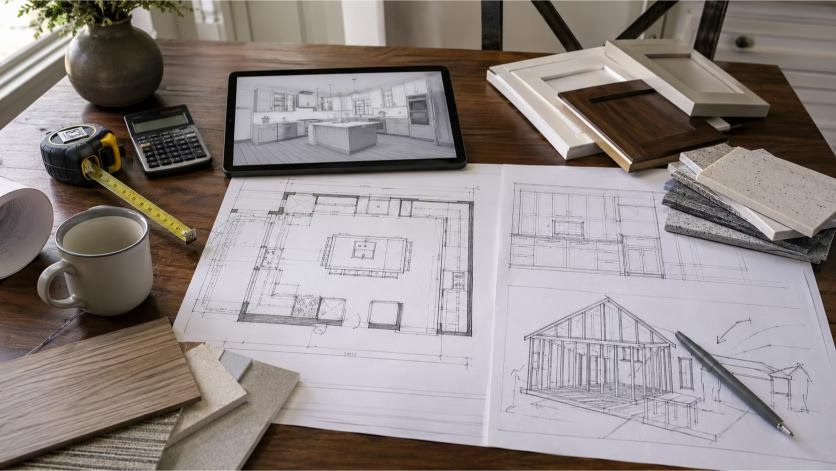
- How much additional space do you actually need? — sketch the kitchen layout you want and count the square footage. Compare that to what you have. The gap tells you whether a bump-out or full addition is the right scope.
- What specifically is the kitchen missing? — is it an island, a dining area, more counter space, better circulation? Specific functional goals help size the addition correctly.
- Does the kitchen renovation happen at the same time? — most homeowners renovate the kitchen as part of the expansion. Deciding whether to do both together or phase them affects how the addition is scoped and how the budget is organized.
- Where will the addition go? — rear of the house, side? Does the proposed direction have adequate setback from the property line? A rough sense of the preferred direction helps the contractor assess feasibility quickly.
- Are layout changes needed inside the existing house? — removing a wall between the kitchen and an adjacent room, relocating a back door, reconfiguring the pantry? Interior changes that follow the addition are separate scope but need to be included in the full estimate.
- What’s the budget range? — a rough budget expectation lets the contractor identify whether the desired scope is realistic and where tradeoffs may need to be made between addition size and renovation finish level.
Planning a kitchen addition or bump-out?
We work with homeowners throughout Bucks County, Montgomery County, Philadelphia, and Mercer County NJ on kitchen additions and bump-outs — from initial feasibility assessment and design through permitted construction and kitchen renovation.
Call us at 609-712-2750 or request a free estimate online. We’ll come to the space, look at the existing kitchen and the adjacent areas, and give you an honest assessment of what scope actually makes sense for your situation and what it will realistically cost.


