
- By Saveli
- In Uncategorized
What Adds the Most Cost to a Kitchen Remodel?
Two kitchens of similar size — same square footage, same neighborhood, same general quality level — can have remodeling budgets that differ by $30,000 or more. The homeowners are often genuinely surprised by this. They expected their kitchen to fall somewhere in the middle of the range they read about, and they’re not sure why it didn’t.
The answer is almost always a combination of the same factors: cabinet tier choice, layout decisions, structural or electrical changes, and the compound effect of premium selections across multiple categories simultaneously. Each decision is reasonable on its own. Together, they move the project to a different budget tier than the homeowner anticipated.
This article explains the specific decisions and conditions that drive kitchen renovation cost most significantly. Not “cabinets, countertops, and labor” as a generic list, but the mechanics of why each one moves the number, and by how much. For cost ranges by project type, the kitchen renovation cost guide covers that in detail. For the full scope of what our kitchen renovation work involves, see our kitchen remodeling page.
Cabinets — the largest single variable in most kitchen budgets
In a standard kitchen renovation, cabinetry represents 30 to 45 percent of the total project cost. No other single element comes close. This makes the cabinet tier decision — stock, semi-custom, or custom — the most consequential budget decision in the project.
Stock vs semi-custom vs custom
Stock cabinets are manufactured in fixed sizes and configurations, available immediately from home improvement retailers. They’re a legitimate choice for budget-conscious renovations and produce a good result when the kitchen layout works with standard sizing. Their limitation is that kitchens with non-standard dimensions end up with fillers — strips of cabinet material added to close gaps — which can look assembled rather than designed.
Semi-custom cabinets are available in smaller size increments, more configuration options, and a wider range of finishes and door styles. Lead time is typically 4 to 8 weeks from order to delivery. They cost more than stock but allow for a kitchen that fits the space properly rather than fitting the space to the cabinet. For most kitchen renovations in Bucks County and Montgomery County, semi-custom is where the best value is.
Full custom cabinets are designed and built specifically for a kitchen — any size, any configuration, built to whatever specification. They’re the highest-quality option and the most expensive by a significant margin. Lead times are longer. The cost premium over semi-custom is real, and whether it’s justified depends on the specific kitchen and the homeowner’s priorities.
The cost difference between stock and semi-custom in a standard kitchen is often $4,000 to $10,000. Semi-custom to full custom can add $10,000 to $25,000 or more. These are the largest single-decision cost jumps in a kitchen renovation.
Interior storage and organizational features
Pull-out base cabinet trays, drawer inserts, soft-close hardware, built-in spice pull-outs, waste bin pull-outs, and specialty corner solutions all add cost to the cabinet order. Each individual item is modest — $50 to $300 per feature depending on the manufacturer and complexity. Across a full kitchen with 15 to 25 cabinet boxes, selecting interior organizational upgrades throughout can add $2,000 to $5,000 to the cabinet order without changing a single door or exterior finish.
Finish and construction quality
Frameless (European-style) cabinet boxes are generally more expensive than face-frame construction. Plywood box construction is more expensive than particleboard. Dovetail drawer boxes cost more than staple-joined ones. Soft-close drawer slides and hinges cost more than standard hardware. None of these are visible in the finished kitchen, but they affect how the cabinets perform and how long they hold up. Understanding which quality features matter for daily use — and which are less impactful — helps prioritize the cabinet budget where it counts.
Layout changes
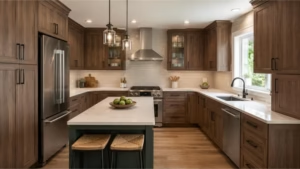
The kitchen layout — where the sink, range, refrigerator, and island are positioned — determines how the kitchen functions every day. It also determines a significant portion of the renovation’s plumbing, electrical, and sometimes structural cost.
Moving the sink
The kitchen sink is connected to supply lines and a drain. Moving it to a different wall, or even to a different position on the same wall, requires extending or rerouting the drain and supply lines. Kitchen drain lines are more complex than bathroom drain lines because the kitchen is typically further from the main stack and the drain may need to travel further or around more obstructions. Moving a kitchen sink adds $1,000 to $2,500 in plumbing scope depending on the distance and routing.
Adding a prep sink in an island
An island prep sink requires a drain run through the floor — the drain line has to travel from the island location to the main drain stack, typically through a finished basement ceiling or through a crawl space. This is more involved than a simple fixture swap and can add $1,500 to $3,000 in plumbing scope depending on the island position relative to the stack.
Relocating the range or adding a gas line
Moving a gas range requires extending or rerouting the gas line. If the kitchen is converting from electric to gas, a new gas line has to be run from the main gas supply, which may involve the gas company and a licensed plumber. If it’s converting from gas to electric, the electrical circuit for the new range (typically 240V, 50A) has to be run from the panel. Either direction adds scope beyond what a same-position appliance replacement would require.
Removing a wall to open the kitchen
Opening a kitchen to an adjacent dining or living space — removing the wall between them — is a common renovation goal and a meaningful cost driver. If the wall is load-bearing, a beam has to be installed to carry the load above. The beam size is determined by an engineer based on the span and what’s above. Installing a load-bearing beam requires a structural engineer’s specification, a building permit, a temporary support structure during construction, and beam installation before any finish work begins. This adds $3,000 to $8,000 to the project depending on the span and the beam size required.
Even a non-load-bearing wall removal involves demolition, electrical relocation (walls often have switches, outlets, and sometimes lighting circuits running through them), patching the floor and ceiling where the wall was, and repainting or retiling the affected areas.
Island addition
An island that requires no plumbing and no electrical work is primarily a cabinet and countertop cost. An island with a prep sink adds plumbing scope. An island with a cooktop adds gas or electrical scope plus a range hood and ventilation path. An island with seating and pendant lighting above adds electrical for the pendants. Each function added to the island adds cost proportionally, and they compound.
Countertops and surface choices
Countertops are the most visible finish surface in a kitchen and among the most discussed during the planning phase. The cost variation within countertops is real but narrower than homeowners often expect — the bigger impact is usually from the total linear footage and the fabrication complexity, not just the material.
Material category
Quartz is currently the most popular countertop material for kitchen renovations in this market, with good reason: it’s non-porous, durable, consistent in pattern, and available in a wide range of appearances. It costs more than laminate or tile and less than many natural stone options. Natural stone — granite, quartzite, marble — costs more in material and involves sealing requirements. The cost gap between mid-range quartz and comparable natural stone is $10 to $30 per square foot installed depending on the specific materials. On a typical kitchen, that’s $500 to $2,500 in total countertop cost difference.
Total linear footage and configuration
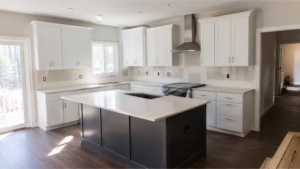
The amount of countertop in a kitchen is determined by the cabinet layout, not by the homeowner’s preference. More cabinets and longer runs mean more countertop. An L-shaped kitchen has less countertop than a U-shaped kitchen of the same footprint. An island adds countertop square footage on top of the perimeter runs. The total fabricated square footage multiplied by the per-square-foot installed price gives the countertop budget, and that number is largely set by the layout.
Edge profiles and waterfall details
A simple eased or beveled edge is the standard. An ogee or other decorative profile adds fabrication labor. A waterfall edge — where the countertop material continues vertically down the side of an island to the floor — requires additional material, precise mitering at the corner, and more installation time. A waterfall edge on both sides of an island can add $1,000 to $3,000 to the countertop cost depending on the material and the fabricator.
Backsplash coordination
Backsplash tile is typically less expensive than countertop material in total cost, but it’s often more visible and affects the kitchen’s overall character significantly. A simple subway tile backsplash in a stacked or offset layout is the cost baseline. A full-height backsplash behind the range, a statement tile in a complex pattern, or a natural stone backsplash to match the countertop each add cost in materials and labor. Tile labor cost is particularly sensitive to pattern complexity — diagonal or herringbone layouts take more time than standard layouts on identical square footage. For more on how countertop and backsplash selections work together in a white cabinet kitchen, see our article on countertop colors for white kitchen cabinets.
Electrical, plumbing, and structural work
Every kitchen renovation involves some electrical work. Most involve plumbing work at the sink. Some involve structural changes. This scope is the part of the project that’s least visible in the finished kitchen and most frequently underestimated in early budgeting.
Kitchen electrical requirements
A kitchen remodel that pulls a permit — which it should for anything beyond cosmetic changes — is inspected by a local building official. In most townships in Bucks County and Montgomery County, the inspection will require the kitchen to meet current electrical code. Many kitchens in homes built before 1990 don’t meet current code: they may have insufficient dedicated circuits for appliances, outlets that aren’t GFCI-protected near water sources, or insufficient counter-height outlet spacing. Bringing a kitchen to current code during a renovation is both required and worthwhile, but it adds electrical scope to what might have been planned as a cosmetic update.
Appliance circuits
A standard electric range requires a 240V, 50-amp circuit. A wall oven and separate cooktop each require their own 240V circuits. A microwave typically needs a dedicated 20-amp circuit. A dishwasher needs a dedicated circuit. A refrigerator with an ice maker needs a water line in addition to a standard outlet. If the kitchen is adding or upgrading any of these appliances, each one needs its circuit confirmed or installed as part of the electrical scope. Older homes with smaller panels may need a panel upgrade before these circuits can be added.
Range hood ventilation
A range hood that vents to the exterior requires a duct path from above the range through the cabinet above it and out through the exterior wall or through the ceiling to the roof. In a straight-line path, this is manageable. In a kitchen where the range is on an island, or where the duct path requires navigating around structural elements or multiple floors, the ventilation work is more involved. Ductless recirculating hoods are simpler to install but don’t remove moisture and grease from the kitchen as effectively as vented ones.
Lighting changes
Most kitchen renovations update lighting: new recessed can positions, pendant lights over the island, under-cabinet lighting, and sometimes a dedicated fixture over the sink. Each new fixture or repositioned fixture requires electrical rough-in before cabinets are installed. Under-cabinet lighting specifically needs to be planned before cabinet installation because the wiring runs inside or behind the upper cabinets — adding it after cabinets are installed is significantly more complicated. A full kitchen lighting upgrade adds $1,200 to $3,500 in electrical scope depending on the number of fixtures and the complexity of routing.
Appliances and finish selections
Appliances have a wider price range than almost any other product category in a kitchen renovation. A 30-inch freestanding electric range can cost $700 or $4,000. A refrigerator can cost $900 or $8,000. A dishwasher can cost $400 or $2,000. The product choices are real and the quality differences between price tiers are real — but the multiplier effect of choosing premium across every appliance simultaneously changes the total project budget significantly.
The practical approach is to identify which appliances the household uses most heavily and prioritize those. A household that cooks every night benefits more from a high-quality range than from premium refrigerator features. A household that rarely cooks can keep the appliance budget modest without affecting daily life. Spending at the right tier for the right appliances produces better outcomes than spending equally across all of them.
Hardware — cabinet pulls and knobs — is another category where the range is wide. At $3 to $5 per pull from a home improvement store versus $15 to $40 per pull from a specialty hardware retailer, a kitchen with 30 to 40 hardware pieces has a $100 to $200 hardware budget or a $600 to $1,600 one. Neither is wrong, but the difference is real across the full kitchen.
Hidden cost factors
Existing electrical limitations
Older homes in Bucks County and Montgomery County were built with electrical panels sized for the appliance loads of their era. A 100-amp panel that served a 1970s kitchen without a dishwasher, garbage disposal, microwave, or high-efficiency refrigerator may be at or near capacity before any new appliance circuits are added. If the renovation adds circuits that exceed panel capacity, a panel upgrade is required before those circuits can be installed. Panel upgrades are typically $1,500 to $4,000 depending on the service size and the work involved.
Uneven floors and walls
Kitchen cabinets are designed to be installed level and plumb. Houses are not always level and plumb — particularly older homes where floors have settled unevenly over decades. Cabinets installed on an uneven floor require shimming and scribing to produce a finished result that looks level. If the floor variation is significant, a self-leveling compound over the floor before cabinet installation adds scope. The extent of this work is unknown before demo and can’t be included in an original estimate with precision.
Scope additions after demo
Demo is when the existing kitchen is removed and the actual condition of the substrate is visible. Plumbing that was assumed to be fine turns out to need updating. A subfloor that looked acceptable from above turns out to be soft or delaminated near the dishwasher. An outlet that was expected to be in a convenient location for an appliance circuit turns out to be on the wrong circuit. Each of these produces a conversation with the contractor about additional scope, and each has a cost.
Budgeting a 10 to 15 percent contingency above the base estimate — particularly in older homes — is practical planning rather than pessimism. The contingency covers these discoveries without requiring a mid-project budget conversation that disrupts the project schedule.
Cabinet lead times and material delays
Semi-custom and custom cabinets have lead times of 4 to 10 weeks depending on the manufacturer and order complexity. If cabinet selection is deferred or changed after order is placed, the lead time restarts. A project that’s planned to begin on a specific date may be delayed if cabinet selection isn’t finalized in time for the order to arrive before the start date. This doesn’t add monetary cost directly, but it can add cost indirectly through delayed completion or double-scheduling of subcontractors.
How homeowners can manage kitchen renovation cost
Keep the layout if it works
If the existing positions of the sink, range, and refrigerator are functional — and particularly if the kitchen’s relationship to adjacent spaces is acceptable — keeping plumbing and appliances in their current locations is the most effective cost control available. The saved scope budget applies to cabinets, countertops, and finishes instead.
Prioritize the cabinet decision early
Because cabinets are the largest single budget item and have the longest lead time, the cabinet tier decision needs to be made early in the planning process — before the project is scoped and priced. A project scoped around semi-custom cabinets is a different project than one scoped around stock cabinets. Getting aligned on cabinet direction before estimates are prepared produces comparable quotes rather than quotes that can’t be compared because they assume different products.
Finalize selections before construction begins
Every product change after construction starts costs more than the same change made before it. A countertop material change after the fabricator has templated requires a new template and a new fabrication timeline. An appliance change after cabinet rough-in requires verifying that the new appliance dimensions match the cabinet opening — and sometimes modifying the opening. A backsplash tile change after tile has been ordered may involve a restocking fee and a replacement order delay. Finishing product selection before work begins keeps the project on schedule and on budget.
Choose where to spend and where to simplify
Not every element in a kitchen needs to be at premium specification. The elements that affect daily use most directly are cabinets (how they function and hold up), countertops (durability and maintenance), and lighting (how usable the work zones are). These are worth investing in. A designer backsplash, imported stone, custom hardware, and premium appliance features across every category simultaneously compounds the budget quickly. Identifying which elements matter most to the household and investing there — while simplifying elsewhere — produces a better result at a given budget than spreading premium selection evenly across everything.
Our kitchen design page covers how to work through these decisions before the renovation begins.
Ready to understand what your kitchen renovation would involve?
We work with homeowners throughout Bucks County, Montgomery County, Philadelphia, and Mercer County NJ on kitchen renovations of all scopes and budgets. We’ll come to your kitchen, look at the existing conditions and layout, and give you a detailed written estimate that explains where the cost is going and why.
Call us at 609-712-2750 or request a free estimate online. We’ll get back to you within one business day.


