

- By Saveli
- In Uncategorized
Egress Window for a Basement Bedroom: When It’s Required and What It Involves
Egress gets mentioned in nearly every basement bedroom conversation, but it’s frequently misunderstood. Homeowners hear the word and sometimes assume it applies to all finished basements, or alternatively dismiss it as a technicality they don’t need to worry about. Neither is usually accurate.
This guide explains what egress actually means in a basement context, when it matters and when it typically doesn’t, what installation involves, and why the decision has to be made before framing — not after.
Basement Remodeling Service Page
What Egress Means in Plain Language
Egress means a way out. In the context of sleeping rooms, egress requirements exist to ensure that a person can escape a burning room without going through the fire — specifically, through a window that is large enough to climb out of, positioned low enough to reach, and wide enough to allow passage.
Building codes set minimum requirements for egress windows: a minimum net clear opening area, a minimum clear opening height, a minimum clear opening width, and a maximum sill height above the floor. The specific numbers vary somewhat by code version and local adoption, but the general principle is consistent: a sleeping room in a basement needs a window that meets egress standards.
Egress does not mean any window. A typical basement hopper window — the small horizontal slit window near the top of the foundation wall — almost never meets egress requirements. Meeting egress requires a window of specific minimum dimensions, which in most cases means installing a new, larger opening in the foundation wall.
Finished Family Room vs Legal Bedroom: The Core Distinction
The egress requirement applies to sleeping rooms. It does not apply to all finished basement rooms.
A finished basement that contains a family room, a home office, a gym, or a playroom does not require an egress window by code because none of those rooms are used as sleeping areas. The egress requirement is specifically tied to rooms intended to be slept in.
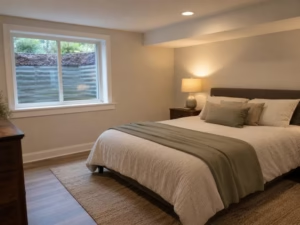
A basement room that will be used as a bedroom — a dedicated sleeping space for a family member, a guest, or a rental occupant — requires egress if it is going to be permitted and used as such. A room that has a bed in it but isn’t designated or permitted as a bedroom is a gray area that varies by jurisdiction and circumstance.
The practical question is: how do you want the room to function, and how do you want it to be characterized — on the permit, in the inspection, and at resale?
When Egress Usually Matters
Basement Bedroom for a Family Member
If a child, teenager, or household adult is going to sleep regularly in the basement, egress matters for safety regardless of code. A bedroom without a way to exit in a fire is a serious safety concern. If the room is being finished and permitted as a bedroom, egress is required. If it’s not being permitted as a bedroom but will be used as one, the safety issue doesn’t go away.
Guest Suite
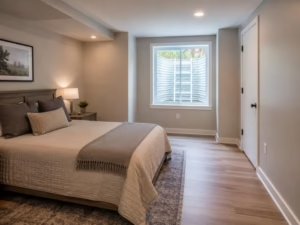
A guest suite — a finished basement space with a bed area and bathroom intended for overnight guests — functions as a bedroom. When this scope is permitted and built correctly, egress is part of the requirement. A guest suite without proper egress is also a harder sell at resale, where buyers and their agents increasingly scrutinize how basement rooms are characterized and whether they meet requirements.
In-Law or Accessory Dwelling Space
A basement configured as in-law accommodation — with a sleeping area, bathroom, and potentially a kitchenette — is a space where egress matters significantly. In-law suites are sometimes occupied by elderly residents who may have limited mobility. The safety implications of an egress-deficient sleeping room in this context are real.
Increasing Bedroom Count for Resale
One of the reasons homeowners finish basement bedrooms is to increase the bedroom count for listing purposes. A room can only be counted as a bedroom in a real estate listing if it meets the requirements for a bedroom — which in most jurisdictions includes egress. A basement room without proper egress that’s marketed as a bedroom creates disclosure liability and may be challenged during the buyer’s inspection.
When Egress Is Usually Not the Main Issue
For a basement that isn’t being configured as a sleeping space, egress is typically not a primary planning issue:
- A family room or recreation area doesn’t require egress by code
- A home gym doesn’t require egress by code
- A home office doesn’t require egress by code
- A media room or theater room doesn’t require egress by code
- A playroom doesn’t require egress by code
That said, local requirements vary, and it’s worth confirming with your contractor what applies in your specific municipality. Some jurisdictions have requirements that go beyond the minimum code. The safest approach is to verify rather than assume.
Why Egress Must Be Planned Before Framing Begins
Egress window installation is a structural project. It involves cutting through the foundation wall — a structural element of the house. The location of that opening affects the framing layout around it. The waterproofing at that section of the wall needs to be coordinated with the window installation. The window well outside needs space to be excavated and properly drained.
None of this can be done neatly after framing is in place. A finished basement bedroom with framing already built to the wall, insulation installed, and drywall hung cannot have an egress window added without tearing out a significant portion of what was just built. This is an expensive, avoidable problem that happens when the egress decision is treated as something that can be figured out later.
The time to decide on egress is during the planning phase, before any framing begins. Once that decision is made, the layout can be built around it from the start rather than revised around it after the fact.
What Egress Window Installation Actually Involves
Excavation
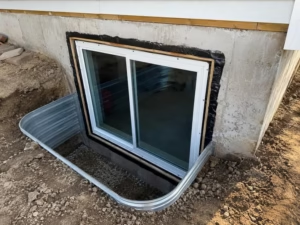
An egress window in a basement sits at or below grade. Installing one requires excavating outside the foundation wall to create a window well of sufficient size. The depth of excavation depends on how far below grade the window will be. In a typical basement, this means digging down several feet in a controlled area immediately against the foundation.
Cutting the Foundation Wall
The foundation opening is cut through the block, poured concrete, or stone wall. This is not a delicate operation. It requires specialized cutting equipment, generates significant debris, and is inherently a structural modification to the foundation. The cut opening is then framed with a lintel or header to carry the load above the opening.
Window and Window Well Installation
The egress window unit — which must meet the minimum net clear opening requirements — is installed in the cut opening and properly flashed, sealed, and finished. The window well is installed against the exterior foundation wall, sized to allow egress and meet the minimum area requirements. Most window well installations include a drainage provision at the bottom of the well — gravel backfill connecting to the foundation drainage system or a dry well — to prevent the well from collecting standing water.
Interior Finish Work
The interior of the opening is framed, insulated, and finished to match the surrounding wall. The window well exterior is finished or covered with a clear polycarbonate well cover, which keeps debris and water out of the well while maintaining the egress capability and allowing light to enter.
Restoration and Cleanup
The excavated area outside the foundation is backfilled and graded appropriately. Landscaping in the area is typically disturbed and needs to be addressed as part of the project.
How Egress Affects Cost and Layout
An egress window installation is a meaningful scope item. In southeastern Pennsylvania, expect a realistic cost range of $3,500 to $7,000 per egress window depending on foundation type, soil conditions, depth of excavation, and site accessibility. Stone foundations and deep excavation requirements push toward the higher end.
The layout implications are significant. The window location needs to be placed on an exterior wall (obviously), but also in a position that works with the room layout, provides adequate clearance for a bed and egress path within the room, and doesn’t conflict with mechanical or structural elements in the ceiling above. These spatial decisions are framing decisions, and framing decisions happen at the start of the project.
How Egress Affects Permits and Inspections
An egress window installation requires a building permit in Pennsylvania municipalities. The permit covers both the structural modification to the foundation and the window installation. Inspections typically occur at the opening (before the window is installed, so the framed opening can be inspected) and at final completion.
For a basement bedroom project that also includes finish work and a bathroom, the egress permit is one of several permits — building, plumbing, and electrical — that need to be pulled and managed. All of them need to be in place before work begins.
The permit record for the egress window is also what establishes that the basement room can be characterized as a legal bedroom. At resale, that permit record matters. Egress windows installed without permits create the same kind of disclosure issues as any other unpermitted work.
Common Mistakes Homeowners Make
Calling a Room a Bedroom Without Planning Egress
The most common mistake is designing a basement bedroom — even putting a bed in it and calling it a bedroom — without addressing egress. The room may function perfectly well for years. The problem appears at resale, when the bedroom can’t be listed as such without an egress window, or when a buyer’s inspector flags the condition.
Adding Egress Too Late in the Project
Deciding to add egress after framing is complete requires opening walls, potentially moving electrical rough-in, and tearing out any insulation that’s already been installed near the window location. This is an expensive sequence to reverse.
Ignoring Window Well Drainage
A window well without proper drainage becomes a water collection point. Water that pools in a window well eventually finds ways into the basement through the window frame, particularly in older or less-carefully-installed units. A properly drained window well is part of a correctly installed egress window — not an upgrade.
Assuming an Existing Small Window Meets Egress
Existing basement windows — the small horizontal hoppers typically installed at the top of the foundation wall — almost never meet egress requirements. Their net clear opening is too small and their sill height is typically too high. A homeowner who assumes an existing window satisfies the egress requirement will find out during the permit application or inspection that it doesn’t.
How BMR Discusses Egress During Basement Planning
When a homeowner tells us they want a basement bedroom, guest suite, or in-law space, egress is one of the first planning questions we address. We look at the wall options for the window location, assess the exterior conditions for excavation, evaluate the foundation type, and discuss how the window placement interacts with the room layout before any framing plan is finalized.
If you’re unsure whether egress applies to your project, the answer is usually: it depends on how you want the room characterized and what your municipality requires. We help clarify that during the estimate walkthrough and work with you to build the scope correctly from the start.
Frequently Asked Questions
Do all finished basements need egress windows?
No. Egress requirements apply to sleeping rooms, not to all finished basement spaces. A basement with a family room, gym, home office, and playroom does not require egress. A basement with a room intended and permitted as a bedroom does. Local requirements vary, so confirming with your contractor and municipality is the right step.
Does a basement office need an egress window?
Not under most building codes. A home office is not a sleeping room and therefore doesn’t trigger egress requirements. That said, if your township has adopted specific requirements beyond the standard code, or if the room could be interpreted as a sleeping room, it’s worth confirming locally.
Can I call a basement room a bedroom without an egress window?
You can use a room as a sleeping space, but you cannot list it as a bedroom in a real estate transaction without meeting the requirements for a bedroom — which typically includes egress. A room without egress listed as a bedroom creates a disclosure issue and may be flagged during a home inspection, requiring correction before the sale can close.
How much does a basement egress window affect project cost?
In southeastern Pennsylvania, a realistic range is $3,500 to $7,000 per egress window, depending on foundation type, excavation depth, soil conditions, and site access. It’s a meaningful addition to the project budget and needs to be in the scope estimate from the beginning rather than added as a change order.
When should egress be planned during a basement remodel?
Before framing begins. The location of the egress window affects the room layout, the framing around the opening, and the waterproofing at that section of the foundation wall. All of these are decisions that happen at the start of the project. Deciding on egress after framing is substantially more expensive.
Who determines the final egress requirements?
The local authority having jurisdiction (AHJ) — typically the municipal building department — is the final authority on egress requirements for your specific project. Your contractor should be familiar with local requirements and should verify them as part of the permit application process.
Planning a Basement Bedroom? Start the Egress Conversation Early
If you want a basement bedroom, guest suite, or in-law space, the egress, framing, permits, and finish work need to be planned in the right sequence. BMR Belmax Remodeling reviews layout options, egress feasibility, and permit requirements during the estimate walkthrough for every basement bedroom project — so the scope is correct from the start and nothing needs to be reversed mid-project.
We serve homeowners in Bucks County, Montgomery County, Philadelphia, and Mercer County NJ. Call 609-712-2750, email sales@belmaxremodeling.com, or request a free estimate online. We respond within one business day.


