
- By admin
- In Uncategorized
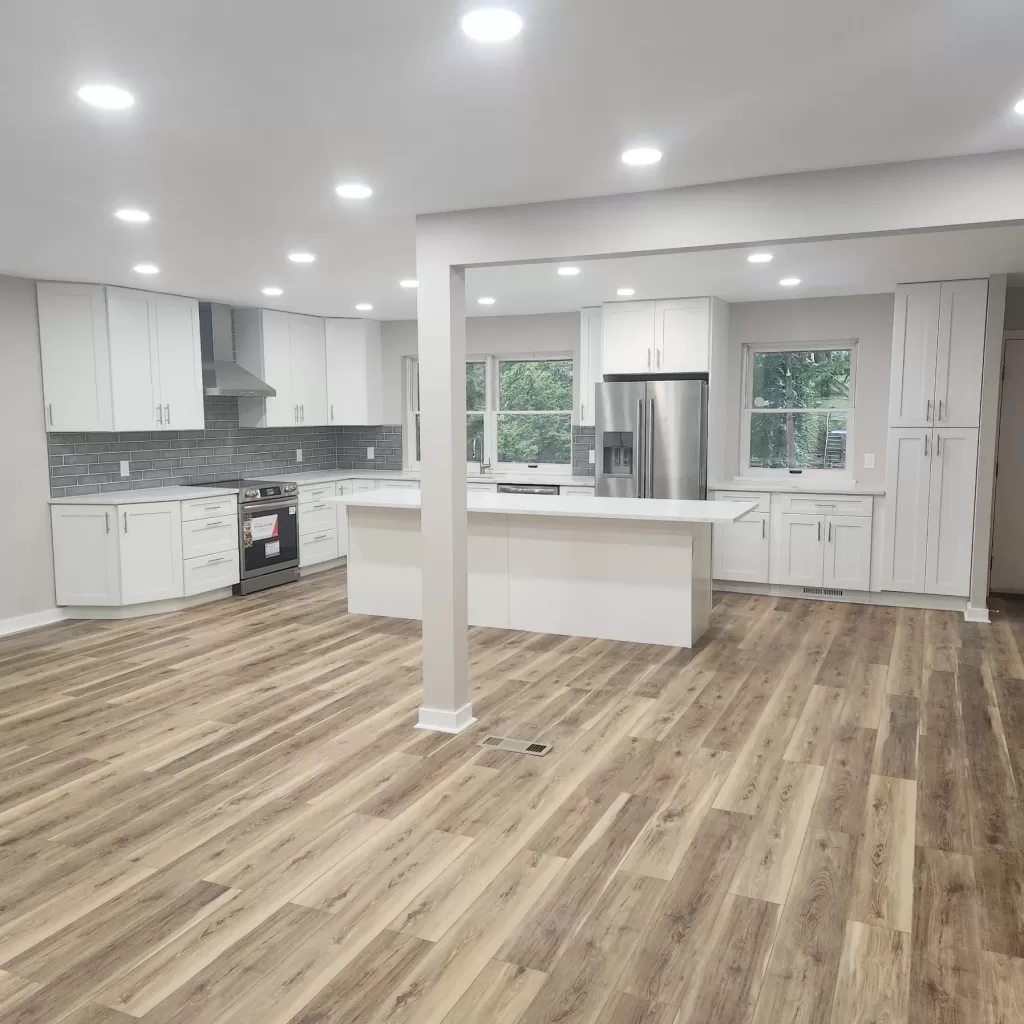
KITCHEN ISLANDS WITH SEATING
Kitchen Islands With Seating — Planning, Layout, and What Actually Works
A kitchen island with seating is one of the most requested features in a kitchen remodel. Done well, it adds a casual eating area, keeps guests close to the cook, and gives the kitchen a natural gathering point that a dining table in another room doesn’t provide.
Done poorly, it makes the kitchen harder to use. An island that’s too large leaves no working clearance around it. One that’s positioned wrong blocks the path between the refrigerator and the range. Seating forced onto a side that doesn’t have enough overhang produces a row of uncomfortable stools that nobody actually uses.
This article covers the planning decisions that determine whether an island with seating works well in your specific kitchen. If you’re planning a kitchen renovation and want to include an island, our kitchen remodeling team can walk through the layout options during a free estimate.
When an island with seating actually makes sense
Not every kitchen has room for an island with seating. The first honest question is whether the space supports it — not whether it would be nice to have.
Room size and kitchen layout
A kitchen island with seating on one side needs a minimum of 42 inches of clearance between the seating edge of the island and the nearest wall, cabinet, or appliance behind it. 48 inches is more comfortable. Less than 42 inches and the person seated at the island is blocking the path every time someone needs to pass behind them.
In a U-shaped or L-shaped kitchen, the island sits in the open floor area. In a galley kitchen, there typically isn’t enough floor space for an island with seating on any side without creating clearance problems. In an open-concept kitchen that connects to a living or dining area, an island with seating often works particularly well because the seating side faces the living space rather than a kitchen work area.
How the kitchen is used daily
An island with seating works best when it serves a clear daily function: a place for kids to sit during breakfast, a spot for someone to sit with coffee while the other cooks, a casual eating area that handles most meals without requiring the formal dining table. If the kitchen is used primarily by one person and guests rarely gather in it, the extra prep and storage space an island without seating provides may be more useful than the seating configuration.
Entertaining and family use
For households that entertain regularly or have multiple people in the kitchen at the same time, an island with seating on one side creates a natural division between the cooking zone and the watching-and-talking zone. People can sit at the island without being in the work triangle, which keeps the kitchen functional even when several people are in it simultaneously.
Common kitchen island seating layouts
Seating on one side only
The most common and most practical configuration. The seating side faces away from the kitchen work area — toward a dining room, living room, or open space — and the kitchen side of the island functions as a work surface. This keeps the seated people out of the cook’s path and makes the island useful for both food prep and casual seating without those two uses competing.
A one-side seating island typically accommodates two to four stools depending on the island length. A 48-inch island comfortably seats two. A 72-inch island seats three comfortably, four if the stools are compact.
Seating on two sides
Two-sided seating works in large, open-concept kitchens where the island is positioned as a room divider between the kitchen and an adjacent space. It requires more floor area and more clearance on both sides — at least 42 inches on both the kitchen side and the seating side. In most standard kitchen sizes in homes across Bucks County and Montgomery County, two-sided seating is only feasible if the kitchen has been opened to an adjacent space or is originally quite large.
Raised bar vs counter height
Counter-height islands (36 inches) use counter-height stools at approximately 24 to 26 inches. Bar-height islands (42 inches) use taller bar stools at approximately 28 to 30 inches. The raised bar creates a visual separation between the seating area and the kitchen work surface, which some homeowners prefer for concealing prep mess from seated guests. Counter height tends to feel more casual and conversational. Both work — the choice is primarily aesthetic and functional preference rather than a practical recommendation.
One caution on raised bar overhangs: a two-tier island with a raised bar section on the seating side requires structural support for the overhang if it extends more than about 12 inches. This is standard construction but needs to be factored into the island design from the start, not added as an afterthought.
Clearance and space planning — the numbers that actually matter
Clearance is where most island seating plans fail in practice. Here are the key dimensions:
- 42 inches minimum between the seating edge of the island and the nearest wall, cabinet, or appliance. This is the functional minimum for a circulation path behind seated people. 48 inches is recommended.
- 12 to 15 inch overhang on the seating side to allow knee clearance under the countertop for seated stools. Without adequate overhang, stools can’t be positioned close to the island and seating is uncomfortable.
- 24 inches of width per seat along the seating side. Two stools need at least 48 inches of island length on the seating side. Three stools need at least 72 inches. Crowding stools closer than 24 inches makes them difficult to use.
- 42 to 48 inches between the island and the kitchen work runs (the countertops along the walls). This is the working clearance for the cook — enough to open appliance doors, pull out drawers, and move between work zones without the island blocking the path.
In a kitchen where these clearances can’t all be met simultaneously, the island needs to be smaller, the seating needs to be on fewer sides, or the island shouldn’t include seating. A common mistake is designing the island first and then discovering the clearances don’t work during the remodel.
Storage vs seating — what you give up on the seating side
The seating side of an island cannot also have cabinets or drawers that open toward the seated position. That means every linear foot of island that’s dedicated to seating is linear footage that doesn’t have cabinet storage on that face.
For a 60-inch island with seating on one end covering 36 inches, approximately 24 inches of island base is available for storage on the seating-side face. The kitchen-facing side typically retains its full cabinet and drawer configuration.
This tradeoff is worth understanding before finalizing island dimensions. A larger island with seating isn’t necessarily better than a smaller island with more storage. The right balance depends on what the household actually needs from the island — storage and prep space or seating and gathering.
Design choices that affect how the island actually functions
Countertop overhang and stool selection
The overhang on the seating side needs to be deep enough for knee clearance — at least 12 inches, ideally 15 inches for comfortable seating. The overhang also needs support if it extends beyond about 12 inches; unsupported cantilever countertops flex under load and eventually crack at the edge or at the cabinet connection.
Stool height has to match the island or bar height. Buying stools before confirming the finished island height is a common mistake. Confirm the countertop height with your contractor before purchasing seating.
The countertop material on the island affects the overall kitchen design. If the island countertop is a different material or color from the perimeter countertops — which is common and can work well — the selection needs to be made as part of the broader material conversation. Our article on countertop colors for white kitchen cabinets covers how countertop and cabinet combinations work together visually.
Sink or cooktop in the island
Adding a sink or cooktop to an island significantly increases its utility as a prep surface but also increases cost and affects the seating configuration. A sink in the island requires a drain and supply lines run through the floor — plumbing work that needs to happen during the rough-in phase. A cooktop requires ventilation, which means either a ceiling-mounted hood above the island (a structural and aesthetic consideration) or a downdraft ventilation system built into the island.
A sink or cooktop on the island also affects where seating can be placed. Seated people positioned too close to a cooktop is a safety and practical problem. Seated people on the same side as a sink get splashed. These configurations require careful planning of which side the seating is on and how far it is from the working elements of the island.
Traffic path between island and appliances
The work triangle — the path between the refrigerator, range, and sink — should not require passing through the seating area. If seated guests are positioned between the refrigerator and the range, the cook has to navigate around them constantly. This is one of the most common functional problems in kitchens where the island was positioned for aesthetics rather than workflow.
The seating side of the island should always face away from the primary work triangle path, not into it.
Common mistakes homeowners make with island seating
Island too large for the room
The most frequent problem we see in kitchen remodel planning is an island that’s sized for the dream kitchen rather than the actual kitchen. A 4×6 foot island in a kitchen that only supports a 3×4 foot island leaves insufficient clearance on multiple sides. Everything becomes harder to use — appliances can’t be accessed easily, drawers can’t be opened fully, and the cook is constantly maneuvering around the island instead of moving efficiently through the workspace.
Island size has to be determined by working backward from the clearance requirements, not forward from the desired island features.
Not enough clearance behind the seating
A seating side with 30 or 36 inches of clearance behind it works when nobody is sitting there. The moment someone sits down, the path behind them is blocked or reduced to a squeeze. If a second person then tries to pass, one of them has to stand up or flatten against the wall. This creates daily frustration in a kitchen that looked fine in the floor plan.
Trying to fit too many seats
Four stools on a 60-inch island is too many. The math is 24 inches per seat — four stools need 96 inches, or 8 feet. At 60 inches (5 feet), three stools are a tight fit and two are comfortable. Crowding stools makes them difficult to pull in and out, and people seated at the ends have no elbow room.
Poor appliance and island relationship
An island positioned directly across from the dishwasher means the dishwasher door can’t be fully opened or blocks the walking path when it is. An island positioned across from the oven means pulling the oven rack out puts it within reach of seated guests. These conflicts are avoidable during the design phase but expensive to fix after installation.
How island decisions affect renovation cost
Island cost within a kitchen renovation varies significantly based on size, cabinetry configuration, countertop material, and whether plumbing or electrical is involved.
A standard base cabinet island — prefabricated or semi-custom cabinets assembled into an island configuration with a countertop — adds $2,000 to $5,000 to a kitchen renovation at mid-range material levels. A custom-built island with matching cabinetry, a waterfall countertop edge, and built-in seating panels runs $5,000 to $12,000 or more.
Adding a sink to the island adds $1,500 to $3,000 for plumbing rough-in and installation. Adding a cooktop adds similar cost for gas or electrical rough-in plus the ventilation system, which can add another $1,500 to $4,000 depending on the hood configuration.
The countertop on the island is often where homeowners choose a premium material — a different stone, a waterfall edge, a contrasting color. That’s a reasonable aesthetic choice, but the island countertop is also priced per square foot like everything else. A 3×5 foot island surface with a 15-inch overhang on the seating side has meaningful square footage. For a full breakdown of how kitchen elements affect project cost, the kitchen renovation cost page covers that in detail.
Planning a kitchen with an island?
If you’re planning a kitchen renovation in Bucks County, Montgomery County, or surrounding areas and want to work through the island layout options, our kitchen design team can help you get the proportions right before any decisions are finalized.
We work with homeowners throughout the area — including as a kitchen remodeling contractor in Montgomery County — on kitchen renovations from straightforward cabinet replacements through full layout reconfigurations. Call us at 609-712-2750 or request a free estimate online. We’ll come to the space and give you a realistic layout assessment and written quote.


