
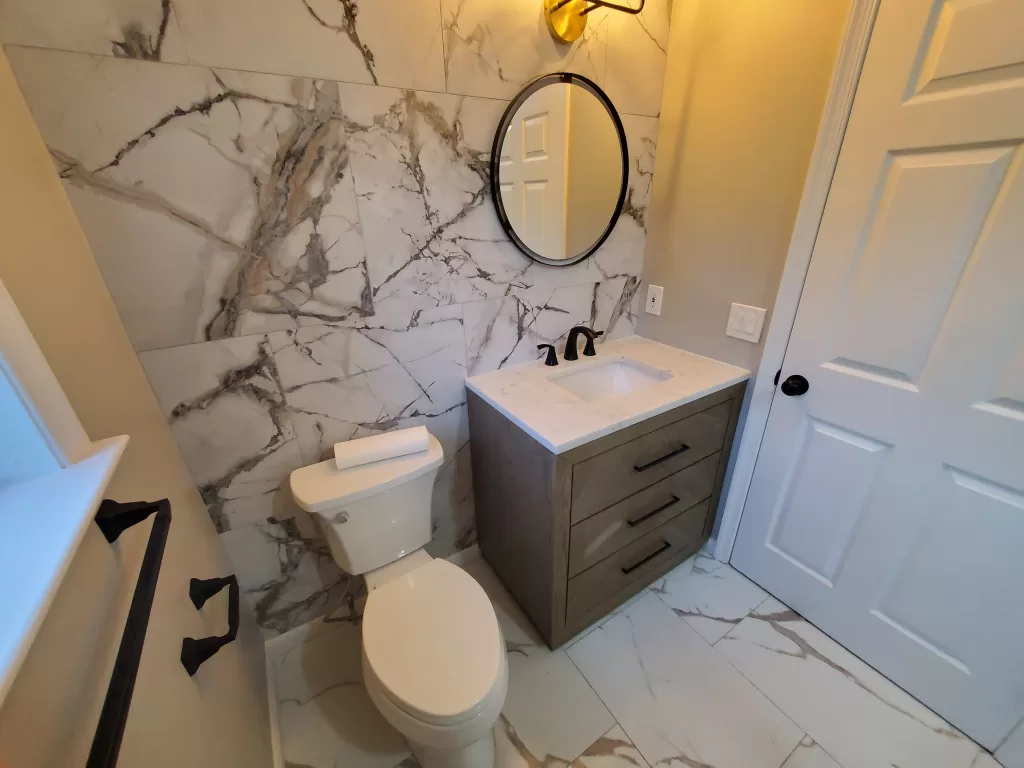
- By admin
- In Uncategorized
Bathroom Design Trends Worth Following — and Some That Aren’t
Homeowners planning a bathroom renovation naturally look at design trends for direction. That’s reasonable — design does evolve, and some current directions genuinely produce better-looking, better-functioning bathrooms than what was standard ten years ago.
The problem with trend articles is that they rarely tell you which trends add installation complexity, which ones cost significantly more to execute, which ones will feel dated in five years, and which ones look better in a large master bathroom than they do in a small hall bath. A tile pattern that photographs beautifully on a social media account is not the same thing as a practical choice for a 50-square-foot bathroom that two people share.
This article breaks down current bathroom design trends from a contractor’s perspective — which ones are genuinely worth considering, which ones require honest cost and complexity conversations before committing, and which ones to approach carefully. For specific planning help, our bathroom remodeling team handles projects throughout Bucks County, Montgomery County, and surrounding areas of Pennsylvania.
Bathroom design trends that are actually practical
These directions have staying power because they improve how bathrooms function and look without being highly maintenance-dependent or excessively expensive to execute well.
Larger showers, fewer tubs
The trend toward walk-in showers in place of tub-shower combos is one of the most consistently practical design shifts in bathroom renovation. Most homeowners in Bucks County and Montgomery County who renovate a master bathroom convert a tub-shower combination to a dedicated walk-in shower. The tub gets used infrequently; the shower is used every day.
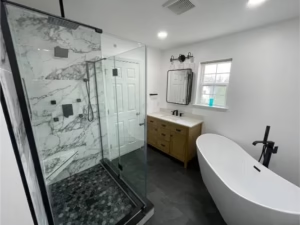
Reclaiming the tub footprint gives the shower meaningful size — and a genuinely larger shower is one of the improvements homeowners are most satisfied with. A 42×60 or 48×72 shower with a frameless glass enclosure functions and feels completely different from a 36×36 shower stall. This is a functional improvement, not just a visual one. For more on how shower decisions affect master bathroom design, see our article on master bathroom remodel ideas.
Warmer finishes replacing cool chrome
Brushed nickel, matte black, brushed gold, and warm bronze finishes on faucets, showerheads, towel bars, and hardware have largely replaced the cooler polished chrome that was standard for decades. These finishes show water spots less than polished chrome and complement a wider range of tile and vanity choices. The shift is practically motivated as well as aesthetic.
One caution: mixing metal finishes within a single bathroom requires intentionality. Matte black fixtures with brushed gold hardware and brushed nickel accessories produces visual confusion rather than designed contrast. Pick a primary finish and be consistent with it across all fixtures in the space.
Improved vanity storage and organization
Deep drawers rather than doors-and-shelves under the sink, drawer inserts for everyday items, and taller vanity configurations with more storage height are design improvements that consistently improve daily bathroom usability. The era of the pedestal sink in a primary bathroom has largely passed because people understand how much storage they actually need.
A vanity with well-organized drawer storage, adequate counter space for the people using the bathroom, and lighting that works at the mirror — sconces at face height rather than a bar light overhead — is the baseline that any bathroom renovation should hit before pursuing more visual design decisions.
Better lighting
Vanity-level lighting has replaced overhead-only illumination as the standard in well-executed bathroom renovations. Sconces flanking the mirror, or a lit mirror with built-in side lighting, provides even illumination across the face for grooming — which a single bar light mounted above the mirror can’t do because it creates shadows. This is a functional improvement that happens to look better than the old approach.
Recessed fixtures in the shower ceiling (wet-rated) for shower lighting, and dimmer capability on the main fixtures, have also become standard expectations. None of these are expensive upgrades relative to total project cost, but they make a meaningful difference in how the finished bathroom is used.
Large-format tile with simpler layouts
12×24 porcelain tile installed in a clean stacked or offset layout has become a reliable, lower-maintenance alternative to small mosaic tile. Fewer grout lines mean easier cleaning and a cleaner visual. This is both a design direction and a practical one. Large-format tile in a simple layout often reads as more refined than small tile in a complex pattern, at lower labor cost.
Frameless or semi-frameless shower glass
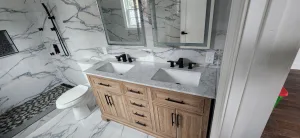
A clear frameless or semi-frameless shower enclosure visually opens the bathroom and makes it read as a continuous space rather than two compartments divided by a heavy frame and curtain. In smaller bathrooms especially, this change has significant impact on how large the room feels. It adds cost compared to a shower curtain or framed enclosure, but it’s one of the higher-impact improvements per dollar in most bathroom renovations.
Trends that add cost and complexity — know what you’re committing to
These directions are genuinely popular and can produce beautiful results. They also have real cost and installation complexity implications that trend articles rarely mention.
Floor-to-ceiling tile
Tiling all bathroom walls floor to ceiling — not just the wet area — is visually dramatic and produces a very clean, finished look. It also significantly increases tile square footage, substrate work, and labor time. A bathroom where tile stops at 4 feet on the non-wet walls costs meaningfully less than one where tile goes to the ceiling throughout.
Floor-to-ceiling tile also increases the grout maintenance area and makes future repairs more visible if a tile needs to be replaced. If the goal is a fully tiled bathroom, budget for it accurately. If cost is a priority, limiting full tile coverage to the wet area and shower while using paint or a simpler finish on dry walls produces a good result at lower cost.
Large-format tile on floors
Large-format floor tile — 24×24 or larger — looks clean and modern. It also requires a flatter, more precisely prepared substrate than smaller tile because imperfections in the floor read differently under large panels. Significant variation in floor flatness can cause large tiles to crack at unsupported points. Substrate preparation for large-format floor tile adds cost and time compared to standard format tile.
In a shower floor specifically, large-format tile requires a linear drain rather than a center drain, because the tile can’t be cut into wedge shapes to slope toward a center point. A linear drain is a valid design choice but adds plumbing cost and affects the shower floor’s visual organization. This needs to be specified during the design phase, not decided after tile is already ordered.
Freestanding tubs
A freestanding tub is one of the most photographed bathroom design elements and one of the most frequently installed in spaces that don’t actually support it well. A freestanding tub needs at least 12 to 18 inches of clearance on all sides to look proportional and be accessible for cleaning. It needs a floor-mount faucet, which requires supply lines run through the floor — plumbing work that goes beyond a standard wall-mount installation. And it occupies significant floor area that, in many master bathrooms, is better used for a larger shower.
The honest question before committing to a freestanding tub: does the household actually use a tub regularly? If the existing tub gets used rarely, installing a freestanding tub because it looks good in photos is spending $2,000 to $6,000 or more on a fixture that becomes a decorative element rather than a functional one.
Heated floors
Radiant floor heating under tile is a genuine comfort upgrade in a Pennsylvania bathroom and one of the more popular additions to bathroom renovations in this market. It’s also best installed during a renovation when the floor is being removed and retiled anyway — retrofitting it afterward requires tearing up finished floor. If a bathroom renovation is being planned and the budget supports it, heated floors are worth adding during the project rather than trying to add them later.
Cost is typically $500 to $1,500 for the mat and thermostat depending on floor area, plus the electrical circuit. It’s a modest addition to a renovation budget and a noticeable daily improvement in a cold-climate state.
Multi-head shower systems
A rain head, a handheld on a slide bar, and a fixed showerhead on the same shower valve is an achievable and useful shower configuration. Full thermostatic multi-function systems with body jets, separate volume and temperature controls, and four or more shower functions are significantly more expensive — both in fixture cost ($2,000 to $8,000 for the valve and trim) and in the plumbing work required to supply them adequately.
Body jets in particular require water volume that most standard residential water supplies can’t sustain at full pressure across all functions simultaneously. The shower experience with body jets running on inadequate water pressure is not what the showroom demo suggested. Confirming water supply capacity before specifying a full multi-body system is worth the conversation.
Timeless choices vs trend-driven choices
The practical distinction between a timeless design choice and a trend-driven one is whether a homeowner would be comfortable with the decision in 15 years. Not everything has to be timeless — a renovation you’ll enjoy for a decade before changing is a reasonable use of money. But understanding which choices are durable and which are more fashion-dependent helps with how much to spend on each.
Choices that hold up well over time
Neutral tile in a large format and clean layout. Frameless or semi-frameless shower glass. A well-proportioned double vanity with good storage. Brushed nickel or matte black hardware. A walk-in shower with a bench and niche. Simple, well-executed waterproofing and quality tile work. These aren’t the most exciting design choices to photograph, but they produce bathrooms that look and function well for 15 to 20 years without feeling dated.
Choices that are more trend-dependent
Heavily veined stone tile on all four shower walls. Matte black everything throughout the bathroom. Bold color on the vanity. Statement wallpaper on a non-wet wall. Vessel sinks. These choices are visually distinctive now and may feel dated in eight to ten years. None are wrong if the homeowner understands the decision is somewhat fashion-dependent and budgets accordingly.
The general principle: put the permanent investment into function, structural quality, and waterproofing. Put the design personality into elements that are more replaceable or easier to live with long-term.
What works in different bathroom sizes
Small bathrooms — restraint is the right direction
Small bathrooms are the most common candidate for over-designing. A small bathroom with patterned floor tile, a bold vanity color, a decorative backsplash, and accent wall tile creates visual chaos rather than visual interest. In a tight space, every element is immediately visible and competing elements produce a room that feels busier rather than richer.
In a small bathroom, the design moves that actually work are: light tile in a clean layout, large-format tile to reduce grout line density, frameless glass to open the sightline, a wall-mounted vanity to clear the floor visually, and a large mirror. Keep the material palette simple — one or two tile types maximum. For a more detailed look at what actually works in small bathrooms, see our article on small bathroom remodeling.
Hall and guest bathrooms — quality over statement
A hall bathroom used by multiple people daily benefits from durability over distinctiveness. Porcelain tile that holds up to heavy use, a vanity with adequate drawer storage, a quality shower or tub installation with proper waterproofing — these matter more in a high-use shared bathroom than visual statement-making. A guest bathroom sees less traffic and can support more distinctive choices if the household wants to take them.
Master bathrooms — where design investment pays off most
A master bathroom renovation is where more investment in design and finishes makes the most sense — it’s used by the same people every day, it’s the most personal space in the house, and it has the most square footage for design decisions to read at appropriate scale.
A master bathroom renovation is where a larger shower, a freestanding tub if the space genuinely supports it, premium tile, a full double vanity with good lighting, and higher-end fixtures all make the most proportional sense relative to cost. For a full look at what works in master bathroom renovation, the master bathroom remodel ideas article covers what actually improves these spaces vs what costs money without proportional benefit.
Common mistakes homeowners make following design trends
Copying a design that was photographed in a different size bathroom
Most bathroom design inspiration photos are taken in larger bathrooms — master baths with generous square footage, professional lighting, and wide-angle lenses. The frameless glass shower, the freestanding tub, the full-height tile, and the floating double vanity all fit because the room has enough space for each element to breathe. Trying to fit all of them into a smaller bathroom produces a version that crowds everything and achieves none of the visual effects from the photo.
Choosing materials without thinking about long-term maintenance
Natural marble tile on shower walls photographs beautifully. It also etches, stains, and requires periodic sealing. White grout in a high-traffic shower stays clean for about six months before it becomes a maintenance project. Highly polished dark tile shows every water spot and fingerprint. These are real daily-life considerations that trend presentations don’t cover. Choosing materials based on how they look in photos without understanding how they perform in daily use leads to bathrooms that look great at installation and become burdens afterward.
Over-designing in a bathroom where function is already limited
A bathroom where the basic layout doesn’t work well — the door clearance is awkward, the shower is undersized, the vanity blocks circulation — benefits more from fixing those problems than from adding design features on top of them. Expensive tile in a shower that’s still 36×36 is a better-looking version of the same functional constraint. Fixing the layout issue first, then adding design quality, produces a better result.
How to use design trends without overspending or overcomplicating
The most useful framework for bathroom design decisions is to separate the permanent infrastructure from the design expression.
Permanent infrastructure — waterproofing, tile substrate, shower construction, plumbing configuration, vanity size and placement — should be decided based on function and long-term durability. These are the decisions that are expensive or impossible to change later. Get them right.
Design expression — tile color and pattern, hardware finish, vanity style, mirror choice, paint color — can reflect current preferences more freely because some of these elements are more replaceable or more livable with over time. Spend appropriately on each category rather than treating every decision as equally permanent.
One specific recommendation: use a trend choice in one controlled area rather than throughout the bathroom. A bold tile on the shower feature wall, with simple tile everywhere else, achieves a design statement without committing the whole bathroom to a choice that may feel dated in a decade. This approach also keeps cost contained, because the complex or expensive tile covers a limited area rather than the full bathroom.
For a detailed look at how bathroom renovation decisions affect project cost, see our bathroom renovation cost guide.
Planning a bathroom renovation?
If you’re planning a bathroom renovation in Bucks County, Montgomery County, or surrounding areas of Pennsylvania and want help thinking through design direction, layout decisions, and material selections alongside realistic cost expectations — call us at 609-712-2750 or request a free estimate online.
We’ll come to the space, look at what’s there, and have an honest conversation about what the project involves and what it will cost. No pressure — just a practical discussion about your specific bathroom.


