
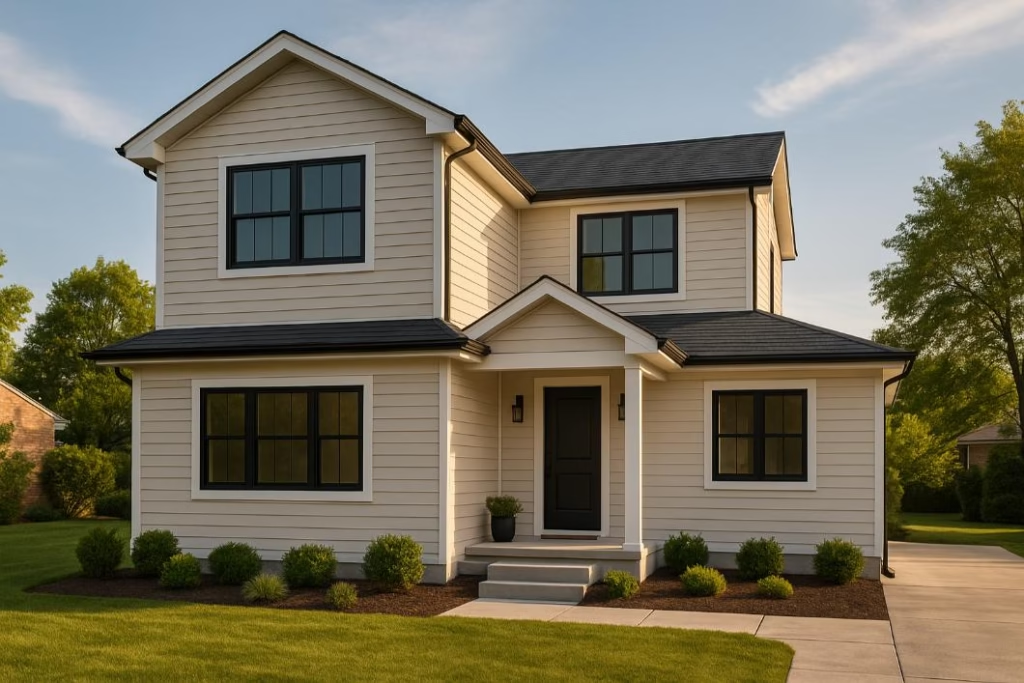
Adding a Second Floor: Cost, Timeline & What to Expect
Adding a Second Floor — What It Involves, What It Costs, and What to Expect
Adding a second floor to an existing house is one of the most significant projects a homeowner can undertake. It’s also one of the most frequently misunderstood — both in terms of what the construction actually involves and in terms of what living through it is like.
A second-floor addition is not a scaled-up version of a room addition. It involves removing the existing roof, building an entirely new floor system over the first floor, framing new rooms with all their mechanical and utility requirements, and then rebuilding the roof on top of the new second floor. The existing house structure has to support everything that’s added above it. The household typically lives through months of significant construction disruption.
This article covers what a second-floor addition actually involves, when it makes sense, what drives complexity and cost, and what homeowners should think through before starting the planning process. For a broader look at addition types, see our home additions guide. For information about our addition work specifically, visit our home addition services page.
When a second-floor addition makes sense
The lot doesn’t support a first-floor expansion
The most common reason a homeowner considers adding a second floor rather than a first-floor addition is lot constraint. Many homes in Bucks County and Montgomery County sit on lots where township zoning setback requirements — typically 25 to 30 feet from the rear property line and 10 to 15 feet from the side lines — leave little buildable area for a first-floor expansion. Going vertical is the only path to meaningful additional square footage.
The household needs a large square footage increase
A second-floor addition over a full first floor can effectively double the house’s habitable space. For a family that needs multiple bedrooms, additional bathrooms, or a significant increase in total square footage that a targeted first-floor addition can’t provide, a second floor may be the only path that delivers the needed space within the existing footprint.
The first floor layout works reasonably well
A second-floor addition makes most sense when the existing first floor is functional and doesn’t need to be reconfigured as part of the project. The first floor kitchen, living space, and layout stay largely intact. The second floor is built above it, connected by a new staircase, and the household gains a floor of new space without changing how the first floor is organized.
If the first floor also needs significant reconfiguration — opening the kitchen, adding a main-floor bathroom, rearranging rooms — that scope needs to be planned alongside the second floor addition, not treated as separate.
A master suite is the primary goal
One of the most common second-floor addition projects is adding a master suite above the existing first floor. A bedroom, private bathroom, and walk-in closet added as a dedicated second-floor suite creates separation from the rest of the house, doesn’t require the household to give up any first-floor rooms, and produces a primary suite that’s fully integrated into the house rather than appended to it. Our dedicated master suite addition article covers the planning considerations for that specific scope.
What makes a second-floor addition complex
Second-floor additions are structurally more demanding than first-floor additions because everything added above has to be carried by the existing structure below. This creates a set of assessments and decisions that don’t apply to ground-floor projects.
Structural assessment of the existing first floor
The first-floor walls and foundation have to carry the additional load of the new second floor — the floor system, the framing, the roof, and everything inside. In most homes, the existing exterior walls can carry this load. In some, particularly ranch homes built with minimal framing assumptions or homes with identified structural issues, reinforcement is needed before second-floor framing begins.
This isn’t something to guess at. A structural engineer assesses the existing construction and specifies what, if anything, needs to be reinforced before the project can proceed. This assessment happens during the design phase and its findings affect both feasibility and cost.
Foundation
Most residential foundations in this area are sized for the original house load. Adding a full second floor typically doesn’t require foundation work when the existing foundation is in sound condition and the first-floor walls can transfer the new load appropriately. When the existing foundation has issues — cracking, settlement, moisture problems — those need to be addressed before additional load is placed on the structure.
The structural engineer’s assessment addresses foundation adequacy as part of the overall structural review.
Roof removal and rebuild
The existing roof has to come off before the second floor can be framed. This is one of the most disruptive phases of the project from the household’s perspective. A temporary roof — heavy-duty tarps and protective covering — protects the first floor from weather exposure during the period between roof removal and the new roof being weathertight. This transition period is typically 1 to 3 weeks depending on framing speed and weather.
The new roof is designed and built as part of the addition, not as a repair or replacement of the old roof. Its configuration — pitch, overhang, ridge position — is determined by the architectural design of the second floor.
Staircase planning
A second floor needs a staircase, and the staircase needs to come from somewhere on the first floor. Finding the right location for the staircase is one of the more significant design challenges in a second-floor addition. A staircase takes approximately 40 to 60 square feet of first-floor space and affects the surrounding room layout. The staircase position also determines how the second floor is accessed and how the second-floor hallway and rooms are oriented.
In many homes, there isn’t an obvious staircase location that doesn’t disrupt some first-floor room or circulation. Working out the staircase position early — during the design phase — is essential because it has downstream effects on both floors.
Utility extension
HVAC, electrical, and plumbing all need to be extended to the second floor. HVAC is the most complex: the existing system may or may not have capacity to serve the additional square footage. An assessment of system capacity happens during planning. If the existing system can serve the addition through extended ductwork, that’s the lower-cost path. If it can’t, a supplemental system — typically a ductless mini-split or a second zone with its own air handler — is added for the second floor.
Electrical circuits run from the existing panel through the floor system to new junction points on the second floor. If the panel is near capacity, an upgrade may be required. Plumbing is only required on the second floor if a bathroom is included — which is the case for most master suite additions and most projects that include bedrooms intended for daily use.
Permit complexity
Second-floor additions require full building permits in every Bucks County and Montgomery County township. Plan submissions typically include architectural drawings and a structural engineer’s report. Inspections are required at multiple phases: framing, rough electrical, rough plumbing (if applicable), insulation, and final. The permit review period varies significantly by township — some municipalities process applications in two to four weeks; others take considerably longer. Planning and permitting often take two to four months before construction begins.
We manage permit applications and inspection scheduling as part of every project we handle as general contractor. Permit coordination is not a detail to figure out after the project is otherwise planned — it’s a front-end task that affects the overall timeline significantly.
What drives second-floor addition cost
Second-floor additions in Bucks County and Montgomery County typically run $175 to $300+ per square foot of finished space depending on scope and finish level. These are the variables that move the number most.
Size of the second floor
A partial second floor over one section of the house involves less framing, less roofing, and less roof removal than a full second floor over the entire first-floor footprint. More square footage means more of everything: structural framing, roofing, insulation, drywall, flooring, and mechanical rough-in. Total square footage is the baseline cost driver.
Structural reinforcement required
If the existing first-floor structure needs reinforcement before the second floor can be framed — additional posts, beams, wall plates, or foundation work — this adds cost on top of the standard addition scope. What reinforcement is needed, if any, is determined during the structural assessment. It can’t be predicted before that assessment is done.
Bathroom component
A second floor without a bathroom is simpler and less expensive than one with a full master bath. The bathroom is the most plumbing-intensive element of most second-floor additions, requiring drain lines run through the floor system, supply lines, waterproofing, tile work, and ventilation. A full master bath with a custom shower, double vanity, and freestanding tub costs significantly more than a basic full bathroom. The bathroom specification is the largest single finish variable in second-floor addition cost.
Roof complexity
A straightforward gable or hip roof over the second floor is the cost baseline. A complex roof configuration — multiple roof planes, dormers, unusual pitches, or integration with portions of the existing roof that aren’t being rebuilt — adds framing time and roofing scope. Roof configuration is a design decision made during the architectural planning phase, not during construction.
HVAC approach
Extending existing ductwork to a new second floor is less expensive than adding a new air handler and system. If the existing system doesn’t have capacity, a mini-split for the second floor adds $4,000 to $8,000 depending on the number of zones. Getting the HVAC assessment done early prevents scope surprises when mechanical rough-in begins.
Finish level
Foundation and framing costs are relatively fixed for a given footprint. Flooring, bathroom finishes, trim, windows, and exterior cladding are where homeowner selections move the final number significantly. The same second-floor shell can be finished simply or elaborately — the structural scope is the same; the finish scope varies.
What to expect during the process
Planning and design — 6 to 12 weeks
Architectural drawings and structural engineering need to be completed before permits can be submitted. The design phase involves multiple rounds of plan review and refinement. Staircase location, bathroom configuration, room layout, and exterior design all get worked out during this phase. Structural assessment results are incorporated into the drawings. This phase takes longer than most homeowners expect.
Permitting — 4 to 10 weeks
After plans are submitted, permit review takes 4 to 10 weeks depending on the township. Some municipalities have faster review cycles. Others require zoning review in addition to the building permit, which adds time. Inspection scheduling during construction is also coordinated with the township, and inspection delays can affect the project schedule at multiple phases.
Construction — 3 to 6 months
The construction sequence for a second-floor addition is: roof removal and temporary protection, structural reinforcement if needed, floor system framing, exterior wall framing, roof framing and new roofing, window installation and exterior weathertightness, mechanical rough-in (electrical, HVAC, plumbing), insulation, drywall, finish work, and punch list.
The period between roof removal and new roof installation is the most exposed phase. Experienced crews move through this phase quickly and have robust temporary protection in place. Weather delays during this phase extend the timeline.
Living through it
Most households stay in their homes during a second-floor addition, particularly if the first floor remains livable and the construction is above. The most disruptive period is during roof removal and rough framing — noise, dust, and the knowledge that your house is temporarily open to the sky are real. Most homeowners manage this with temporary relocation during the most intensive phase, or with designated quiet areas in the first floor that are protected and functional.
What’s harder to manage than the noise is the duration. A second-floor addition from permit submission to completion typically takes 6 to 10 months. Households that go into the process prepared for that timeline have a much better experience than those expecting it to be done faster.
Common planning mistakes
Underestimating how disruptive the project is
A second-floor addition is not like a kitchen renovation that happens in one room while the rest of the house operates normally. Roof removal affects the whole house. Staircase construction affects first-floor circulation. Mechanical rough-in runs through ceilings and walls throughout the house. A realistic picture of what the household will experience during construction should be part of the decision to proceed, not a surprise after the project starts.
Not resolving staircase location before planning proceeds
The staircase location is one of the most consequential design decisions in a second-floor addition and one of the most commonly deferred. Homeowners want to see the second-floor layout before committing to a staircase position, but the staircase position affects both floors. It needs to be resolved during the design phase, not treated as a finish detail.
Assuming any home is equally suited for a second floor
Ranch homes, split-levels, homes with significant structural issues, and homes with HVAC systems that are already at capacity are all candidates for more involved assessments before a second-floor addition can proceed. The structural assessment, HVAC capacity evaluation, and design feasibility work that happens at the start of planning exists precisely to identify these issues before money is committed to a project that may not be straightforward to execute.
Focusing only on square footage, not on how the rooms work
A second floor that adds 1,500 square feet but has awkward room sizes, poor bathroom placement, or a staircase that eats into bedroom space is less functional than one with 1,000 square feet planned thoughtfully. The quality of the layout matters as much as the total square footage added.
What to decide before requesting estimates
Getting useful, accurate estimates for a second-floor addition requires these questions to be answered — at least at a rough level — before anyone visits the site:
- How much additional space is needed? — one large bedroom and a bathroom, multiple bedrooms with bathrooms, a master suite only? The scope of the second floor is the first question.
- Full second floor or partial? — over the entire first-floor footprint or over a portion of it? A partial second floor involves less scope but also limits what can be built above.
- Bathroom component? — one bathroom, two bathrooms, a full master bath with custom shower? This is the largest cost variable after total square footage.
- Staircase preferences? — where in the first floor is the staircase acceptable? Are there rooms or areas that cannot be disrupted for the staircase?
- Timeline tolerance? — a realistic second-floor addition takes 6 to 10 months from permit submission through completion. Is that workable for the household?
- Budget range? — a rough budget expectation lets the contractor assess whether the desired scope is realistic and where tradeoffs need to be made.
Considering a second-floor addition?
We work with homeowners throughout Bucks County, Montgomery County, Philadelphia, and Mercer County NJ on second-floor additions. We have an in-house architect and structural engineer, which means we manage the full process — from initial feasibility assessment and structural review through permitted construction — without the homeowner having to coordinate those professionals separately.
Call us at 609-712-2750 or request a free estimate online. We’ll come to the property, assess the existing structure, and give you an honest picture of what’s feasible, what the project involves, and what it will cost.


