
- By Saveli
- In Build, Flooring, Renovation
Finished Basement vs Basement Remodel: What Scope Are You Actually Pricing?
If you’ve gotten two basement estimates that are $20,000 apart, the most likely explanation is that the contractors weren’t pricing the same project. One scoped a basic finish. The other included a bathroom, a defined home office, and dedicated electrical for the entertainment area. Same phrase, entirely different work.
This happens constantly in basement contracting because homeowners and contractors use the terms “finished basement” and “basement remodel” interchangeably. They don’t mean the same thing. Understanding the difference before you request estimates means you get comparable numbers and a realistic picture of what your project actually costs. Basement Remodeling Service Page.
What Contractors Usually Mean by a “Finished Basement”
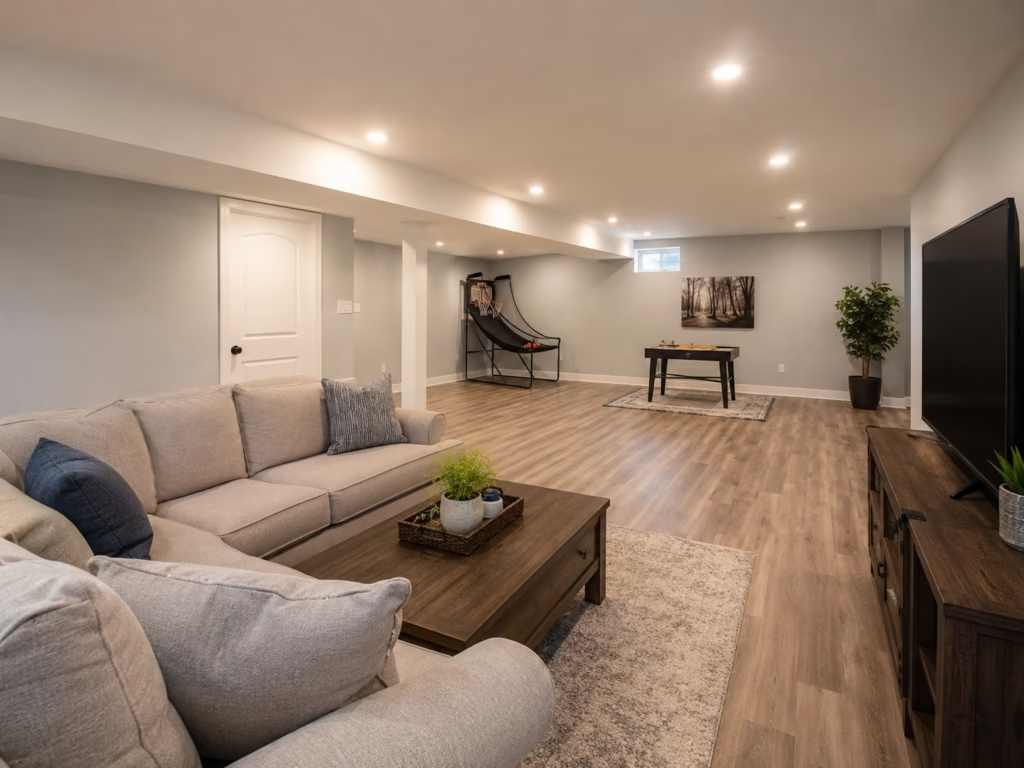
A finished basement, in its most basic sense, means taking a raw unfinished space and making it livable. That involves framing the perimeter walls, insulating, hanging drywall, installing flooring, running the circuits needed for lighting and outlets, adding recessed lights or surface fixtures, trimming the doors and openings, and painting.
There’s no plumbing. There are no defined rooms separated by interior walls, beyond possibly a utility room enclosure. The space becomes a functional open area — usable as a family room, playroom, or informal hangout area — without the complexity of trade-intensive additions.
This is the floor for a legitimate basement finishing project. It is not a small job, but it is a more predictable one than a remodel with bathroom, bar, and multiple defined rooms.
What Contractors Usually Mean by a “Basement Remodel”
A basement remodel implies something more than framing and drywall. It usually means defined rooms with their own purposes, coordinated trade work beyond basic circuits, and at least one significant addition — a bathroom, a wet bar, an egress window, or a dedicated home office.
A remodel requires more planning, more permits, more trade coordination, and more sequencing discipline than a basic finish. The framing is more complex because rooms have specific functional requirements. Electrical, plumbing, and HVAC all need to be thought through before framing is locked in. Changes after framing is up cost more than changes before.
What a Basic Finish-Out Includes
For a standard basement finishing project on an open, unfinished basement without significant conditions:
- Perimeter wall framing — treated bottom plate on slab, framed walls at exterior perimeter
- Insulation — exterior walls and sometimes ceiling, appropriate for below-grade conditions
- Drywall — walls and ceiling, taped, finished, and painted
- Flooring — typically LVP, engineered hardwood, carpet, or tile depending on use and moisture conditions
- Lighting — recessed fixtures planned for the space, wired on dedicated circuits
- Electrical — outlets per code, circuits sized for the intended use, connected to panel
- Trim and doors — baseboard, door casings, interior doors for utility enclosures
- Utility enclosure — framing and access around HVAC equipment, water heater, and electrical panel
What basic finish does not typically include: interior partition walls creating separate rooms, any plumbing, HVAC zone additions, egress window installation, or any bathroom or wet bar work.
Basement Remodel with Defined Rooms
Adding interior partition walls to create specific-function spaces is where a basic finish crosses into a remodel in terms of planning complexity.
Home Office
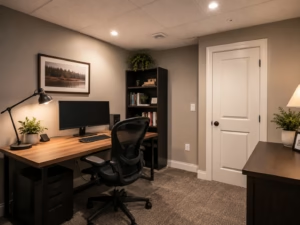
A home office needs wiring planned for equipment loads, lighting that doesn’t cause glare on screens, acoustic consideration from the floor above (specifically, the insulation approach in the ceiling), and usually a door that can close. None of this is dramatically expensive, but it needs to be part of the framing plan from the start.
Gym or Workout Room
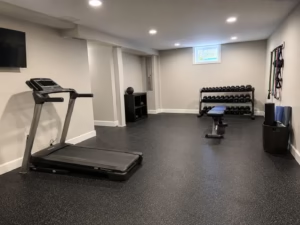
A gym typically needs rubber flooring over the slab, dedicated circuits for any cardio or strength equipment, and good lighting. Rubber flooring is installed over the concrete directly — it doesn’t require the same subfloor approach as LVP or engineered wood. Ceiling height matters more in a gym than in most other basement rooms.
Media or Theater Room
Dedicated media spaces need careful electrical planning — home theater setups draw significant amperage when fully loaded. Acoustic insulation between the media room and adjacent spaces is worth specifying. In a theater room, lighting design matters more than in open spaces: dimmable fixtures, avoid fixtures that create glare on the screen wall.
Storage and Mechanical Access
Every basement finishing project should include deliberate planning around mechanical room enclosures. The HVAC unit, water heater, and electrical panel all need to remain accessible for service. How those areas are enclosed — and what type of door and clearance is provided — is a framing decision, not an afterthought.
Basement Remodel with Bathroom
Adding a bathroom to a basement finishing project is the single most common thing that moves a project from “simple finish” to “real remodel” in terms of cost, trades coordination, and planning requirements.
Why Plumbing Changes the Project
A bathroom requires drain lines (often involving slab cutting if no rough-in exists), supply lines, venting, dedicated electrical circuits, and waterproofing in the shower area. It needs to be located relative to the main drain stack, and that location needs to be confirmed before framing begins — not after.
Existing Rough-In vs Slab Cutting
If the home has an existing bathroom rough-in in the slab from original construction, the plumbing access situation is much simpler. If it doesn’t, adding drain lines requires cutting into the concrete slab, which adds cost and disruption. Whether a rough-in exists is one of the first things to verify before estimating a basement bathroom.
Half Bath vs Full Bath
A half bath (toilet and sink) is simpler and less expensive than a full bath with a shower. A full bath with a custom tile shower is the most expensive configuration. The right choice depends on how the space will be used. For entertainment spaces, a half bath is often adequate. For guest suites or in-law spaces, a full bath is usually necessary.
Basement Remodel with Wet Bar or Kitchenette
A wet bar is one of the more popular additions to basement entertainment spaces. The scope typically includes cabinetry, a countertop, an undermount or drop-in sink, an undercounter refrigerator, and sometimes a wine cooler or additional appliances.
Plumbing and Electrical
The wet bar needs a drain for the sink (which may require slab work if no drain is accessible) and a supply line. The undercounter refrigerator needs a dedicated 20-amp circuit. If a kegerator or dishwasher drawer is part of the plan, additional circuits are needed. None of this is as complex as a full bathroom, but it still needs to be in the framing plan before walls close.
Dry Bar vs Wet Bar
A dry bar — cabinetry, countertop, and refrigerator without a sink — costs considerably less and avoids the plumbing work entirely. For homeowners who want the storage and entertaining function without the plumbing complexity, it’s a reasonable compromise. A wet bar with a working sink is more practical over time but requires a drain.
Basement Guest Suite or Legal Bedroom
A basement guest suite — an actual sleeping and bathing space that could function as in-law accommodation — is the most complex and expensive baseline configuration for a basement project.
Egress Window Requirements
Any room intended to function as a legal sleeping area in Pennsylvania requires an egress window meeting specific minimum dimensions. Installation involves exterior excavation, cutting through the foundation wall, a window well with proper drainage, and finishing on both sides. It’s structural work requiring a permit and needs to be planned before framing — not added after.
Privacy, HVAC, and Lighting
A guest suite needs a door that closes completely, adequate HVAC conditioning for year-round use, and lighting that works as a bedroom. If the basement will be used regularly as a sleeping space, a dedicated HVAC zone is worth considering rather than extending from the main system, which may not condition the basement adequately on its own.
Updating an Older Finished Basement
Updating a basement that was finished in a previous decade is its own category of project and is often misunderstood as simpler than it turns out to be.
What’s Being Removed
Basements finished in the 1980s and 1990s across Bucks County and Montgomery County commonly have carpet glued directly over concrete, wood paneling on the walls, drop ceilings with old fluorescent fixtures, and single-bulb overhead lights. Removing these is labor-intensive. Carpet removal over concrete usually reveals what the concrete looks like underneath, which affects what flooring can be installed. Wood paneling often conceals framing conditions that need to be assessed before drywalling over them.
Prior Unpermitted Work
A significant portion of 1980s and 1990s basement finishing work in this area was done without permits. That’s a problem for updating projects because it means there’s no inspection record for the existing electrical and framing. When a remodel opens those walls, the existing work needs to be brought up to current code — which may mean rewiring, reframing, or other corrections that weren’t in the original estimate.
Hidden Conditions
Old walls and ceilings in finished basements conceal what they contain. Moisture damage behind paneling that looked dry is common. Old insulation that’s failed or was never properly installed shows up when walls come down. In homes built before the late 1970s, asbestos in floor tiles or pipe insulation is a real possibility that requires testing before demolition.
Why Two Estimates May Not Be Comparable
Most estimate discrepancies in basement projects come from one of three sources: different scope assumptions, different permit inclusion, and different subcontractor arrangements.
A contractor who includes permits, uses licensed plumbing and electrical subcontractors, and prices moisture evaluation and contingency into their number will quote higher than one who doesn’t. A contractor who assumes a rough-in exists will quote lower than one who prices in slab cutting. A contractor who assumes open-plan and the other who assumes two defined rooms plus a bathroom are quoting different projects.
Before comparing numbers, confirm what each estimate actually includes. Ask specifically about permits, about who does the plumbing and electrical, and about whether they’ve priced the scope you described or the scope they assumed.
How to Define Your Basement Scope Before Requesting Quotes
Getting comparable estimates starts with being specific before contractors arrive. You don’t need a finished design, but you need answers to these questions:
- Open plan or defined rooms? If rooms, what’s each room’s function?
- Bathroom or no bathroom? If bathroom, half bath or full bath? Shower?
- Wet bar or dry bar?
- Bedroom intended? Egress required?
- What’s happening with the existing mechanicals — utility room, or open enclosure?
- Is the basement currently unfinished or does it have prior finished work to remove?
- What finish level are you targeting — basic functional, mid-range, higher-end?
The more specifically you can describe the intended result, the more accurately contractors can price it — and the more meaningfully you can compare numbers when estimates come back.
Frequently Asked Questions
Is finishing a basement the same as remodeling a basement?
Not exactly, though the terms are often used interchangeably. A basic finish means taking an unfinished space to a livable state — framing, drywall, flooring, lighting. A remodel implies more: defined rooms, trade-intensive additions like bathrooms or bars, and a higher level of planning and coordination. In practice, many projects fall somewhere between the two.
Why are basement estimates so different?
Usually because the contractors are pricing different scopes. One may assume a basic open finish; another may have priced a bathroom and two defined rooms. One may include permits; another may not. One may use licensed trade subcontractors; another may not. Before comparing numbers, confirm what each estimate actually covers.
What is the least expensive way to finish a basement?
A basic open finish with standard materials, no plumbing additions, and a manageable ceiling height is the least expensive path. Keeping the plan open rather than adding partition walls, avoiding bathroom additions, and choosing mid-range flooring and lighting keeps costs at the lower end of the range. That said, doing it with permits and proper materials is still a meaningful investment — expect $30,000 and up in the southeastern PA market for a legitimate basic finish.
Does adding a bathroom make it a full basement remodel?
Adding a bathroom significantly increases project complexity regardless of what you call it. It introduces plumbing trades, potentially slab cutting, venting requirements, dedicated electrical, and waterproofing scope that a basic finish doesn’t have. In practical terms, yes — a basement finishing project that includes a bathroom is a different level of project than one without.
Should I update an older finished basement or start fresh?
It depends on what’s behind the existing walls. If the prior work was done reasonably well with proper framing and electrical, an update may be able to work around it. If the prior work was unpermitted, has moisture damage, or used materials that need to be removed anyway, starting fresh is often cleaner and more cost-certain. A walkthrough that opens wall sections to inspect existing conditions before committing to an approach is worth doing.
What should I decide before requesting basement quotes?
At minimum: whether you want a bathroom, whether you want defined separate rooms or an open plan, whether any room needs to function as a legal bedroom, and what the current state of the basement is. These answers tell a contractor what they’re actually pricing. Without them, estimates are either vague or based on assumptions that may not match what you want.
Know What You’re Asking For Before Anyone Gives You a Number
BMR Belmax Remodeling works with homeowners in Bucks County, Montgomery County, Philadelphia, and Mercer County NJ on basement projects from straightforward finish-outs to full build-outs. When we walk a basement, we help identify what scope you’re actually working with — whether that’s a simple finish, a remodel with bathroom, or an update to an older finished space. From there, we build a detailed written scope so the estimate reflects the actual project.
Call 609-712-2750, email sales@belmaxremodeling.com, or request a free estimate online. We respond within one business day.


