
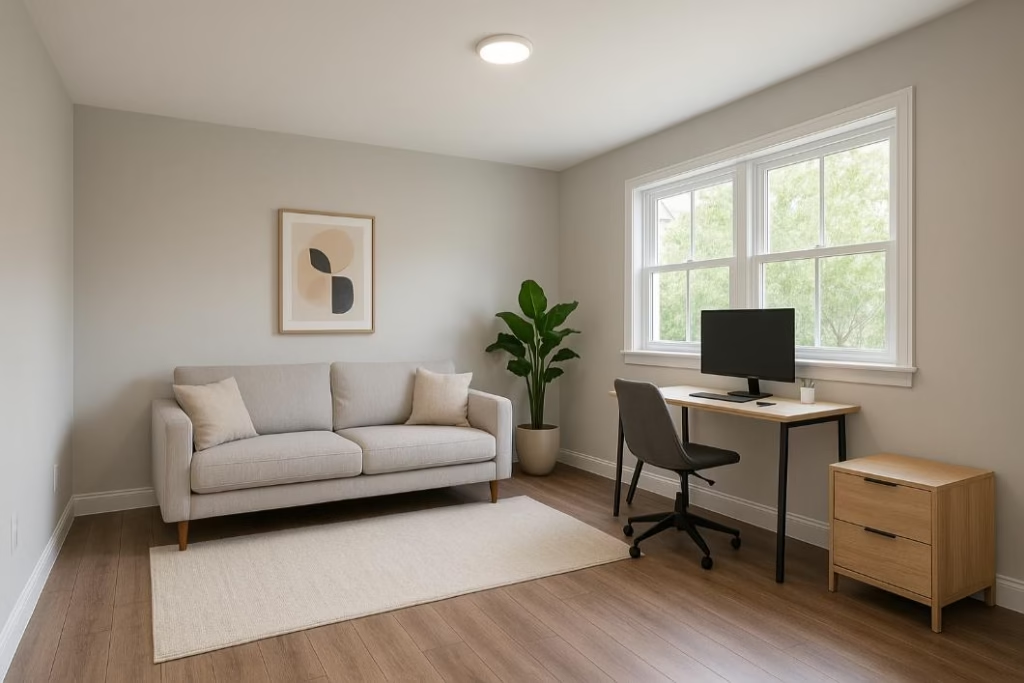
Should You Convert Your Garage Into a Room?
Converting a Garage Into Living Space — What You Need to Know Before You Start
Garage conversions appeal to homeowners for an obvious reason: the structure is already there. No foundation to pour, no framing from scratch, no roof to build. The space exists — it just needs to become something livable. On paper, that sounds like the most straightforward way to add square footage to a home.
In practice, garage conversions are more involved than most homeowners expect, and the right answer to “should I convert my garage?” depends heavily on the specific garage, the specific home, and the specific township. This article walks through the real decision factors — the construction obstacles, the permit considerations, the resale tradeoffs, and the cases where a garage conversion makes sense versus where a proper home addition is the better move.
This is contractor guidance, not a pros and cons list.
Why homeowners consider garage conversion
The appeal is clear. A two-car garage is 400 to 500 square feet — roughly the size of a reasonable home office, a guest suite, or a family room. For a household that has outgrown its living space but isn’t ready for a full home addition, converting underused garage space seems like the obvious intermediate step.
The conversion is also commonly framed as less expensive than an addition. That’s often true — but the cost gap is smaller than people expect, and the scope of work is larger than it looks from the outside.
When a garage conversion genuinely makes sense
Attached garage with direct interior access
An attached garage that already connects to the house through an interior door is the strongest candidate for conversion. The heating and cooling infrastructure is close. The electrical panel is accessible. The interior doorway already exists or requires modest framing work. The new room integrates naturally into the home’s floor plan.
The space isn’t being used for its intended purpose
If the garage has become a storage room for things that could be relocated, or is routinely empty while cars park in the driveway, the parking function has already been abandoned in practice. Converting it formalizes what’s already happening without changing daily behavior.
The household needs that specific type of space
A home office that doesn’t require a full bathroom, a workout room, a playroom, a music studio — uses that don’t require significant plumbing work keep conversion costs manageable. The more plumbing the converted space requires, the more the cost climbs toward what a small addition would cost.
The site and zoning allow it
In most townships in Bucks County and Montgomery County, converting an attached garage to living space requires a permit and meets zoning requirements for minimum parking on the property. In some HOA communities and some municipalities, the conversion may not be permitted at all, or the garage door must be replaced with a façade that matches the home’s exterior. Checking zoning and HOA rules before planning anything is the required first step — not an afterthought. Our general contractor team can help assess permit requirements during an initial estimate conversation.
The real construction obstacles in garage conversions
This is where most online articles stop being useful. The typical garage has several conditions that make it unsuitable for living space without real construction work — and those conditions drive the actual cost.
The slab
Garage slabs are poured on grade without the insulation, vapor barrier, and thermal break that a living space floor requires. A bare concrete slab in a Pennsylvania climate is cold in winter, damp in humid months, and not appropriate as a finished floor substrate without intervention.
The standard approach is to install a subfloor system over the concrete — either a sleeper system with rigid insulation between the sleepers, a dimple mat with a floating subfloor on top, or a specialty product designed for this purpose. This adds height to the floor, which affects door clearances and the transition back into the house. It adds cost, typically $2,000 to $5,000 depending on the size of the garage and the system used.
In some garages, the slab is also lower than the adjacent interior floor level. Bringing the finished floor height into alignment with the rest of the house may require additional buildup or may simply create a step transition at the connecting doorway.
Insulation
A standard attached garage has minimal or no wall insulation and no insulated ceiling. The garage door opening — whether the door is being kept, replaced with a wall, or replaced with windows and a door — is a large thermal gap that has to be addressed. Converting an uninsulated garage space into a heated and cooled room requires full wall insulation, ceiling insulation, and an exterior wall where the garage door was that meets current energy code requirements.
This is not cosmetic work. It’s the reason garage conversions are more expensive than they look and why the finish work can’t start until it’s done correctly.
Ceiling height
Standard garage ceiling height is 8 to 9 feet — workable for most room uses. But if the garage has a storage loft, HVAC ductwork crossing below the ceiling, or lower-than-standard framing, finished ceiling height becomes a real constraint. Lowering a ceiling to 7 feet is not an acceptable solution for living space. This needs to be assessed before planning the conversion.
Moisture
Garage slabs are often slightly sloped toward the door for drainage, and they’re not designed to resist moisture migration from below the way a conditioned space floor is. In Pennsylvania, basement and slab moisture is a seasonal reality. A conversion done without proper vapor barrier and moisture management creates a finished room that develops mold, efflorescence, and moisture damage over time. This is one of the most common garage conversion failure modes.
HVAC
Garages don’t have HVAC supply and return air. The options for conditioning a converted garage are extending the existing home system if it has capacity, adding a ductless mini-split, or installing baseboard or radiant heating. Each has different installation cost and performance characteristics.
Extending the existing system requires a mechanical assessment of whether the current system can handle the additional square footage — in older homes in this area, the answer is frequently no without equipment upgrades. A ductless mini-split is a reliable standalone solution at $3,000 to $6,000 installed, and it handles both heating and cooling independently of the home’s existing system.
Electrical
Garage circuits are typically wired for 15 or 20 amp service appropriate for a garage — lighting, outlet, door opener. A converted living space needs circuits appropriate for the room’s use, GFCI protection where required, and potentially additional panel capacity if the existing panel is at or near capacity. The electrical rough-in for a garage conversion is real work, not a minor addition.
The garage door wall
The garage door opening is the largest wall in the garage, and what replaces it matters structurally and visually. The header spanning the opening was sized for a garage door — it may or may not be adequate to support the new wall load depending on how it was framed. A contractor needs to assess the existing header before planning the new wall configuration. The exterior finish of the new wall also has to integrate with the home’s existing siding and roofline — which is more involved than simply closing the opening.
Cost drivers — why garage conversions cost more than expected
A basic garage conversion — insulation, subfloor, drywall, painting, flooring, lighting, mini-split — for a single-car garage typically runs $20,000 to $35,000 in this market. A two-car garage with similar scope runs $30,000 to $50,000.
Adding a bathroom pushes the cost significantly higher. Bathroom rough-in requires drains, supply lines, ventilation, and waterproofing that add $8,000 to $15,000 or more to the project depending on the plumbing distance from existing lines and whether the slab needs to be cut to route the drain.
The variables that push cost toward the higher end of any range:
- Slab moisture mitigation beyond standard vapor barrier
- New wall at the garage door opening with exterior siding and trim matching the existing home
- Panel upgrade if existing electrical capacity is insufficient
- Any plumbing, particularly a full bathroom
- Ceiling height issues requiring structural modification
- Detached garage requiring new utility runs from the main house
Detached garage — a different calculation
A detached garage conversion is fundamentally different from an attached one. The mechanical systems — HVAC, electrical, plumbing if needed — all require new runs from the main house across the distance between the structures, underground where applicable. This adds cost and complexity that doesn’t exist in an attached conversion.
A detached garage conversion with a bathroom, HVAC, and electrical that’s properly connected and permitted runs significantly more than an attached conversion of the same size. For many detached garages, the total project cost is comparable to a small home addition — which raises the question of whether the conversion or a proper addition is the better investment.
Garage conversion vs home addition — which makes more sense
This is the question homeowners most need help answering before they start planning.
Garage conversion is the better choice when:
- The garage is attached and the space genuinely works for the intended use
- The household doesn’t use the garage for parking and has no intention of changing that
- The conversion doesn’t require significant plumbing work
- Budget is a real constraint and the conversion scope is manageable
- The intended use — home office, gym, playroom — doesn’t demand full integration with the home’s primary living space
A home addition is the better choice when:
- The household still needs or wants parking, even occasionally
- The new space needs to feel fully integrated with the home’s living area rather than being accessed through what was a garage
- Significant plumbing is required — at that point, the cost gap between conversion and addition narrows considerably
- The garage conditions — moisture, slab issues, ceiling height, detached location — make the conversion scope comparable to new construction anyway
- Resale value is a primary consideration
The resale question is worth addressing directly. In Bucks County and Montgomery County, garages matter to buyers — particularly in communities where street parking is limited or where winter weather makes outdoor parking genuinely inconvenient. A properly executed garage conversion done with permits and matching finishes doesn’t typically hurt resale as much as a poorly executed one, but losing the garage function does affect the pool of buyers interested in the home. This is a realistic tradeoff to make consciously rather than discover at listing time.
For homeowners who want more space without giving up the garage, a home addition is the path that solves the space problem without the resale tradeoff. Our home additions page covers what a full addition involves and what different project types cost in this market.
If you’re considering a larger scope of project — adding an entire floor to the home — the guide to adding a second floor covers what that involves, what it costs, and what to expect from the process. For homeowners specifically looking to expand the primary suite, the master suite addition guide is worth reading before you start planning.
Permit and township considerations in Pennsylvania
Every township in Bucks County and Montgomery County has its own requirements for garage conversions, and they’re not uniform. Some townships are straightforward — submit plans, get a permit, proceed. Others have specific requirements about parking minimums, exterior appearance standards, or what the conversion can be used for.
A few things that come up regularly in this area:
- Some townships require that the number of off-street parking spaces on the property remain the same before and after the conversion. If your home has a two-car garage and no driveway depth for two additional cars, the conversion may not be permitted without a variance.
- HOA communities in this area sometimes prohibit garage conversions entirely, or require architectural review and approval before permits are submitted.
- If the converted space will be used as a rental unit or ADU, additional requirements apply — separate entrance, separate utility metering in some cases, and specific habitability standards.
We handle permit applications and township coordination as part of every project. The first step before any planning is a permit and zoning check — which we can help assess during an initial estimate conversation.
Ready to figure out if a conversion or addition is right for your situation?
The honest answer to “should you convert your garage into a room?” is: it depends on your specific garage, your specific home, and your specific goals. There’s no universal answer that applies to every situation.
What we can do is look at your garage with you, assess the real conditions — slab, moisture, HVAC options, electrical, the garage door wall situation — and give you an honest picture of what the conversion would actually involve and what it would cost. We can also tell you when a home addition is a better path given your goals and budget.
Request a free estimate online or call us at 609-712-2750. We serve Bucks County, Montgomery County, Philadelphia, and Mercer County NJ. We’ll get back to you within one business day.


