
- By Saveli
- In Uncategorized
Basement Finishing Planning Guide: What to Assess Before Work Begins
Most homeowners approach a basement remodel by thinking about the finished product — what the family room will look like, whether there’s room for a home office, where the bar should go. That’s reasonable. But the decisions that actually determine whether a basement project goes smoothly aren’t design decisions. They’re readiness decisions, and they need to happen first.
This guide walks through the practical questions you should be asking before you talk to contractors, request estimates, or commit to a finish direction. None of it is design advice. All of it affects scope, cost, and timeline — often significantly.
Assess Moisture First. Everything Else Depends on It.
Moisture is the variable that can change a basement finishing project more than any other single factor. It’s also the one that’s easiest to minimize during a quick walkthrough and hardest to fix after walls are closed. Addressing it first isn’t optional — it’s the correct sequence.
What You’re Looking For
There’s a meaningful difference between the types of moisture problems a basement can have, and they point to different solutions.
Bulk water intrusion is groundwater or surface runoff entering the basement through cracks in the foundation wall, gaps around windows, or at the floor-wall joint. You’ll typically see it after heavy rain or rapid snowmelt. Water stains at the base of walls, efflorescence (white mineral deposits on block or stone foundation surfaces), rust stains, and actual water on the floor are all evidence of this. In older homes with stone or block foundations — common across Bucks County and Montgomery County — this is particularly worth checking carefully.
Condensation looks like moisture but comes from a different source: warm, humid air contacting cold basement surfaces. It’s common in unfinished basements during summer months. You can test for it by taping a piece of plastic sheeting to the wall, sealing the edges, and leaving it for 24 to 48 hours. Moisture on the outside of the plastic is condensation. Moisture on the side against the wall means water is coming through the foundation.
Chronic dampness is subtler — the basement never floods, but it never really dries out either. A musty smell, mold on stored items, soft or deteriorating framing in any existing partial walls, and staining patterns on the concrete floor are all indicators.
Why This Comes Before Everything Else
Finishing over any of these conditions — even the relatively minor ones — is a mistake that’s expensive to correct. Water behind drywall creates mold. Moisture under flooring buckles or degrades it. Humidity against fiberglass insulation eventually compromises it. None of this fails immediately; it fails after the walls are closed and the floor is down, which is when it’s hardest and most costly to address.
Before requesting any finishing estimates, spend time in the basement after a significant rain event. Look at the floor-wall joint, the base of the foundation walls, and anywhere you see existing staining. If you have any history of water in the space — even infrequent and minor — be direct about that with any contractor you speak with. It affects whether waterproofing needs to happen before finishing, what type of flooring makes sense, and how insulation should be installed.
Ceiling Height: Measure It Before You Plan Anything
Ceiling height is the second thing to nail down before planning a basement finish, because it affects what’s possible and what isn’t. This is especially true in older Pennsylvania homes where basement ceiling heights were not designed with finished living space in mind.
How to Measure Correctly
The number that matters is not the unfinished floor-to-joist height. It’s the floor to the bottom of the lowest obstruction in meaningful areas of the basement — which is often a duct, beam, water line, or drain pipe running perpendicular to the joists.
Measure in several places, particularly in the areas where you plan to finish. Note where the mechanicals are routed and how low they drop. The finished ceiling system itself — whether framed drywall or a drop ceiling grid — takes up additional height beyond that. A framed and drywalled ceiling typically consumes three to four inches compared to the unfinished joists. A drop ceiling grid takes slightly less but has its own design implications.
What the Number Means in Practice
Pennsylvania code requires a minimum finished ceiling height for habitable space. The exact minimum varies by municipality and the code version in use locally, but most townships are working from requirements in the range of seven feet for habitable rooms, with limited allowances for beams and mechanical runs in specific areas.
If your unobstructed floor-to-lowest-obstruction measurement is around seven and a half feet or more, you likely have workable ceiling height for a standard finished space. If it’s closer to seven feet before mechanicals, ceiling approach matters a lot — and you may need to choose between full coverage and partial drops that maintain clearance around obstructions.
If your measurement is under seven feet in significant portions of the basement, understand before you go further that this is a real constraint. Some older colonials and cape cods in this area simply have low basements, and a contractor needs to plan around that honestly rather than promise a result the space can’t deliver.
Mechanical Obstructions
HVAC ducts, water supply and drain lines, and main beams are the most common ceiling height constraints in older homes. Sometimes mechanicals can be rerouted to gain clearance in key areas — but that adds cost and scope. In other cases, the right approach is designing the ceiling around the obstruction with soffits or partial drops that frame the mechanicals rather than fighting them. Either way, knowing your actual ceiling height — with obstructions noted — before you design the finished space prevents planning for a ceiling height that the space can’t deliver.
Egress: What It Means and When It Actually Applies
Egress gets mentioned frequently in basement finishing conversations and is sometimes either overstated or misunderstood. Here’s the practical version.
What Egress Means
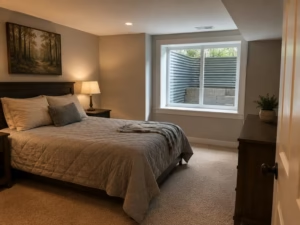
An egress window is a window that meets specific minimum size requirements and is positioned so that a person can exit the room in an emergency — specifically, a fire. In basement applications, egress requirements apply to rooms intended to be used as sleeping areas. They are a code requirement for bedrooms, not for all finished basement rooms.
A finished basement family room, home office, gym, or playroom does not require an egress window by code. A room that will function as a bedroom — and be sold or listed as one — does.
The Decision You Need to Make
Before planning a basement layout, decide whether you want or need a legal bedroom in the space. If the basement is going to be a multi-function recreation area, that question is off the table. If you’re building a guest suite, an in-law space, or planning to increase the bedroom count when you eventually sell, then egress is relevant — and it needs to be planned before framing begins.
This is also a conversation that matters for how the space is permitted. A room designed as a sleeping area without meeting egress requirements creates a compliance issue. Not listing it as a bedroom means it won’t count as one formally, even if it functions like one.
What Installation Involves
An egress window in a basement isn’t a simple window replacement. It involves excavating outside the foundation to the required depth, cutting through the foundation wall, framing the opening, installing a proper window well, and finishing the opening on both sides. It’s structural work that requires a permit, and it needs to be coordinated early because it affects framing and waterproofing in that section of the wall. Plan it as a real scope item with real cost — not an afterthought — if it’s part of the project.
Permits: A Practical Overview
Permits get treated as a nuisance by some homeowners and as an unnecessary cost by others. Neither is the right frame. Here’s what actually matters.
What Triggers a Permit in Pennsylvania
In most Pennsylvania municipalities, finishing an unfinished basement to habitable space requires a building permit. This covers the framing, insulation, drywall, and finish work that creates a new living area. Electrical work — new circuits, outlets, lighting — requires a separate electrical permit. Plumbing rough-in for a bathroom or wet bar requires a plumbing permit. HVAC modifications typically require one as well.
The specific requirements vary by township. What’s consistent across the region is that significant basement finishing work in a single-family home is not permit-exempt. If a contractor tells you otherwise, ask them to be specific about which scope they’re claiming doesn’t require a permit and why.
What the Process Involves
Permits require plans to be submitted to the local building department, fees to be paid, and inspections to occur at key stages — typically before walls close so rough-in work can be inspected, and at final completion. In Bucks County and Montgomery County townships, two to four weeks is a reasonable general expectation for permit processing, though it can run shorter or longer depending on the municipality and current volume.
This timeline affects project scheduling. Rough-in work can’t be covered until inspections happen. A realistic project timeline accounts for this rather than treating permits as paperwork that runs invisibly in the background.
Why Skipping Permits Creates Real Problems
Unpermitted basement finishes create problems in three consistent ways. First, if the work doesn’t meet code in ways discovered later — by a future buyer’s inspector, during a refinance appraisal, or during your own future renovation — correcting it often means opening finished walls. Second, homeowner’s insurance may not cover losses involving unpermitted work in the affected area. Third, at resale, unpermitted finished space is a disclosure issue that buyers and their agents increasingly ask about directly. A legitimate contractor obtains permits, manages the inspection process, and treats them as a normal part of the project.
Layout Planning: The Decisions That Drive Everything Downstream
Layout decisions made before framing begins determine how every subsequent phase of the project goes. Changing the layout after framing is in place isn’t impossible, but it’s expensive and disruptive. Getting it right upfront starts with understanding what the space actually contains.
Work Around Your Mechanicals — Don’t Fight Them
Every basement has fixed elements that can’t be easily moved: the electrical panel, the water heater, the HVAC equipment, and the main drain and water supply runs. These need to remain accessible, which means they can’t be buried inside finished walls without proper access provisions, and rooms can’t be laid out in ways that block service access to critical equipment.
Before sketching any room layout, identify exactly where these elements are and note what clearance they require. Your HVAC contractor and electrician both have service access requirements that framing needs to accommodate. A layout designed without knowing where the mechanicals are will create conflicts during build-out.
Decide on Bathroom Placement Before Anything Is Framed
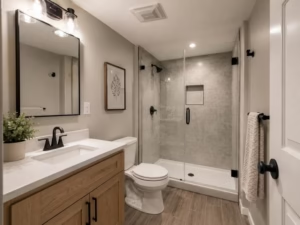
If a bathroom is part of the plan — even tentatively — its location needs to be settled before framing begins. Bathroom drain lines need to tie into the home’s existing drain system, and the bathroom location is partly constrained by where that connection is practical. In basements with an existing floor drain or rough-in, options are more flexible. In basements without either, slab cutting may be required, and the location of the cut affects both cost and project sequence.
A bathroom added as an afterthought to a partially framed basement costs more and creates more disruption than one planned from the start. Decide firmly before framing starts — even if it means delaying the start date while the location is confirmed.
Define How Each Area of the Space Will Function
The framing layout should follow function, not the other way around. Before finalizing any plan, define each zone: what will happen there, how many people will use it at once, where they’ll enter and exit, and what the space needs to support.
A home office needs power in the right places and acoustic consideration from the floor above. A playroom needs durable, easy-to-clean surfaces more than architectural detail. A guest bedroom has different lighting and privacy requirements than a family room. These aren’t design preferences — they’re layout requirements that affect where walls go, where electrical rough-in happens, and what the flooring scope looks like. Get specific about each area before talking to a contractor.
Systems Behind the Walls: What to Understand Before Framing
You don’t need to know how to run electrical or HVAC ductwork. You do need to understand which decisions get locked in by framing and can’t easily be changed after walls close.
Electrical
A finished basement needs dedicated circuits — not circuits tapped into the floors above. How many circuits and what they serve depends on how the space will be used. A home theater setup with equipment, a mini-fridge, and a gaming area has very different electrical requirements than a simple sitting room.
Before estimates are collected, check your electrical panel. If it’s older and running near capacity, an upgrade may be part of the basement finishing scope — not because of the basement work itself, but because the home doesn’t have capacity for new circuits without it. In older homes, outdated panel types or wiring configurations may also affect what can be added and how. An electrician assesses this during the estimate walkthrough. Know to ask.
HVAC
A finished basement is conditioned space and needs to be treated as part of the home’s heating and cooling load. Extending existing ductwork into the basement is the simpler and less expensive approach; adding a dedicated zone with its own thermostat provides more flexibility and is worth considering if the basement will be used regularly as full living space.
If your existing HVAC system is older or is already running at the edge of its capacity for the above-grade floors, adding a finished basement to that load can surface problems that were always there. Raise this with your HVAC contractor during the estimate rather than discovering it after the basement is finished and the upstairs rooms start running hot.
Insulation
Basement walls in Pennsylvania need insulation for both thermal performance and moisture management, and the approach matters for below-grade conditions. Fiberglass batt insulation installed directly against a block or stone foundation without appropriate vapor control is a setup for moisture problems over time. Rigid foam board, closed-cell spray foam, or properly constructed wall assemblies are the right approaches for below-grade applications.
During the estimate process, ask specifically: how are you insulating the basement walls, and why that approach for this foundation type? The answer tells you whether the contractor is thinking about below-grade conditions correctly or applying above-grade logic to a different environment.
Plumbing Rough-In Timing
If a bathroom or wet bar is part of the plan, plumbing rough-in happens before framing is complete and well before drywall goes up. Drain lines need to run to the main stack, supply lines need to be roughed in, and venting needs to be planned — all before walls close around it.
One consideration worth raising with your contractor: if you’re even partially likely to want a bathroom at some point in the next several years, roughing in the drain lines during this project may be worthwhile. The cost of rough-in during an active project is substantially lower than opening finished walls to add it later.
What to Check Before You Request Estimates
By the time you’re ready to request estimates, the following questions should have answers — or at least informed starting points. Contractors who get these answers upfront give you better numbers and fewer surprises mid-project.
- Moisture history Any evidence of past or current water intrusion? When did it last occur and what happened — standing water, seepage, or dampness?
- Ceiling clearance Floor to the bottom of the lowest obstruction in the main areas of the basement. Note where beams, ducts, and pipes run.
- Scope definition What will each area of the finished basement be used for? Is a bathroom part of the plan? A wet bar? A bedroom requiring egress? A dedicated office or gym?
- Panel capacity When was the electrical panel last updated, and is it running near capacity? Know what you know before the electrician visits during the estimate.
- HVAC condition Is the existing system adequate for the above-grade floors, or is it already being pushed? When was it last serviced?
- Foundation type Poured concrete, concrete block, or stone? This affects both waterproofing approach and insulation strategy.
- Prior finishing work If part of the basement was previously finished, when was it done and was it permitted? Prior unpermitted work may affect the current project’s scope.
- Budget range and timeline Roughly what are you expecting to spend, and when do you need the space to be functional? These affect how contractors scope and sequence the work.
Frequently Asked Questions
Do I need to fix moisture problems before getting estimates?
Not necessarily — but disclose any moisture history during the walkthrough. A thorough estimator will assess conditions during the visit and factor any required waterproofing into the scope. If you have active water intrusion that’s ongoing, addressing it first makes the estimate more accurate, since the waterproofing scope needs to be defined before the finishing scope can be properly priced.
How do I know if my basement needs waterproofing or just better humidity control?
The plastic sheeting test is a useful starting point. Active staining at the floor-wall joint, efflorescence on foundation walls, or any history of standing water after heavy rain points toward waterproofing. Consistent dampness without a clear intrusion source, combined with high summer humidity, is more likely a condensation and ventilation issue. A contractor experienced with basement conditions can assess this during a walkthrough — it’s a key part of the pre-finishing evaluation.
What if my basement has a mix of finished and unfinished areas?
That’s common in older homes and it doesn’t significantly complicate the project. The existing finished sections set some constraints — especially if they were done without permits — but the scope of a current remodel can address both the unfinished areas and updates to older finished sections as a single coordinated project. What matters is understanding what the existing finished areas contain inside the walls before new framing is planned around them.
Will a finished basement count as additional square footage for home value purposes?
Finished below-grade square footage is typically counted separately from above-grade finished space in appraisals and listings. It does add value — particularly in Bucks County and Montgomery County — but it’s credited differently than above-grade square footage in a formal appraisal. A basement with a bathroom typically carries more value than one without. Having the work permitted matters for resale — unpermitted space carries a disclosure obligation and can complicate a transaction. Basement Remodeling Services.
How far in advance should I start planning a basement remodel?
The planning process — assessing conditions, defining scope, collecting estimates — typically takes four to eight weeks when done properly. Permit timelines in Bucks County and Montgomery County townships add another two to four weeks before construction can begin. If you have a target date for when the space needs to be functional, work backwards from that rather than assuming work can start immediately after an estimate is accepted.
The Next Step Is a Conversation, Not a Commitment
If you’ve worked through the questions in this guide and have a clearer picture of what the space is working with, you’re in a good position to have a productive first conversation with a contractor. The goal of that conversation isn’t to lock anything in — it’s to walk through the space together, confirm conditions, and start building a realistic scope.
BMR Belmax Remodeling handles basement finishing and remodeling projects throughout Bucks County, Montgomery County, Philadelphia, and Mercer County NJ. We assess moisture conditions, ceiling height, mechanical constraints, and layout options during every estimate walkthrough — and we’re direct about what we find. If there are conditions that need to be addressed before finishing begins, we’ll tell you that, and why, before any scope is committed to.
Call 609-712-2750, email sales@belmaxremodeling.com, or request a free estimate online. We respond within one business day.


