
- By Saveli
- In Uncategorized
Basement Remodeling in Older Pennsylvania Homes: What Changes the Scope
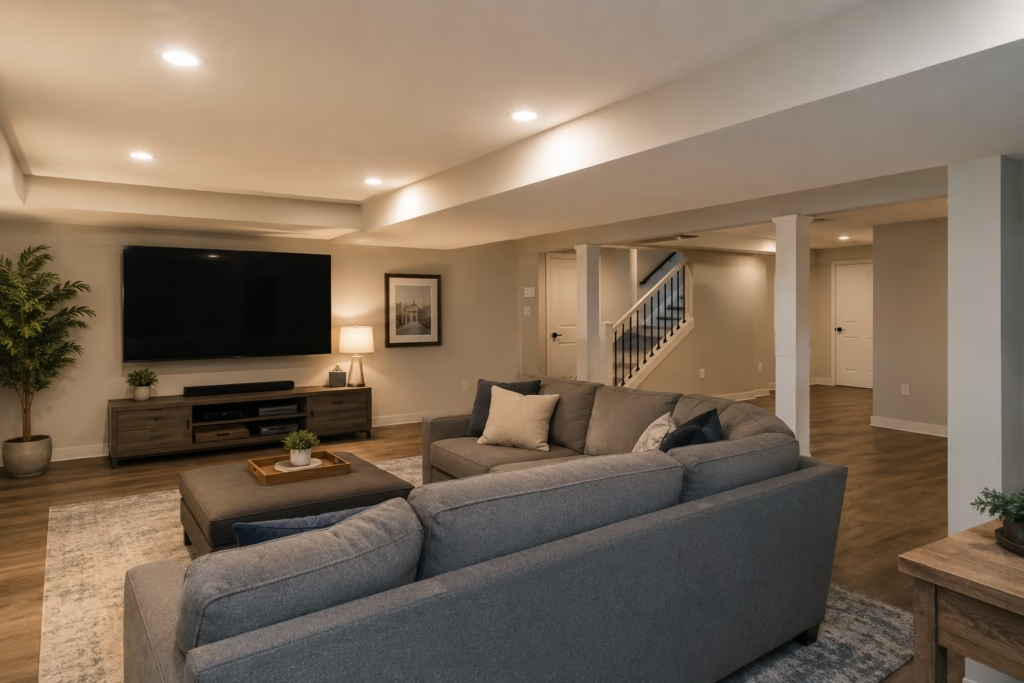
A basement finishing project in a home built in 2010 and one in a home built in 1965 are different projects. Same word, same general scope, genuinely different field conditions. The older home carries variables the newer one typically doesn’t — foundation type, moisture history, electrical age, ceiling constraints, possible prior finished work — and those variables affect planning, cost, and timeline in ways that aren’t obvious from a first walkthrough.
This guide is written for homeowners with older homes in Bucks County, Montgomery County, and the surrounding area who are thinking about finishing or remodeling a basement and want to understand what they’re working with before any contractor conversations begin.
Basement Remodeling Service Page.
Why Pennsylvania Housing Stock Matters Here
Southeastern Pennsylvania has a dense concentration of housing built between the 1940s and the mid-1980s. Colonials, split-levels, cape cods, and ranches constructed in the postwar building boom and through subsequent decades of suburban expansion make up a large portion of the housing inventory in communities throughout Bucks County, Montgomery County, and the surrounding area.
These homes were well-built for their time. They were not built with finished basements in mind. The ceiling heights reflect the era’s standards for storage and utility space. The foundations were built to be functional, not to be finished against. The electrical systems were sized for the households of the time. Understanding what that means for a finishing project today is the point of this guide.
Stone and Block Foundations: What They Mean for Finishing
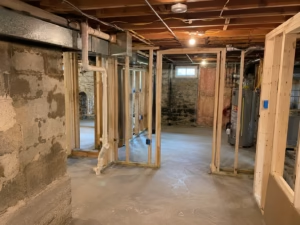
Poured concrete foundations, which became standard in most residential construction from the 1970s onward, are the most moisture-resistant and structurally uniform of the common foundation types. Many older homes in this area have masonry foundations — concrete masonry units (block) or, in homes built before the 1950s, fieldstone.
Moisture Migration
Block and stone foundations are inherently more porous than poured concrete. Moisture moves through the mortar joints and through the masonry units themselves over time. A poured concrete foundation may have isolated cracks; a block foundation has potential moisture migration at every mortar joint. This doesn’t mean all block foundations are wet, but it means moisture evaluation is more critical than with poured concrete, and the insulation approach needs to account for the foundation type.
Efflorescence and What It Tells You
Efflorescence — the white, chalky mineral deposits that form on the surface of masonry — is present on many unfinished block and stone basement walls in older homes. Its presence confirms that water has been moving through the wall and depositing dissolved minerals on the surface. It doesn’t necessarily mean the basement floods. It does mean moisture migration is occurring, and it’s information a finishing contractor needs before determining how the walls should be assembled.
Repointing and Crack Repair
Block foundations with deteriorated mortar joints or cracked blocks may need repointing or repair before finishing. Stone foundations may need assessment of the foundation condition before work proceeds. This isn’t always required, but it’s something that needs to be evaluated — not assumed away — during the pre-finishing walkthrough.
Wall Assembly Approach
For block and stone foundations, the wall assembly approach matters more than for poured concrete. Installing fiberglass batts directly against the foundation surface without a vapor barrier creates a condition where moisture migrating through the masonry encounters the insulation and causes degradation and potential mold. Rigid foam against the foundation face, continuous closed-cell spray foam, or a properly designed wall assembly with appropriate vapor management is the correct approach for older masonry foundations.
Moisture History in Older Basements
Older basements in this region have years or decades of moisture history. The conditions of that history — whether the space has been consistently dry, occasionally damp, or periodically wet — are the most important input into a responsible finishing assessment.
Reading the Evidence
A careful walkthrough of an older unfinished basement tells a story. Tide lines on the foundation walls indicate past water levels. Rust stains on metal elements show where water has contacted steel over time. Old sump pits, whether functional or capped, indicate that previous owners addressed water. Staining patterns at the floor-wall joint show where water has entered historically. White residue on the slab around the perimeter shows prior wicking.
None of this evidence requires a specialist to read. It requires looking carefully and asking the right questions. A contractor who doesn’t look for these signs during a walkthrough isn’t giving you an accurate picture of what finishing the space actually involves.
Sump Pump Evaluation
Many older homes in this area have sump pits and pumps that were installed anywhere from five to thirty or more years ago. A sump pump at or near the end of its service life is a liability in a finished basement. A pump failure during a heavy spring storm after the basement is finished is an expensive problem. Before finishing work begins, evaluate the pump’s age and condition, confirm there is battery backup capacity for power outages, and replace it if there’s any question about its reliability.
Low Ceiling Height: The Most Common Constraint
Ceiling height is the variable that most consistently creates planning complications in older PA basements, and it’s one that can’t be wished away.
Actual vs Perceived Height
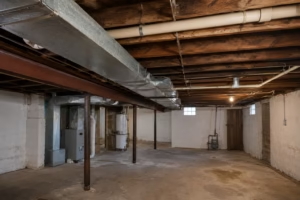
The difference between the floor-to-joist measurement and the floor-to-lowest-obstruction measurement is where most ceiling height problems originate. An older colonial may have seven feet nine inches from the slab to the bottom of the joists, which sounds workable. After accounting for HVAC ductwork running below the joists, a main beam or two, drain lines from the floors above, and the finished ceiling system itself, the clearance in significant areas of the space may be six feet ten inches or seven feet. That’s a real constraint on how the space can be designed and what ceiling treatment is feasible.
Measuring Correctly
The correct measurement is from the finished concrete floor to the bottom of the lowest obstruction in the area being finished — not to the bottom of the joists. That obstruction is often a duct, a steel beam, or a drain line running perpendicular to the joists. Measure in multiple locations. Note where the low points are and how extensive the affected areas are.
Design Solutions for Low Ceilings
A ceiling that is genuinely too low to drywall throughout the full area can sometimes be handled with strategic soffits that enclose the mechanical runs below a higher general ceiling, allowing the main ceiling to clear those obstructions. In some cases, mechanical runs can be relocated to gain clearance in key areas. A drop ceiling allows easier access to mechanicals than a drywalled ceiling and can be configured to accommodate obstructions, though it typically comes with some height cost of its own. Understanding the ceiling constraints before designing the space is essential.
Older Electrical Panels and Circuit Capacity
Homes built in the 1950s through the 1970s were wired for households that consumed dramatically less electricity than modern households. The panel sizes and circuit configurations that were standard then are often inadequate for adding a finished basement with lighting, entertainment equipment, home office loads, and potentially a bathroom or wet bar.
Common Panel Issues in Older Homes
Certain electrical panel brands manufactured during this era have documented reliability and safety concerns and are commonly flagged during home inspections. Federal Pacific Electric (FPE) and Zinsco panels are the most widely known examples. Homes with these panels may need panel replacement before adding the circuits a finished basement requires. This isn’t guaranteed, but it’s a real possibility in homes of this age.
Beyond brand concerns, many older 100-amp or 125-amp service panels are simply at or near capacity for the home’s current load without adding the circuits a finished basement needs. An electrician evaluates this during the estimate. If a panel upgrade is required, it’s better to know before the project starts than to discover it after rough-in begins.
Aluminum Wiring
Some homes built between the mid-1960s and mid-1970s were wired with aluminum branch circuit wiring rather than copper. Aluminum wiring requires specific outlet and switch devices rated for aluminum and proper treatment at connections to prevent the corrosion and expansion issues that have made aluminum branch circuit wiring a known hazard. A home with aluminum wiring doesn’t preclude basement finishing, but it does require that any new circuits and connections be handled with the appropriate practices and devices.
HVAC and Mechanical Constraints
Ductwork Position and Layout
In older homes, HVAC ductwork in the basement was run for function, not for aesthetics or future finishing convenience. Main supply and return trunks often run at ceiling height through the center of the space, and branch ducts drop below the trunks to serve the floors above. The result is a ceiling environment that’s more obstructed than in newer construction and harder to finish at a consistent height throughout.
Before finalizing any ceiling design, map out the duct locations and dimensions in the basement. Some ducts can be relocated or redesigned as part of the finishing project, but that adds HVAC scope and cost. Others are in fixed locations that the finishing plan needs to work around. Knowing which situation you have is part of the early planning phase.
Conditioning the Finished Space
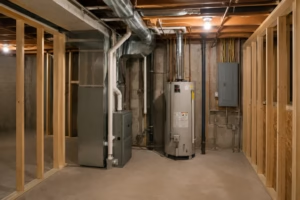
Older HVAC systems were sized for the above-grade conditioned space. Adding a finished basement as conditioned living area adds heating and cooling load. Whether the existing system can handle that additional load depends on how the system was sized and how much capacity it has in reserve. An HVAC contractor can assess this during the estimate phase. If the existing system is undersized, the options include upsizing the system, adding a supplemental mini-split for the basement zone, or accepting that the basement may not condition as well as the rest of the house in extreme weather.
Equipment Access
Furnaces, boilers, water heaters, and electrical panels all need to remain accessible for service. In an older home where these elements are grouped in a utility area, the finishing plan needs to provide a properly sized, properly accessed utility room. Closets and partial enclosures are common, but they need adequate clearance for actual service work, not just enough room to reach the equipment.
Existing Finished Basement Work
Many older homes in this area have basements that were finished at some point in the past — sometimes decades ago. What’s there ranges from reasonably done work to shortcuts that need to be corrected before any finishing project proceeds.
What Older Finished Basements Typically Contain
Basements finished in the 1970s, 1980s, and 1990s often share a common profile: carpet glued directly to the concrete slab, wood paneling applied over furring strips with no insulation behind it, a drop ceiling with old fluorescent lighting, and a single overhead light per room. Bathrooms, if present, may have been added informally over time without permits.
Removing carpet glued to concrete is labor-intensive and often reveals what the slab surface looks like underneath — sometimes including old moisture staining. Paneling removal exposes the wall framing behind it, which may reveal moisture damage, inadequate insulation, or electrical that needs to be evaluated. Drop ceiling removal is usually faster but involves significant debris.
Unpermitted Prior Work
A significant portion of basement finishing work done in Bucks County and Montgomery County before the 1990s was done without permits. This is a problem for anyone updating that work today, because bringing the project to current standards often means correcting what’s behind the old walls — electrical that wasn’t installed to code, framing that doesn’t meet current standards, insulation that was either absent or inadequate.
These corrections are not optional. When a renovation opens walls in a space that was previously finished without permits, the new work needs to meet current code, and the building department inspector will see what’s being corrected. This is a legitimate source of change orders in older basement remodeling projects, and it’s why the contingency budget for older home basement projects should be toward the higher end of the typical range.
Hidden Conditions Inside Old Walls
Opening old finished basement walls in an older home reveals what’s actually there. Common findings include moisture damage to the framing that wasn’t visible from the surface, old wiring that wasn’t run through the walls correctly, missing insulation in sections, and in some cases active or past moisture evidence that was concealed by the finish materials. None of this can be fully anticipated from a surface walkthrough.
Asbestos and Lead: Testing Before Demolition
In homes built before the late 1970s, materials containing asbestos were commonly used in construction products including floor tiles (especially 9×9 and 12×12 vinyl composition tiles), pipe and duct insulation wrapping, joint compound, and ceiling tiles. Lead-based paint was standard prior to 1978.
Testing before demolition is standard practice for homes of this age, and it’s not alarmist — it’s the appropriate professional approach. Disturbing asbestos-containing materials without identification and proper handling creates a serious health hazard and regulatory liability. If testing identifies asbestos or lead in materials that will be disturbed by the project, abatement by a licensed contractor needs to occur before finishing work begins.
Permits, Prior Work, and Resale
Older homes with finished basements have a permit history that matters when the house is eventually sold. A basement finished in 1985 without permits is a disclosure issue that affects the transaction — either because the buyer’s inspector flags it, because the buyer’s lender requires it to be addressed, or because the buyer simply doesn’t want to take on an unknown.
When a remodeling project opens walls in an unpermitted finished basement, the renovation is an opportunity to establish a permit record for the work being done. The new work gets permitted and inspected; the prior work gets corrected to current code as part of the project. This adds cost, but it also creates a clean permit record for the finished space going forward.
Homeowners who are updating an older finished basement and plan to sell the home in the next several years should think of proper permitting not as a burden but as a feature. A finished basement with a permit record and modern electrical, insulation, and moisture management is a different asset than one without.
How to Budget Realistically for an Older Basement
The cost principles for older basement remodeling are the same as for any basement — scope, finish level, and utility work drive the number. What’s different is the contingency that a responsible budget should include.
In a straightforward newer construction basement with no prior work, a ten percent contingency above the estimated cost is a reasonable buffer. In an older home with a block or stone foundation, prior finished work, and possible electrical or moisture conditions, plan toward fifteen percent or more. The things that aren’t visible during a walkthrough — what’s behind the paneling, what the old wiring actually looks like, whether there’s moisture damage behind the framing — show up once work begins.
A contractor who prices older basement work without acknowledging possible hidden conditions is giving you a number that feels better than it should. The honest approach is to identify what’s known, note what can’t be known without opening walls, and build a scope that includes a realistic allowance for the conditions that will likely be found.
Pre-Estimate Walkthrough Checklist for Older Homes
Before contractor conversations begin, spend time in your basement and note the following:
- Foundation type Poured concrete, concrete block, or stone?
- Efflorescence Any white chalky deposits on the foundation walls?
- Water staining Stains at the base of the walls, floor-wall joint, or on the slab?
- Sump pump Present? How old? Battery backup?
- Musty smell Any musty or mildew odor when you enter?
- Ceiling height Floor to lowest obstruction in key areas?
- Ductwork routing Where do main ducts run and how low do they drop?
- Electrical panel Age, brand, estimated available capacity?
- Prior finished work Any existing finished areas, and was it permitted?
- Floor tiles 9×9 or 12×12 vinyl tiles that may be original construction?
- Pipe insulation Any wrapped or lagged pipes that may contain asbestos?
- Prior moisture remediation Evidence of prior patching, waterproofing paint, or drainage work?
This information doesn’t need to be formally compiled — it’s the background knowledge that makes a contractor walkthrough more productive and an estimate more accurate. Contractors who ask these questions during a walkthrough are doing due diligence. Contractors who don’t are leaving unknowns in their number.
Frequently Asked Questions
Are older basements harder to remodel?
They’re more variable. A well-maintained older home with a dry poured concrete basement and a modern electrical panel may be as straightforward as newer construction. An older home with a stone foundation, low ceilings, panel concerns, and prior unpermitted finished work is a more complex project. The key is evaluating what’s actually there before pricing the scope.
Can you finish a basement with a block or stone foundation?
Yes. Neither type makes finishing impossible. Both require moisture evaluation and an appropriate wall assembly approach that accounts for the foundation’s porosity. Block and stone foundations are routinely finished successfully when the conditions are properly assessed and the wall assembly is designed appropriately.
What if my basement has low ceilings?
Low ceilings constrain the design options and may require working around obstructions with soffits or strategic layout decisions. In some cases, mechanical runs can be relocated to gain clearance in key areas. If the basement is genuinely below code minimum for habitable space, that limits what areas can be formally finished as living space. A realistic assessment of the ceiling constraints before planning begins prevents designing a finished space that the physical conditions can’t support.
What if part of my basement was finished years ago?
Prior finished areas need to be assessed for condition and permit status before new work is planned around them. If prior work was done without permits or has moisture damage behind the surfaces, addressing it as part of the current project is generally cleaner and more cost-certain than working around it. Opening sections of old walls during a walkthrough to assess conditions is a reasonable step before finalizing scope.
Should older basement materials be tested before demolition?
In homes built before 1978, yes, particularly if there are original floor tiles, pipe insulation wrapping, or existing joint compound that will be disturbed. Testing is straightforward and inexpensive relative to the cost of discovering asbestos during demolition without having tested first.
Why do older basement remodels often have more change orders?
Because more conditions are unknown before walls open. Moisture damage behind old paneling, electrical that needs correction, foundation conditions that require treatment, and old materials that require testing and handling — none of these are fully visible during a pre-demolition walkthrough. A realistic contingency budget and a contractor who communicates clearly when unexpected conditions arise are the right responses, not an expectation that everything will be exactly as it appeared before work began.
We Know What’s Behind Older Pennsylvania Basement Walls
BMR Belmax Remodeling has finished and remodeled basements in older homes throughout Bucks County, Montgomery County, and the surrounding area. We know what block and stone foundations require, what older electrical conditions look like, what low-ceiling projects need to account for, and what prior unpermitted finished work typically conceals. When we walk an older basement, we assess moisture history, foundation type, ceiling height, mechanical layout, electrical panel condition, and prior finished work condition before finalizing a scope.
If there are conditions that need to be addressed before finishing begins — waterproofing, electrical corrections, material testing — we tell you that directly. Our goal is a scope that reflects what the project actually requires, not one that changes after the walls are open.
Call 609-712-2750, email sales@belmaxremodeling.com, or request a free estimate online. We respond within one business day.


