
- By Saveli
- In Kitchen and bath
First-Floor Home Additions — What’s Involved and How to Plan
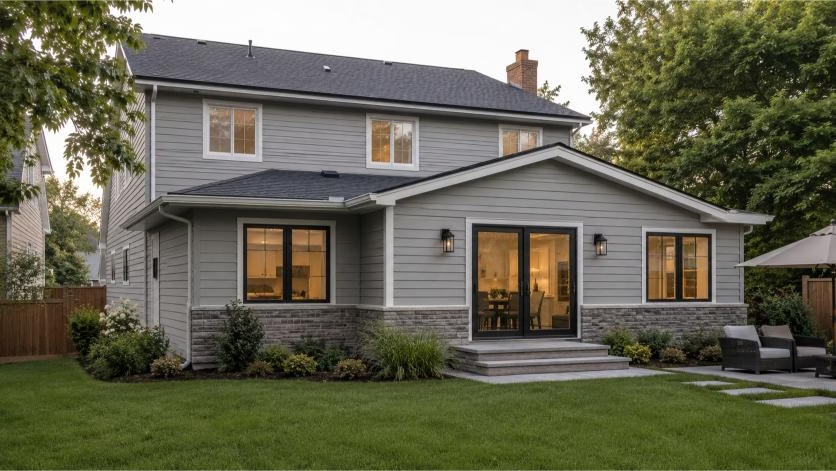
A first-floor addition extends an existing house horizontally — out the rear, side, or in some cases front — to create new living space at grade level. It’s the most common type of home addition and covers a wide range of room types: a larger kitchen, an expanded family room, a guest bedroom, a home office, or a combination of spaces that reorganizes how the ground floor functions.
First-floor additions are also the most straightforward addition type structurally. The foundation work is well understood, the framing is standard, and the project doesn’t require lifting the roof off the existing house or adding a staircase. That doesn’t make them simple — they still involve significant construction — but the path from planning to finished space is clearer than most other addition types.
This article focuses specifically on first-floor additions: what they involve, what drives complexity and cost, and what to think through before requesting estimates. For information about our addition work specifically, visit our home addition services page.
When a first-floor addition makes sense
A first-floor addition is the right answer when a household needs more living space at the ground level and the lot has room to support it. It makes particular sense in several situations.
The house needs more functional living area
The most common driver is straightforward: there isn’t enough room. A family room that’s too small for how the household actually uses it, a kitchen that doesn’t have space for a table or island, a living room that has to serve as a dining room, a home office wedged into a bedroom corner. These aren’t design preferences — they’re functional constraints that don’t resolve with different furniture or organization.
A specific room type is needed that the house doesn’t have
A dedicated home office that doesn’t displace a bedroom. A guest suite on the main floor for aging parents or frequent visitors. A mudroom between the garage and kitchen. A laundry room relocated from the basement. These are room types that many older homes in Bucks County and Montgomery County simply weren’t built with, and that internal reconfiguration can’t create without eliminating something else the household needs.
A kitchen or dining expansion is the goal
Kitchen expansions and kitchen bump-outs are a significant subset of first-floor additions. A kitchen that’s too small to function well for a household that cooks regularly, or that lacks room for a proper island or dining area, is a problem that can sometimes be solved by opening into an adjacent room — but often requires adding new square footage to resolve meaningfully.
Second-floor construction isn’t practical or desirable
Some households prefer to stay single-story, whether for accessibility reasons, aesthetic preference, or because the existing second floor layout doesn’t lend itself to expansion. Others find that their lot doesn’t support a first-floor addition but could support second-floor work — the reverse is also true. A first-floor addition is the right choice when the lot has buildable rear or side area and a second-floor addition isn’t the preferred path. For a detailed look at the second-floor alternative, see our article on adding a second floor.
Common types of first-floor additions
Rear addition
The most common configuration. The addition extends behind the existing house, using rear yard space within the township’s required setback from the rear property line. The existing rear exterior wall typically becomes an interior wall, with a new opening created to connect the addition to the house.
Rear additions work well when the lot has adequate rear depth and the back of the house connects naturally to the rooms being expanded or added. In most Bucks County and Montgomery County townships, rear setback requirements are 25 to 30 feet from the rear property line — meaning the addition can’t extend within that distance of the rear boundary. The buildable depth between the house and the setback line determines maximum addition depth.
Side addition
A side addition extends the house laterally. It works when the lot has adequate side setback — typically 10 to 15 feet from the side property line depending on the township — and when the side of the house offers a practical connection point for the rooms being added.
Side additions sometimes require more thought about how the new space connects to the existing floor plan. A bedroom added on the side of a house needs a logical path to it from the rest of the living area — which may mean a short new hallway or an adjustment to existing circulation. Getting the connection right during the design phase prevents a finished addition that’s awkward to reach.
Bump-out
A bump-out is a smaller, more targeted addition — typically 50 to 150 square feet — that extends a specific room a few feet outward. The most common application is a kitchen bump-out: pushing one wall of the kitchen out to create room for a larger island, a breakfast nook, or additional counter space that the existing footprint can’t accommodate.
Bump-outs are less expensive than full room additions because the foundation and roof area is smaller. But they still require the same structural steps — footings, framing, roof tie-in, exterior finishing — so the cost per square foot is often higher than a larger addition where those fixed costs are spread over more space.
Multi-room first-floor addition
Some first-floor additions create more than one room: a primary bedroom and ensuite bathroom, or a family room and adjacent mudroom, or a kitchen expansion that incorporates a new dining area. These are larger in scope, involve more foundation and roof area, and often include plumbing if a bathroom is part of the addition.
A master suite on the first floor is a specific version of this — particularly useful for single-story homes or for homeowners who want the primary suite at grade level for accessibility. Our dedicated article on master suite addition covers what that specific project type involves.
What affects construction complexity
Every first-floor addition involves the same core construction sequence: foundation, framing, exterior envelope, mechanical rough-in, insulation and drywall, and finish work. What varies is how complicated each phase is for the specific project.
Foundation work
A first-floor addition requires a new foundation along its perimeter. In Pennsylvania, footings must extend below the frost line — typically 36 to 42 inches depending on the township — which means excavation, forming, and concrete work before above-grade construction begins. Soil conditions, site access, and whether the addition is over a crawl space, slab, or partial basement all affect the complexity and cost of this phase.
Foundation work is essentially fixed once the addition footprint is set — it has to happen regardless of what rooms are being added or how they’re finished. It’s one of the reasons additions cost more per square foot than renovating existing space: you’re building new structure from 36 inches below grade up.
Structural connection to the existing house
The addition has to connect structurally to the existing house through the foundation, the floor system, and the roof. If making the connection requires opening through a load-bearing exterior wall — which is the case for most additions that create a passable opening rather than a doorway — a beam must be installed to carry the load above. This is standard work but needs to be engineered and permitted.
The size of the opening affects beam size. A wide opening between the existing kitchen and a new addition requires a larger beam than a standard doorway opening between a new bedroom and a hallway. Structural assessment happens during the design phase.
Roof tie-in
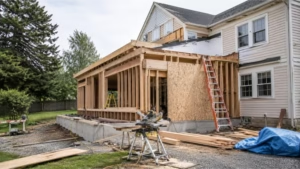
Every addition needs its roof connected to the existing roof in a way that sheds water, doesn’t create ice dam conditions, and is properly flashed at every junction. A simple shed roof over the addition — sloping away from the house — is the cleanest and least complex option. A gabled roof that matches the existing pitch is more involved. A complex junction that creates a valley between the addition roof and the existing roof requires careful planning and precise flashing detail.
The roof tie-in is where long-term moisture problems originate when it’s done poorly. It’s worth understanding what the roof configuration will be before work begins, not discovering it’s more complicated than expected during framing.
HVAC extension
New square footage needs heating and cooling. In most cases, the existing home’s HVAC system is assessed for whether it has capacity to serve the addition. If it does, ductwork is extended to the new space. If it doesn’t — which is common in older homes in Bucks County and Montgomery County where original systems weren’t sized for expansion — a supplemental system is needed. A ductless mini-split is the most common solution: it handles both heating and cooling for the new space without requiring the existing system to be upgraded.
Electrical
New circuits run from the existing panel to the addition for lighting, outlets, and any specific loads (an HVAC unit, kitchen appliances, bathroom circuits). If the existing panel is near capacity, an upgrade may be required before new circuits can be added. Panel capacity is assessed during the planning phase, not mid-project.
Plumbing
A bedroom or living space addition doesn’t require plumbing. A bathroom or kitchen addition does — and plumbing is one of the larger cost variables when it’s involved. Drain lines, supply lines, and ventilation all have to reach the new space from the existing house systems. Where those systems are located in the existing house determines how complex the routing is. A bathroom addition directly adjacent to an existing wet wall is far simpler to plumb than one on the opposite side of the house.
Permits
All first-floor additions in Pennsylvania require building permits. Plan submissions typically require architectural drawings and structural review. Inspections happen at multiple phases: footings, framing, rough mechanical (electrical, plumbing, HVAC), insulation, and final. Permit timelines vary considerably by township — some municipalities in Bucks County and Montgomery County process applications within two to three weeks; others take significantly longer. We manage permit applications and inspection scheduling as part of every project.
What drives first-floor addition cost
First-floor additions in Bucks County and Montgomery County typically run $150 to $300+ per square foot of finished space depending on scope and finish level. Here are the factors that move the number most significantly within that range.
Total square footage
More square footage means more of everything: more foundation, more framing, more roofing, more insulation, more drywall, more flooring. The per-square-foot cost decreases somewhat as the addition gets larger because the fixed costs — mobilization, permits, the structural connection work — are spread across more space. A 300 sq ft addition typically costs more per square foot than a 500 sq ft addition at similar finish levels.
Foundation type and site conditions
Difficult soil — rock, high water table, unstable fill — increases excavation cost and sometimes requires modified foundation approaches. Easy site access and standard soil conditions are the cost baseline. Rocky soil in particular is common on some lots in this area and can add $5,000 to $15,000 or more to foundation scope depending on the extent.
Roof complexity
A simple shed roof is the least expensive option. A gabled roof that matches the existing pitch adds cost. A complex roof junction that creates a valley or requires integrating with dormers or multiple existing roof planes adds more. The roof is a meaningful cost component — and getting it right structurally and in terms of water management is not a place to cut.
Bathroom or kitchen inclusion
An addition that includes a bathroom or kitchen adds plumbing scope on top of the standard structural and mechanical work. Plumbing rough-in, fixtures, tile work, and waterproofing add $15,000 to $40,000 or more depending on the bathroom or kitchen scope. This is the single largest cost variable after overall square footage.
Structural opening size
A narrow doorway connection between the addition and the existing house requires a smaller beam than a wide open passage. Homeowners who want the addition to feel fully integrated — no visual division between the existing space and the new space — often want a wide opening, which requires a larger engineered beam. The beam cost itself isn’t enormous, but the structural assessment and the opening work add scope.
Finish level
Foundation, framing, and mechanical work are relatively fixed costs for a given footprint. Flooring, trim, windows, exterior siding, lighting, and any cabinetry are where homeowner selections move the final number. The same structural shell can be finished simply at one budget or elaborately at another.
Common planning mistakes
Not accounting for exterior integration
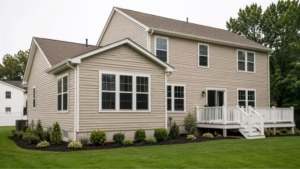
An addition that looks visually disconnected from the existing house — mismatched siding material, a roofline that doesn’t relate to the existing roof, windows that don’t coordinate in style or proportion with the existing facade — creates a result that reads as appended rather than integral. Exterior design coordination is a planning decision made during design, not a cosmetic detail addressed at the end. Getting it right affects both how the finished house looks and its resale value.
Focusing only on square footage, not on how the space connects
A 400 sq ft addition that connects to the existing house through a narrow doorway in an awkward location functions differently than a 300 sq ft addition with a wide, well-positioned opening that makes the new space feel part of the original house. How the addition integrates into the existing floor plan — where the connection is, how wide it is, how the traffic flow works between old and new — determines whether the addition actually improves how the house lives.
Underestimating how interior changes follow the addition
Adding square footage to the back of a kitchen frequently requires reconfiguring the kitchen layout to take advantage of it. A rear family room addition may require relocating a back door or rethinking the transition between kitchen and new room. These interior changes are separate scope from the addition itself but they’re predictable — they should be scoped and priced during planning, not discovered after the addition walls are framed.
Not resolving utility feasibility before design is finalized
Where the HVAC duct runs go, whether the electrical panel has capacity, and whether plumbing can reach a bathroom or kitchen in the addition are questions that have real answers — answers that affect both design feasibility and cost. These need to be resolved during the planning phase. Discovering that the panel needs upgrading or that a drain line requires routing through an unexpected path mid-project is avoidable.
Treating the addition footprint as fully negotiable up until permits
The addition footprint affects setback compliance, foundation scope, roof design, and connection to the existing structure. Changes to footprint late in the design process — after structural plans are drawn and permit applications are submitted — require revisions that add time and cost. Settling on footprint and room configuration early, and treating it as a fixed input rather than something still being decided during construction documents, keeps the project moving efficiently.
What to decide before requesting estimates
Arriving at an estimate conversation with these questions answered — even at a rough level — produces quotes that are based on the same assumptions and can be meaningfully compared.
- Purpose of the space — what specific problem is the addition solving? A larger kitchen, a family room, a home office, a guest bedroom? The purpose drives the room type and functional requirements.
- Preferred location on the house — rear extension, side extension, or a bump-out of a specific room? Even a rough preference matters because setback compliance and structural connection differ by location.
- Approximate size — a targeted bump-out (100–200 sq ft), a standard room addition (200–400 sq ft), or a larger multi-room addition? A general sense of scale is enough to frame an accurate estimate.
- Whether a bathroom or kitchen is included — this is the largest single variable after square footage. Knowing whether plumbing is part of the scope changes the estimate significantly.
- Interior changes needed alongside the addition — will the existing space need to be reconfigured to connect to or take advantage of the addition? A kitchen expansion that also requires a new cabinet layout is a different scope than a bedroom addition that connects through a doorway.
- Budget range — a rough budget expectation helps the contractor identify where tradeoffs may be needed and whether the desired scope is realistic.
With these questions answered, a contractor can give you a meaningful estimate rather than a wide range. It also makes early feasibility conversations more productive — sometimes a specific footprint position isn’t feasible given setback requirements, or a desired room configuration creates a structural complication worth discussing before design begins.
Planning a first-floor addition?
We work with homeowners throughout Bucks County, Montgomery County, Philadelphia, and Mercer County NJ on first-floor additions of all types and sizes. We handle the full scope — initial design and engineering, permit applications, construction, and finish work — under one contract.
Call us at 609-712-2750 or request a free estimate online. We’ll come to your property, look at what’s feasible given your lot and existing structure, and give you a realistic picture of what the project involves and what it will cost. No pressure, no ballpark — a real conversation about your specific situation.


