
- By Saveli
- In Kitchen and bath
Stock vs Semi-Custom vs Custom Kitchen Cabinets — Which Is Right for Your Remodel?
Cabinets are typically 30 to 45 percent of a kitchen renovation budget. That makes the cabinet tier decision — stock, semi-custom, or custom — the most consequential budget choice in the project. It’s also one of the most misunderstood, because the three categories are often described in ways that emphasize appearance while obscuring the practical differences that actually matter: sizing flexibility, construction quality, interior storage options, lead times, and what happens at the edges and corners of kitchens that don’t fit standard dimensions.
This article explains the practical differences between the three categories, where each one makes sense, and how to think through the decision before meeting with a contractor. For information about our kitchen renovation work, see our kitchen remodeling page. For how cabinet selection fits into the planning process, our kitchen design page covers that in detail.
Stock cabinets
Stock cabinets are manufactured in fixed sizes and standard configurations, held in inventory at home improvement retailers and building suppliers, and available for delivery or pickup within days. They’re the entry-level tier in both cost and flexibility.
What stock cabinets include
Stock cabinets come in a limited set of widths — typically 9, 12, 15, 18, 21, 24, 27, 30, 33, and 36 inches for base and upper cabinets — with standard heights of 34.5 inches for bases and 30, 36, or 42 inches for uppers. Door styles, finishes, and interior configurations are limited to what’s in that manufacturer’s catalog. There’s no custom sizing or modification — what’s listed is what’s available.
Construction quality varies significantly within the stock category. Lower-end stock uses particleboard box construction, staple-joined drawer boxes, and standard hinges. Better stock uses plywood boxes and soft-close hardware. The quality difference between the low and high end of the stock range is real and affects how the cabinets perform over years of daily use.
Where stock cabinets work well
Stock cabinets work well when the kitchen layout dimensions align cleanly with standard cabinet widths — where the available wall runs can be filled with standard sizes without large gaps or awkward filler strips. In a kitchen where the dimensions break down cleanly into standard sizes, stock cabinets can produce a finished result that looks comparable to semi-custom at meaningfully lower cost.
They’re appropriate for renovation budgets where containing cabinet cost is a priority, for rental or investment properties, and for kitchens where the goal is a finish update rather than a design transformation.
Where stock cabinets fall short
The primary limitation is gap management. When standard cabinet widths don’t add up to the exact wall run length, filler strips close the gap. One or two small fillers in a well-planned kitchen are barely noticeable. Multiple fillers across several runs, or a single large filler that’s visually prominent, can make the kitchen look assembled from parts that don’t fit rather than designed for the space.
Interior storage options are also narrower than semi-custom — pull-out trays and specialty organizers are available from some stock manufacturers but the selection is limited, and the quality of the interior hardware is typically lower.
Semi-custom cabinets
Semi-custom cabinets are manufactured to order within a range of sizes and configurations that’s significantly wider than stock. They’re available in smaller size increments — typically in 3-inch increments, sometimes in 1-inch increments — with a much broader selection of door styles, finishes, interior configurations, and specialty pieces.
What semi-custom cabinets offer
The most important practical difference is sizing flexibility. Because semi-custom cabinets are built to order in smaller increments, the kitchen layout can be designed around the specific dimensions of the space rather than fitting the space to standard sizes. A wall run of any length can be filled accurately, without filler strips.
Interior configuration options are significantly broader. Pull-out base tray systems, deep drawer banks, built-in spice pull-outs, waste bin pull-outs, corner solutions (lazy susans, blind corner pull-outs, magic corner systems), and various specialty storage configurations are available as factory-installed options. These are the features that determine how well the kitchen functions daily.
Construction quality at the semi-custom tier is generally better than stock as a baseline. Most semi-custom manufacturers offer plywood box construction as a standard or upgrade option, dovetail or drawer-lock drawer box construction, and soft-close hardware. Door and finish options are broader, and finish consistency across a full kitchen is more reliable than at the stock tier.
Lead times
Semi-custom cabinets take 4 to 8 weeks from order placement to delivery, depending on the manufacturer and order complexity. This lead time is the primary project scheduling constraint for most kitchen renovations. The cabinet order needs to be placed early enough for delivery to align with the installation phase. If cabinet selection is delayed or a change is made after the order is placed, the lead time restarts.
Where semi-custom makes the most sense
For most kitchen renovations in Bucks County and Montgomery County at mid-range and above budgets, semi-custom is the right tier. It delivers accurate fit, interior storage function, quality construction, and design flexibility at a cost that’s meaningfully less than full custom. Semi-custom makes the most sense when the kitchen has wall runs that don’t align well with standard stock sizes, when interior storage function is a priority, when a specific door style or finish that’s unavailable in stock is desired, or when the overall renovation budget justifies the cabinet quality.
Custom cabinets
Custom cabinets are designed and built specifically for a kitchen — any size, any configuration, any material. There are no standard sizes or catalog limitations. The cabinet maker builds what the design calls for.
What custom cabinets offer
The primary benefit is complete freedom: a cabinet sized to fill an awkward dimension exactly, a built-in refrigerator surround with perfectly matched panels, a kitchen island at an exact custom size with specific leg details, cabinetry to an unusual ceiling height, or a mix of open shelving, closed cabinets, and display niches unique to the design.
Custom also offers the highest available quality ceiling — furniture-grade construction, solid wood face frames and doors, premium interior hardware, dovetail drawer boxes, and finish quality approaching fine furniture. For homeowners who want the best available quality, custom is where it lives.
Custom cabinets are typically built by a local or regional cabinet shop rather than a national manufacturer. The relationship is directly with the cabinet maker, which provides flexibility during design and the ability to address requirements that no manufacturer’s catalog accommodates.
Lead times and cost
Custom cabinet lead times are longer than semi-custom — typically 8 to 14 weeks or more depending on the shop’s workload and order complexity. Any design change after fabrication begins is very expensive. The cost premium over semi-custom scales with complexity, but a kitchen that costs $20,000 to $25,000 in semi-custom cabinets may cost $35,000 to $50,000 or more in custom. The question to answer honestly: does the specific design require full custom, or does semi-custom in the right configuration achieve the same result at lower cost and shorter lead time?
When custom actually makes sense
Custom cabinetry makes the most sense when the design has genuinely unusual requirements: a ceiling height outside manufacturer catalog ranges, a built-in refrigerator installation requiring precisely matched panels, unusual materials or finishes not available from semi-custom manufacturers, or a design intent where the cabinetry functions as fine furniture. For most kitchen renovations — even high-budget ones — semi-custom from a quality manufacturer typically delivers a result that’s indistinguishable from custom at lower cost and shorter lead time.
Cost and timeline at a glance
These are approximate ranges for a standard kitchen in Bucks County and Montgomery County. Actual numbers vary by kitchen size, manufacturer, and specific configuration.
- Stock: $5,000 to $15,000 installed. Lead time: days. Limited sizing and interior options.
- Semi-custom: $12,000 to $30,000+ installed. Lead time: 4 to 8 weeks. Wide sizing flexibility and interior storage options.
- Custom: $25,000 to $60,000+ installed. Lead time: 8 to 14 weeks or more. Complete design freedom and highest quality ceiling.
For more detail on how cabinet cost fits into the overall kitchen renovation budget, see our kitchen renovation cost guide.
Which option fits different projects
Budget-focused renovation
Quality stock cabinets — plywood box construction, soft-close hardware, solid door style — are a legitimate choice when the kitchen layout aligns with standard sizes and the budget needs to be contained. The key is confirming that the kitchen’s specific dimensions work with stock sizing before committing, so filler management is acceptable rather than problematic.
Mid-range family kitchen renovation
Semi-custom is the appropriate tier for most family kitchen renovations. It provides accurate fit, storage function, quality construction proportional to the investment, and enough design flexibility to achieve any standard kitchen design direction. It’s where the most value is delivered per dollar spent.
Unusual dimensions or configurations
Kitchens with non-standard ceiling heights, angled walls, irregular corner configurations, or wall runs that don’t divide into standard widths need either semi-custom for sizing accuracy or custom for truly unusual dimensions. Stock cabinets in these situations produce visible filler problems that undermine the overall renovation quality.
High-budget or design-specific kitchen
At the upper end of kitchen renovation budgets, semi-custom from a premium manufacturer and custom cabinetry from a local shop both produce excellent results. The decision between them comes down to whether the specific design genuinely requires full custom capabilities or whether a semi-custom solution achieves the same outcome. Many high-end kitchens are built with semi-custom because the manufacturer’s quality and flexibility is sufficient for the design intent.
Common planning mistakes
Choosing by appearance alone
Cabinet door style and finish are the most visible aspects of the decision and receive the most attention during planning. But the door style is the same whether the box is plywood or particleboard, whether the drawers are dovetail or staple-joined, and whether the interior has pull-out trays or fixed shelves. Focusing entirely on the door while treating construction quality and interior configuration as secondary produces a kitchen that looks right and functions poorly.
Ignoring lead times in project scheduling
Semi-custom cabinet lead times of 4 to 8 weeks are the primary scheduling constraint for kitchen renovations. Homeowners who sign a contract and then take three weeks to finalize cabinet selection discover that the project start is months later than expected. Cabinet selection needs to be finalized promptly after a contract is signed — not left as a leisurely decision after work has started.
Assuming custom is always worth the premium
Full custom is appropriate when the design genuinely requires it. For the majority of kitchen renovations, it isn’t required, and spending $15,000 to $30,000 more than necessary on cabinetry is money that could have funded a better countertop, appliances, or a layout improvement. The question to ask is whether the specific kitchen design requires custom, not whether custom is theoretically superior.
Not thinking through storage function before selecting cabinets
The storage problems in the existing kitchen — the daily frictions that make the kitchen frustrating to use — should drive the interior configuration of the new cabinets. Deep base drawers instead of doors and fixed shelves. A pull-out system next to the range. A proper pantry cabinet. A functional corner solution. These decisions matter more for daily quality of life than the door style, and they need to be worked out during the design phase before the cabinet order is placed.
See cabinet styles in person before deciding
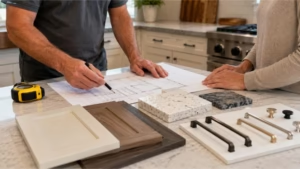
Door samples and online photos show you a single door in isolation. They don’t show you how a finish reads across a full run of upper and lower cabinets, how the cabinet color interacts with a specific countertop material, or how different hardware finishes read against different cabinet colors at real scale.
Our showroom at 390 Easton Rd, Horsham PA has installed cabinet displays in multiple door styles and finishes. Seeing them at full scale — and evaluating them alongside countertop samples and hardware options — consistently changes how homeowners assess their options compared to samples alone. Visit our kitchen showroom page to schedule an appointment.
If you’re planning a kitchen renovation and want to talk through the cabinet decision alongside the overall scope, layout, and budget — call us at 609-712-2750 or request a free estimate online.


