
- By Saveli
- In Kitchen and bath
What Adds the Most Cost to a Bathroom Remodel?
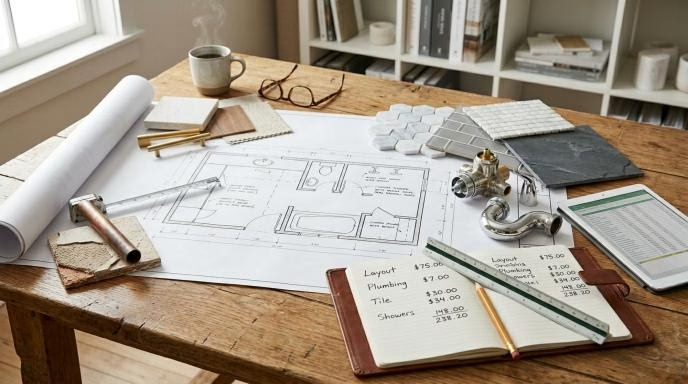
Two bathrooms of nearly identical size can have renovation budgets that differ by $20,000 or more. The difference usually isn’t the tile brand or vanity finish — it’s a handful of scope decisions and site conditions that each add cost independently, and compound when they occur in the same project.
Homeowners researching bathroom renovation costs often find ranges without understanding what moves a specific project toward one end of that range or the other. The answer is almost always the same set of factors: layout changes, wet-area complexity, tile labor, product choices, and whatever the walls reveal after demo.
This article explains those real cost drivers. Not “materials and labor” in the abstract, but the specific decisions and conditions that push bathroom budgets higher. For cost ranges by project type, the bathroom renovation cost guide covers that. For the full scope of what our work involves, see our bathroom remodeling page.
Moving plumbing fixtures
Keeping the toilet, vanity, and shower or tub in their existing positions is the single most effective cost control decision in a bathroom renovation. Every plumbing fixture move requires: opening the floor or wall to access the existing rough-in, capping or extending old lines, running new drain and supply lines to the new position, and patching everything back. Drain lines are the more complex part because they flow by gravity and need a continuous slope to the stack — routing a drain across the room, under a finished basement ceiling, or around structural elements adds significant labor on top of the basic plumbing work.
A rough baseline: $1,500 to $3,000 per fixture moved in Bucks County and Montgomery County, depending on routing complexity. A project that relocates the toilet, moves the vanity to the opposite wall, and repositions the shower drain has three separate plumbing moves, each adding cost independently.
The practical question before any plumbing move: does the existing layout have a genuine functional problem that justifies the cost? A layout that works reasonably well rarely needs reconfiguring. Keeping plumbing in place redirects that budget toward better finishes and fixtures instead.
Custom shower construction
The shower is the most labor-intensive element of most bathroom renovations, and the gap between a basic surround replacement and a fully custom tile shower is significant.
Prefab vs. custom tile
A prefabricated tub surround replacement — new panels over new substrate, existing drain kept in place — is relatively contained work. A custom tile shower built from scratch involves: new drain installation at the correct position, substrate preparation or mortar bed, continuous waterproofing membrane over the entire wet area, tile layout planning, tile setting, grouting, and sealing. Each phase is distinct skilled labor. The material cost of the tile is only part of what a custom shower costs.
Shower size
Larger showers cost more: more waterproofing area, more tile coverage, larger glass enclosures. A 36×36 shower costs less than a 48×72 shower using the same tile and glass — not just proportionally, but because the fixed costs of the waterproofing system and glass templating are spread over more or less labor.
Bench and niche
A built-in bench is framed before waterproofing, waterproofed as part of the shower assembly, and tiled with a sloped top surface. A recessed niche is framed between studs, waterproofed, and tiled with care at every edge and corner. Each adds framing labor, waterproofing material, and tile-setting time — typically $300 to $600 each for a standard bench or niche.
Frameless glass
Frameless or semi-frameless glass enclosures cost more than framed ones. The glass is templated after tile is complete, fabricated to exact opening dimensions, and installed with heavy hardware. This adds $1,500 to $4,000 or more to the shower scope depending on the configuration — and in most master bathrooms it’s one of the highest-impact visual upgrades available, which is why it’s worth understanding upfront rather than as a post-estimate surprise.
Tile choices and coverage area
Tile is consistently underestimated as a cost driver because homeowners focus on the per-square-foot material price and don’t fully account for how installation complexity multiplies that cost.
Coverage area
Every square foot of tile requires substrate preparation, layout planning, tile setting, grouting, and sealing. The decision to tile beyond the wet area — a full vanity accent wall, floor-to-ceiling tile on all four shower walls, bathroom walls outside the shower — directly multiplies labor. More area equals more cost, proportionally.
Tile format and pattern
Large-format tile (12×24 or larger) requires a more precisely leveled substrate than smaller tile, and produces more waste at cuts. A herringbone, diagonal, or chevron layout requires more cuts and more precise positioning than a stacked or offset layout on identical square footage. Two showers tiled with the same tile can have labor cost differences of $500 to $1,500 or more based purely on layout pattern.
Natural stone and specialty tile
Natural stone — marble, quartzite, travertine — costs more in material than comparable porcelain and requires more careful installation: the tile isn’t uniform in thickness, requires more mortar bed adjustment during setting, and needs sealing after installation and periodically afterward. The labor premium on natural stone over standard porcelain is real and not just a material markup.
Trim and edge details
Tile transitions at door frames, wainscot boundaries, niche edges, and unusual angles all require trim tile or clean cut edges. Bathrooms with complex layouts and many transitions have proportionally more trim work than simple rectangular configurations. This rarely shows up in material cost estimates but appears clearly in experienced contractors’ labor estimates.
Fixture and product choices
Freestanding tubs
A freestanding tub requires floor-mount faucet supply lines roughed in through the floor — plumbing work that doesn’t apply to a standard alcove or deck tub. The supply rough-in happens during the plumbing phase at the exact position the tub will sit, before floor tile goes down. The tub is heavier to set, and the floor-mount faucet is typically more expensive than a wall-mount. The combined effect: freestanding tub installation adds plumbing scope and fixture cost on top of the tub price itself.
Multi-function shower systems
A thermostatic shower valve with rain head, body spray, and handheld involves more plumbing rough-in than a standard single-function valve — each function requires a separate rough-in port at the correct height. The valve body and trim cost more. And the plumbing labor to rough in multiple supply ports before walls close adds to the scope meaningfully. A practical note: full multi-body systems require water volume and pressure that residential supply sometimes can’t deliver at full performance across all functions simultaneously.
Custom vanities and cabinetry
The cost difference between stock, semi-custom, and fully custom vanity cabinetry is real — stock from a home improvement store versus semi-custom can be a $1,000 to $4,000 difference in a standard bathroom, and custom built-in cabinetry adds more. The functional difference between semi-custom and custom is often smaller than the price gap suggests. For most bathroom renovations, semi-custom hits the right balance of quality, size flexibility, and cost.
Smart and specialty fixtures
Heated towel bars, digital shower controls, bidet toilets, and LED smart mirrors all carry product cost above standard equivalents — and most also add electrical scope. Heated towel bars need a dedicated circuit. Digital shower controls need an electrical rough-in for the control panel. Each specialty product brings its own installation requirement that a standard product does not.
What the walls reveal after demo
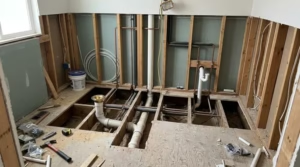
Demo is when the walls come down and the bathroom’s actual structural condition becomes visible. In homes built before 1990 in Bucks County and Montgomery County — where most bathrooms haven’t been renovated since original construction — demo regularly reveals conditions that add scope before new work can begin.
Water damage behind tile
Shower surrounds built before the mid-1990s were often installed without adequate waterproofing. Tile set over greenboard or standard drywall allowed water to work through grout joints over time, reaching the substrate and creating rot and mold behind the tile surface. When it’s found at demo, the affected framing has to be cut out and replaced before new substrate goes in. The extent determines the scope — sometimes a small section, sometimes the entire surround perimeter and subfloor beneath it. This is legitimate necessary work: closing new tile over damaged framing produces a shower that fails again within years.
Subfloor conditions
Bathroom subfloors in older homes are frequently compromised by years of slow moisture exposure from an inadequately sealed tub or shower. A soft, delaminated, or partially rotten subfloor has to be repaired or replaced before tile — installing tile over a compromised subfloor produces cracks and failures quickly. This typically adds $500 to $2,000 depending on extent, plus the labor to remove and reinstall the toilet during floor work.
Galvanized plumbing
Homes built before 1970 commonly have galvanized steel supply lines that corrode from the inside and progressively restrict flow. When a bathroom is opened for renovation, replacing galvanized supply lines is the right decision rather than closing new walls over plumbing that’s clearly deteriorating. It adds $500 to $1,500 to the project depending on run lengths — and saves the homeowner from returning to the same bathroom in a few years when pressure drops or a line fails.
Ventilation and code corrections
Many bathrooms in older homes have exhaust fans that vent into the wall cavity or attic rather than to the exterior — a code violation in most current codes that creates moisture accumulation above the bathroom. When a renovation pulls a permit (which it should for any work beyond cosmetic updates), the inspector may require ventilation to be brought to code. Routing a new vent path to the exterior through finished attic or ceiling space adds scope that wasn’t anticipated.
How to manage cost before scope is finalized
Keep the layout if it works
If the existing positions of the toilet, vanity, and shower or tub are functional, keeping plumbing in place is the highest-leverage cost control available. That budget redirects to better finishes, a larger shower, or a better vanity — all of which affect daily use of the bathroom more than a layout change would.
Finalize product direction before construction
Scope changes mid-project cost more than making the same decisions before demo. A niche added after waterproofing requires tearing out completed work. A valve brand change after rough-in requires reopening the wall. A freestanding tub added after floor tile requires cutting tile and reopening the floor. Our article on what to plan before a bathroom remodel covers the specific decisions that need to be made early.
Choose where to invest and where to simplify
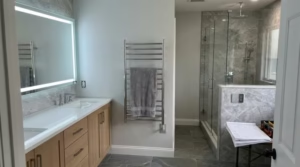
In most renovations, the highest-impact investments are a genuinely larger shower with quality tile and frameless glass, vanity lighting at the correct height, and a well-configured double vanity in a master bathroom. These are used daily and affect every use of the space. Imported stone on every surface, full multi-body shower systems, and custom cabinetry throughout are real upgrades — but each competes for budget that could otherwise fund the improvements with the most daily impact.
Budget a contingency in older homes
For bathrooms in homes built before 1990, a 10 to 15 percent contingency above the base estimate is practical. Water damage, galvanized plumbing, and subfloor conditions are common enough that planning for them is more accurate than assuming the demo will be clean. For a full look at how design choices connect to bathroom renovation cost, our bathroom design page covers the planning process before construction begins.
Ready to understand what your bathroom renovation would involve?
We work with homeowners throughout Bucks County, Montgomery County, Philadelphia, and Mercer County NJ on bathroom renovations of all scopes. We’ll come to your space, look at the existing conditions, and give you a detailed written estimate that explains where the cost is going and why.
Call us at 609-712-2750 or request a free estimate online. We’ll get back to you within one business day.


